Look Up From Your Phone - 7 Places in Bucharest That Spring Transforms Completely
- Articles
- 13 APR 26
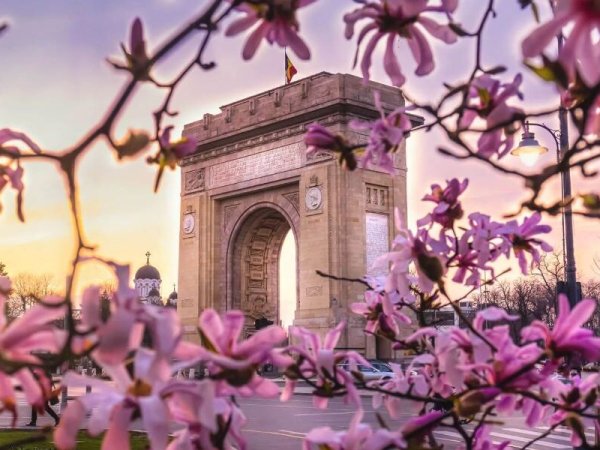
There are a few weeks each year when Bucharest takes on a texture you'll miss if you're not paying attention. Magnolias push past garden fences, wisteria climbs facades until it swallows them whole, and the interwar neighbourhoods shift into something else entirely when the vegetation finally catches up with the architecture. The city you usually move through with your eyes down becomes, briefly, a place worth looking at carefully. The window is short and depends on temperatures, on wind, on how quickly spring decides to settle in. If you choose to look up from your phone at the right moment, you find a side of the city that many people miss year after year without ever realising it.
1. Mahatma Gandhi Street — the magnolia that stops people in their tracks
The magnolia at Mahatma Gandhi Street number 8 is a tree of remarkable scale, its flowers consuming the facade of a house built during the interwar period by architect Constantin Dimopol — and every spring, it becomes one of the most sought-out spots in the city. People come deliberately, pause on the pavement, raise their phones, and linger far longer than they planned. The entire Aviatorilor neighbourhood is dense with flowering trees at every turn, and the magnolia on Gandhi works better as the starting point of a longer walk than as a standalone destination — because once you've started looking up on one street, it becomes difficult to stop.
2. Cotroceni — the most generous neighbourhood in the city
Cotroceni is, without question, the city's most generous neighbourhood when it comes to magnolias — and generous is a word chosen carefully. On some streets around Romniceanu Park, trees on both sides of the pavement reach toward each other overhead, forming floral tunnels through which light filters down pink and diffused. The neo-Romanian, Art Nouveau and Art Deco houses contribute to the composition without overpowering it, and spring is the only season in which the vegetation and the architecture compete equally for your attention. On Eroii Sanitari Boulevard there is a magnolia unique in Bucharest, with a single branch bearing pink flowers while the rest bloom white — the kind of detail that only reveals itself to people who actually stop.
3. Alexandru Philippide Street — the white wisteria you smell before you see
Wisteria arrives immediately after the magnolias, in the second half of April, and Alexandru Philippide Street is one of the strongest arguments for paying attention to that transition. The wisteria here is among the few white specimens in Bucharest, sprawling across two large houses and their shared fence, its scent strong enough to make passers-by pause mid-stride. White wisteria carries a more intense fragrance than its purple counterpart, and given the scale — it effectively covers two adjacent properties — it announces itself from a distance, both visually and otherwise. You turn the corner and you're already there.
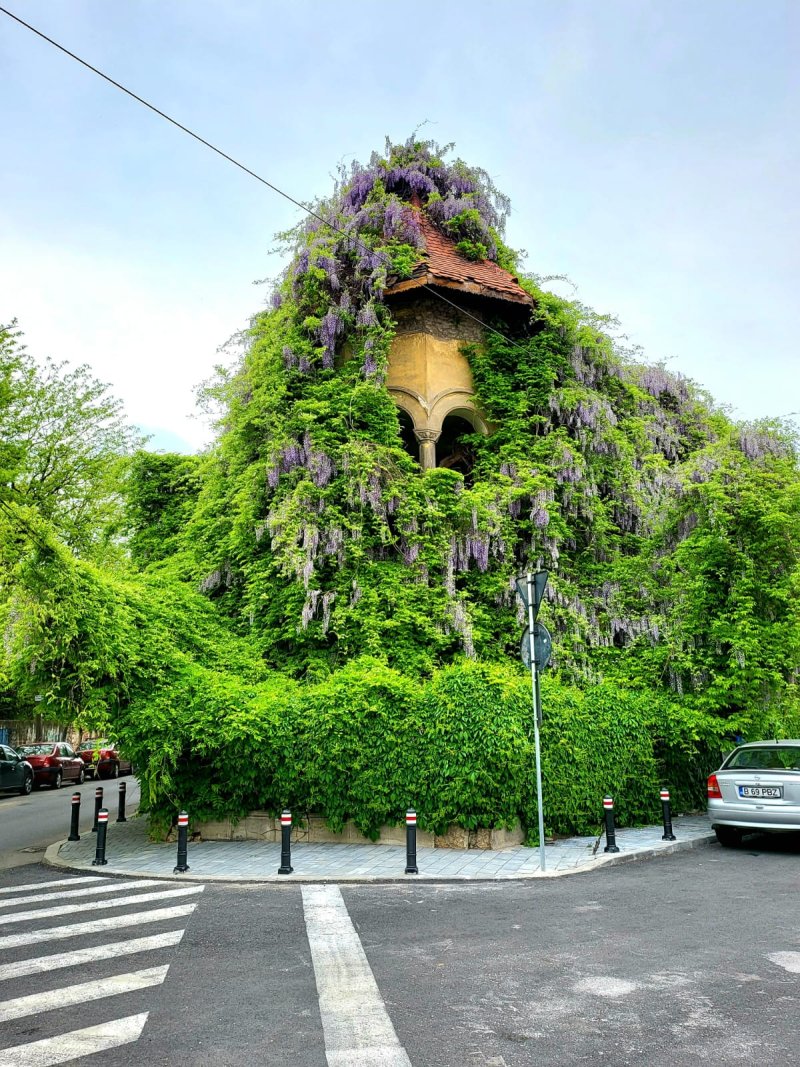
4. Comandor Eugen Botez Street — the house a plant won
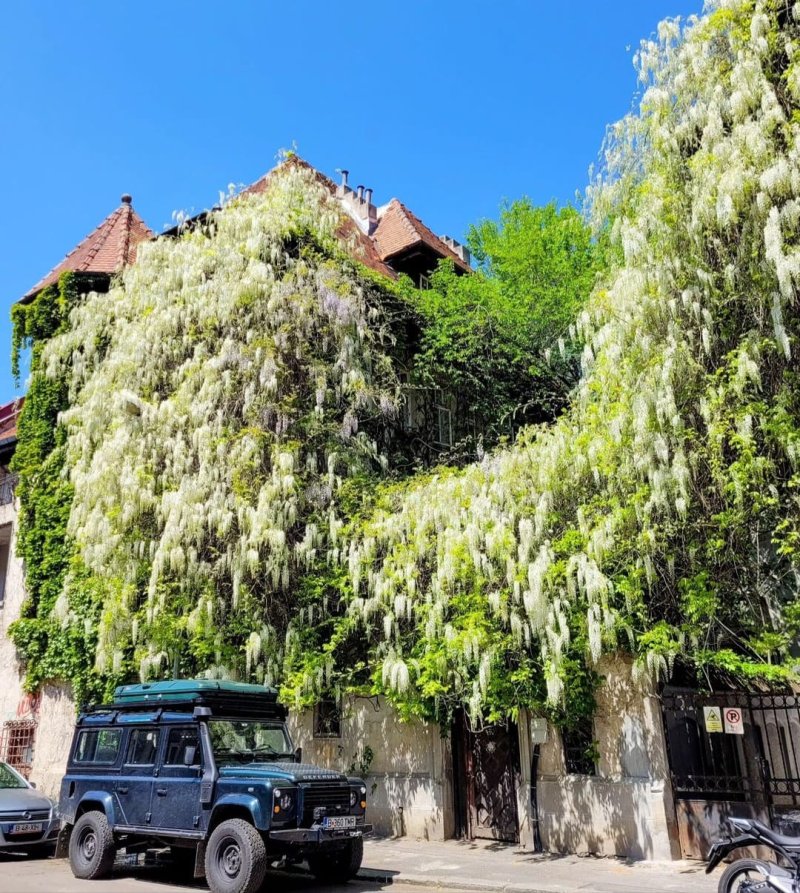
The house at the corner of Comandor Eugen Botez Street and Radu Mihăilă Street, in the Calea Floreasca area, appears long abandoned and is covered almost entirely by wisteria — an image that has circulated on social media for years and endures precisely because it carries something beyond beauty. It's the story of a plant that won a long, quiet argument with a building, and that now occupies the space more fully than the walls it climbs. Come on a weekday morning and you'll likely find the street calm enough to take it in properly.
5. UMF Carol Davila Rectorate, Dionisie Lupu Street — wisteria in an inner courtyard
The wisteria on Dionisie Lupu Street sits inside the courtyard of the Carol Davila University of Medicine and Pharmacy Rectorate, and that interior position is exactly what sets it apart from everything else on this list. The light is different, the atmosphere is quieter, and the way the plant frames the academic architecture feels considered in a way that street-facing wisteria rarely does. You'll need to walk through the gate and exchange a few words with the security guard — and that small effort is precisely why fewer people see it, and precisely why it's worth it.
6. Cișmigiu Park — the wisteria you keep walking past
Cișmigiu has had wisteria for decades, mostly along its secondary paths, tucked into corners that many people cross daily without registering. The specimens here are smaller than the ones climbing private houses across the city, but they carry the same quality — with the particular advantage that you can observe them from a bench, at your own pace, with no traffic behind you and no one else's phone entering your frame. Cișmigiu in the morning, toward the end of April, is one of the few places in Bucharest where time appears to operate under different rules.
7. Lascăr Catargiu Boulevard — architecture and magnolias, no effort required
Lascăr Catargiu Boulevard is one of those routes that many Bucharest residents walk daily with their gaze fixed straight ahead, which is why the magnolias here tend to go unnoticed. At number 54, the building housing the Romanian Aeroclub — designed by architect Duiliu Marcu in 1916 — has two trees in front that will eventually cover the entire facade; right now, midway through that process, they create a frame in which the architecture and the vegetation reinforce each other in equal measure. It's the kind of place that works exactly once a year, for a handful of days, and rewards at least one deliberate stop.
A note on timing
Magnolias typically bloom in the second half of March and the first week of April. Wisteria follows immediately after, arriving in the second half of April and lasting somewhat longer. Both are at the mercy of temperature and weather — a warm year accelerates them, a serious bout of rain brings them to an early close. The places on this list return to the same window every year, and knowing where to look is already half the work.
Main Photo: Doru Nicu