The magnolias are in full bloom! The streets with the most beautiful magnolias in the capital. Bonus: The Magnolia Map
- Articles
- 19 MAR 26
There are a few weeks every year when Bucharest becomes something else entirely. Not that hurried, noisy city you cross with your eyes fixed on your phone, but a city that asks you to look up, to slow your step, to stop in front of a fence over which white blossoms have spilled with quiet generosity onto the pavement. These are the weeks of the magnolias — brief, unpredictable, almost brutal in their passing — and they transform, year after year, the old neighbourhoods of the capital into a spectacle whose only admission ticket is, simply, a walk.
The magnolia is not a flower native to Bucharest. Originally from East Asia and Central America, it reached Europe only in 1688, thanks to English naturalist John Banister, and the first specimens arrived in Romania starting in 1880. The oldest magnolia in the capital stands in the courtyard of Kindergarten no. 133 in Sector 2, on Dragoș Vodă Street, planted, legend has it, by an Austrian pharmacist during the interwar period. Many of the magnolias we see today on the city's streets have a more recent story: a good number were planted in the early 1990s, when Romanians could finally enjoy the freedom to travel abroad. They came home with seedlings, with seeds, with memories of gardens they had seen elsewhere and with a desire to bring some of that beauty back to their own yards. The magnolia was, in its quiet way, also a symbol of opening up.
A Tree with a Long Memory
Before talking about streets and neighbourhoods, it is worth pausing for a moment on the tree itself, because the magnolia is no ordinary plant. The Magnoliaceae family is one of the oldest on the planet, with a history stretching back nearly 95 million years — long before the appearance of bees, which explains why its flowers are pollinated by beetles rather than by more specialised insects. A mature specimen can live a century, reach 25 metres in height and develop a canopy with a diameter of 12 metres, gradually transforming from a modest shrub into a presence that visually dominates an entire street.
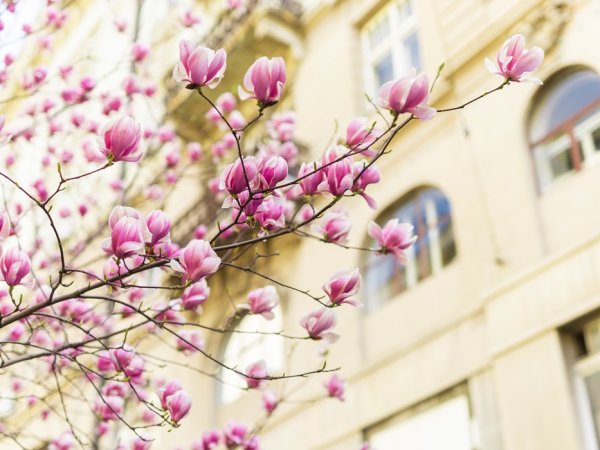
There are over 200 species in the world, and Bucharest is home to some of the most spectacular: Magnolia soulangeana, with its large pink-to-violet flowers that bloom before the leaves appear — creating that impression of blossoms floating in mid-air on bare branches; Magnolia stellata, smaller and more delicate, with thin white petals arranged like the rays of a star; and, far more rarely, Magnolia yulan and the yellow magnolia, genuine rarities of the city. On Diana Robu's map, pink magnolias are marked with a heart of the same colour, while yellow hearts signal the rare pale-yellow varieties, far less common on Bucharest's streets.
The Map That Taught a City to See Itself
No conversation about Bucharest's magnolias would be complete without mentioning the project that genuinely changed the way the city's residents experience spring. The Magnolia Map is an initiative launched and curated by Diana Robu, a communications professional who took Bucharest on foot to document every magnolia she encountered on her walks through the capital.
Her story began simply, almost by accident. The map was born after the spring Romanians spent in lockdown in 2020, when everyone suddenly understood how deeply they missed walking through the city and breathing in the scent of flowering trees. Diana set out in the spring of 2021 with a list of 15 to 20 magnolias she already knew and a Google Maps page on which she had placed a handful of purple pins. Between two points on that improvised map, she discovered another magnolia, then another, and then another still. Today, the Magnolia Map counts at least 1,200 heart-shaped pins — 1,200 reasons for joy, as Diana herself calls them.
What makes this map truly remarkable is not, however, the number of entries. It is the philosophy behind it. There are maps that take you from point A to point B, but the Magnolia Map is not that kind of map. The magnolias are not a destination — they are markers of colour and beauty in a city that is dusty and often a little grim. The map is, at its core, a pretext for rediscovering forgotten little squares, flower-filled courtyards, buildings with stories, people who want to share something. Diana says it was the most therapeutic thing she has ever done — it pushed her out of her comfort zone and taught her to love Bucharest again.
And the community that has gathered around this project says, perhaps, more than any statistic ever could. We are different people, from different generations, who do not listen to the same music and do not drink our coffee the same way, we do not live in the same district and many of us will probably never meet — but for one month a year we share the Magnolia Map, Diana reflects, and in that simple sentence lies something essential about what beauty can do for a city when it is noticed and shared.
The Magnolia on Mahatma Gandhi Street and Other City Celebrities
The magnolia at no. 8 Mahatma Gandhi Street is, without question, the most photographed tree in the city — a specimen of impressive proportions whose blossoms envelop a house built during the interwar period by Constantin Dimopol. It is one of those places where architecture and nature meet so naturally that they seem to have been conceived together from the very beginning: the facade of the house becomes a backdrop for the cascade of pink petals, while the tree itself becomes part of the building. If this magnolia has already captivated you, it is worth continuing to Jean Louis Calderon Street, where, very close to the Hungarian Embassy, another magnificent specimen awaits — and the beautiful architecture of the embassy building completes an authentically Bucharest spring tableau.
Another celebrated magnolia stands in Ioanid Park, one in Circului Park, and another on Dragoș Vodă Street at no. 25, in the courtyard of Kindergarten no. 133 — the very tree said to have been planted by that Austrian pharmacist before the Second World War. On Lascăr Catargiu Boulevard, several magnolias grace houses designed by renowned architects and inhabited by equally renowned personalities, while at no. 54, in the building that houses the Romanian Aero Club, two magnolias will in time come to cover the facade of the house designed by architect Duiliu Marcu in 1916.
Further north, at the Arch of Triumph, two young magnolias embrace the monument raised between 1921 and 1922 to the plans of architect Petre Antonescu, in honour of Romania's participation in the First World War — and if you bring your camera close enough to their petals, you can just catch the silhouette of Cașin Church in the distance.
The Magnolia Neighbourhoods — A Guide to a Spring Walk
Cotroceni is, without doubt, the city's most generous neighbourhood when it comes to magnolias. Here you can admire the remarkable white Stellata magnolias on almost every street — as beautiful as they are fragile — and on Eroii Sanitari Boulevard there is a magnolia unique in Bucharest, with a single branch bearing pink flowers while all the rest are white. The abundance of magnolias throughout this neighbourhood blends seamlessly with the bohemian character of its Art Nouveau and Neo-Romanian houses, genuine architectural jewels, as well as with its charming tea houses and well-tended courtyards. If you want to turn your walk into a full afternoon, Infinitea is a natural stopping point for a cup of tea.
The northern zone — from Piața Victoriei stretching toward Dorobanți, Floreasca and Primăverii — is where magnolias settle with quiet elegance among the interwar villas. In Dorobanți, houses of exceptional architecture designed by Romania's great architects in every style — from Neo-Romanian and Modernism to Art Deco and Mediterranean — stand alongside old trees that have been residents of the neighbourhood for decades, colouring the landscape afresh every spring. Ion Neculce Street, in the area around Mihalache Boulevard, is equally worth a detour.
Vatra Luminoasă, tucked between Șoseaua Iancului and Maior Ion Corău Street, is one of the pleasant discoveries of Diana Robu's map — a neighbourhood rarely visited by those who do not live there, yet surprisingly rich in both magnolias and quality architecture. In the Dristor neighbourhood too, on the streets of Diligenței, Cerceluș and Levănțică, magnolias are a generous presence — and Diana Robu recalls that her favourite magnolia was found precisely here, among old apartment blocks: a tall tree with few flowers, bringing colour to grey walls with an almost defiant grace.
The area around Piața Alba Iulia, toward Mihai Bravu, and the Dămăroaia neighbourhood are two more zones brought to wider attention by the Magnolia Map. In Dămăroaia, at no. 11 on Barbu Delavrancea Street, visitors stop to admire a splendid yulan magnolia with rosy iridescence, sheltered by a beautiful modernist house most likely built in the 1930s or '40s; at no. 61, in the courtyard of the house where Nobel Prize laureate in physiology and medicine George Emil Palade once lived, another magnolia greets passers-by with the same unhurried dignity.
Why Magnolias
There is a question worth asking: why has the magnolia, above all other trees, become a symbol of spring in Bucharest? The answer lies, probably, in the unique combination it offers: the flowers appear before the leaves, on bare branches, which gives them a visual drama and visibility that few other trees can match. They bloom early, when the city has not yet found its usual green, and they do so with overwhelming generosity — a few days in which a single tree can cover an entire street in petals. Then they leave, and it is precisely this transience that is part of their enchantment.
Diana Robu has a phrase that perhaps best captures the relationship between these trees and the capital: it seems the magnolias felt sorry for this dusty city, maybe they felt the cold too, and decided to cover it in petals. It is a small sentence, but it carries the right weight.
The Magnolia Map has added another layer to this story: it has turned a solitary experience — the lone walk in search of a flowering tree — into a collective act. People from different generations, from every district of the city, have begun contributing new addresses, photographs, and stories. Between any two points on the map there is always a host of reasons for joy: historic monuments, curious cats, people eager to share a story. Which means the map is not, in the end, charting the magnolias at all — it is charting the attention and affection with which a city can be looked at.
The magnolia season lasts, in good years, three to four weeks. That is not much. But if you know where to look, it is more than enough to rediscover that Bucharest — even the dusty, hurried one of every other day — has, at every turn, something beautiful to show.