How Bucharest Residents Spent Autumn 100 Years Ago
By Eddie Țone
- Articles
- 14 SEP 26
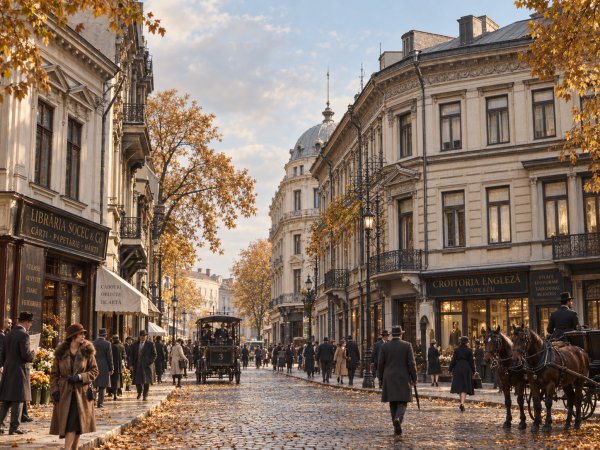
Autumn in Bucharest in, say, 1925 began with the same small negotiation the city still conducts with the seasons today. September still held on to the warmth of summer, garden terraces still had customers, and evening arrived a little earlier, just enough to remind everyone that the season of hats, theatres and serious coats was approaching. Bucharest was gradually retreating indoors, but it took as long a route as possible before getting there. First, people lingered a little longer on Calea Victoriei, went out for some fresh air along the Șosea, wandered through Cișmigiu, tasted a glass of fresh grape must and tried to find out “who was performing” at the theatre.
That, more or less, was autumn in Bucharest a century ago: a mixture of promenades, markets, restaurants, cafés, performances and a great deal of social life. The city lived intensely in public spaces, and people built their leisure time around several habits that had become almost ritualistic. Calea Victoriei served as an urban catwalk, Șoseaua Kiseleff provided the elegant stroll, markets filled with the season’s harvest, gardens enjoyed their final pleasant evenings, restaurants returned to centre stage, and theatres opened their new seasons.
In other words, autumn arrived with russet leaves and a cultural programme. Bucharest residents could put up with many things, but the prospect of an evening completely devoid of good company, music, coffee or post-performance commentary seems to have been considered a spectacular failure of imagination.
The Promenade, an Urban Sport Practised in Good Clothes
For Bucharest residents with both time and a certain amount of money, walking was a social activity in its own right. Calea Victoriei had long been established as one of the great routes of urban encounter. The Bucharest Municipality Museum describes it as a dominant axis of the city and a favourite place for promenades and meetings as early as the 19th century. Shops, hotels, restaurants, confectioneries and representative buildings were concentrated here — precisely the combination capable of turning a walk into a very serious occupation.
Autumn suited Calea Victoriei rather well. Milder temperatures made strolling more comfortable, shop windows provided convenient excuses to stop, while the proximity of theatres and cafés extended the walk well into the evening. The area between the commercial centre and the Romanian Athenaeum concentrated much of the capital’s fashionable life. A Bucharest resident could leave home declaring that he was simply going out for a walk and, several hours later, find himself sitting down for dinner, having coffee or attending a performance. Long before lifestyle apps existed, Bucharest had already invented the technique of making plans that develop entirely on their own.
Another established destination was Șoseaua Kiseleff. Laid out during the first half of the 19th century, the boulevard had become one of the capital’s principal promenade areas. Kiseleff Garden and the broad avenue attracted carriage rides as well as leisurely walks, and the area retained its prestige during the interwar period.
Sources from the Bucharest Municipality Museum also describe evening walks “along the Șosea”, sometimes stretching late into the night. Wealthier Bucharest residents could even hire carriages and head towards the forests and monasteries surrounding the city — places such as Cernica, Snagov, Comana or Țigănești.
Autumn provided a suitably picturesque setting for such escapes. Nicolae Iorga described Bucharest’s surroundings on autumn days in terms of russet forests, fields darkened by rain and farmland changing colour after the harvest. From today’s perspective, a carriage ride towards the edge of town sounds wonderfully romantic. From the passenger’s perspective, it probably also involved a fair amount of bouncing around, because historical charm tolerates bad roads considerably better than the human spine does.
Cișmigiu and the Gardens, the Last Days Spent Outdoors
Bucharest entered the 20th century with a genuine culture of public gardens and garden-restaurants. Terasa Oteteleșanu remains one of the best-known examples. Located on Calea Victoriei, near the old National Theatre, it included a restaurant, terrace, concert hall and a garden shaded by plane trees, lindens and chestnuts. Strauss, Offenbach, Kálmán and Lehár were often heard on its stage, while the venue attracted writers, artists and actors.
At the beginning of autumn, places such as this extended the city’s summer life for as long as the weather allowed. Cooler evenings gradually pushed customers indoors, and cafés and restaurants inherited the sociability that had flourished outdoors throughout the summer.
Cișmigiu offered a more democratic version of leisure. The park had been a favourite destination for strolling for decades, while period documents and photographs even preserve evidence of the restaurant operating inside the gardens. The Bucharest Municipality Museum lists the Cișmigiu Garden restaurant among the establishments representative of social life during the first half of the 20th century, alongside Terasa Oteteleșanu, Hanul lui Manuc, Hotel Imperial, the Military Circle terrace and Café de Paris.
Social differences could even be seen in how parks were used. Memoirs describe Sundays when servants and members of the less affluent population crowded the central gardens, while wealthier classes preferred other routes or excursions towards Șosea and the outskirts.
So a fallen leaf in Cișmigiu could be perfectly egalitarian. The people walking beneath it, somewhat less so.
Autumn Arrived at Obor with Sacks, Baskets and Calculations for Winter
The picturesque side of interwar autumn quickly met its practical counterpart. September and October meant stocking up.
Obor already had more than a century of history as one of the capital’s great commercial areas. The old Târg de Afară market had been relocated to the Obor area during the first half of the 19th century, while the surroundings of Calea Moșilor developed an extraordinary mix of commerce, food and popular entertainment. Taverns, pretzel shops, bakeries and other small businesses serving the constant flow of people operated around the market.
Autumn intensified the spectacle. Sources that have examined price catalogues and testimonies from the interwar period describe the Obor, Matache, Traian, Unirii, Amzei and Domenii markets overflowing with vegetables and fruit bought in large quantities for winter supplies. Cabbages, green tomatoes, potatoes, apples, plums, quinces and grapes entered the city’s domestic economy with impressive efficiency. In the outer neighbourhoods, the season of tomato purée, plum jam and pickles began, turning courtyards into miniature family factories.
Obor still maintained a powerful connection between Bucharest and the surrounding villages. Goods entered the capital by cart, producers came directly to the market, and the urban customer found himself only a few steps removed from the agricultural world that fed the city.
The famous Târgul Moșilor fair deserves a clarification. The great event took place around Pentecost, meaning that it belonged to spring and early summer. During the interwar period, it evolved into an annual exhibition for craftsmen and small industrial producers. In autumn, however, Obor remained extremely busy thanks to its everyday commercial function and seasonal provisioning.
Must Taverns, Pastrami and the Bucharest Philosophy of October
The moment grapes arrived in the markets, one of Bucharest’s classic autumn pleasures made its appearance: fresh grape must.
Accounts of old Bucharest mention must taverns scattered throughout the city and the combination that became traditional: must, pastrami and grilled meat. Ioan Slavici, recalling the capital of earlier times, mentioned Bucharest residents heading out to must taverns until late in the autumn, accompanied by meals of grilled pork, mici and lăutari musicians.
During the interwar period, the custom continued to fit perfectly within the structure of the city. Neighbourhood taverns and establishments close to the markets received fresh produce, while the season’s must provided a remarkably persuasive reason to socialise. Pastrami completed the picture. The relationship between the two appears almost contractual.
Elegant restaurants represented the other side of Bucharest’s gastronomic life. Casa Capșa had already spent decades consolidating its status as a meeting place for politicians, journalists, writers and artists. Its café had been operating since 1891, while its position on Calea Victoriei, close to the National Theatre and Terasa Oteteleșanu, turned the area into an extremely compact cultural ecosystem.
An evening could therefore flow quite naturally from a promenade to a restaurant, then to the theatre and perhaps back to the café afterwards. The performance on stage provided material for the performance around the table.
Autumn Marked the Beginning of the Real Theatrical Rush
If summer favoured gardens and outdoor performances, autumn brought Bucharest back inside its theatres. The National Theatre itself states in its own chronology that theatrical seasons began in autumn and continued until the following summer.
During the 1925–1926 season, the National Theatre was managed by Corneliu Moldovanu and Alexandru Hodoș. A year earlier, Moldovanu had shared the management with Ion Minulescu. Bucharest’s theatrical scene was going through an extremely active period, with the national institution facing competition from private companies and stages attracting major actors.
An excellent example comes directly from September 1925. Teatrul Regina Maria, successor to the Bulandra company, opened its season with “Stăvilarul” by G. Carapancea. Newspapers of the time commented on the season opening, the cast and the staging, evidence that the beginning of the theatrical year was an event closely followed both by the public and by journalists. That same year, Lucia Sturdza Bulandra and Tony Bulandra were joined within the theatre’s organisation by Ion Manolescu, Vasile Maximilian and George Storin, major names of the Romanian stage.
During the 1925–1926 season, Sala Eforie also hosted performances of Henrik Ibsen’s “Ghosts”. The cast included Agatha Bârsescu, George Vraca and George Calboreanu, with Soare Z. Soare directing. Within a single season, Bucharest audiences could therefore encounter Romanian drama, Ibsen and some of the greatest actors of the interwar generation.
Theatre criticism had a remarkable vitality of its own. Camil Petrescu wrote in the press of the 1920s about productions, directors and repertories with a severity capable of ruining the tranquillity of anyone’s coffee. In September 1925, he published an article in “Argus” devoted to the National Theatre, while aesthetic disputes concerning directing and acting formed part of everyday cultural life.
The theatre therefore became one of autumn’s great conversation topics. People talked about casts, premieres, actors, directors, successes and failures. A few hours later, all these subjects could be taken up again at Capșa, where cultural figures had transformed the café into something resembling a parallel institution of the capital.
Capșa, Oteteleșanu and the Art of Spending Two Hours over a Coffee
It is difficult to understand Bucharest life in the 1920s simply by listing the places people frequented. The essential element was the amount of time spent there.
The café functioned as an informal newsroom, literary club, theatrical waiting room and information centre. Capșa became famous precisely because of its clientele. Writers, journalists, actors and politicians met in a space where reputations could grow or become slightly crumpled somewhere between coffee and mineral water. Tudor Arghezi would later compare the café to an “academy”, a formulation that says quite enough about the social importance of the place.
Just a few steps away, Terasa Oteteleșanu completed the city’s bohemian geography. Its proximity to the National Theatre created one of Bucharest’s most fertile concentrations of cultural life. An actor, playwright and theatre critic could meet before the performance, after the performance and, with a little luck, even during the interval.
Autumn suited establishments like these particularly well. As the weather pushed tables indoors, the café once again became the city’s living room.
A Century Ago, Bucharest Lived Autumn in Public
Seen from a distance, Bucharest in 1925 looks surprisingly familiar. People went for walks, looked at shop windows, occupied restaurant tables, discussed performances, visited parks and turned the season into a reason to eat specific foods. Technology and scenery have changed radically; the social mechanism looks strikingly similar to the one we know today.
The main difference lay in the intensity of life lived in public space. The café, garden, market, pavement and theatre formed a social network equipped with chairs, tables, carriages and plenty of noise. Information travelled through newspapers and conversation. A theatrical premiere could become the evening’s topic at Capșa, an elegant appearance on Calea Victoriei could generate commentary, while the market offered a spectacle of its own every morning.
Autumn also had a very concrete rhythm. September prolonged walks and garden evenings. October brought winter provisions, must taverns and increasingly long evenings in restaurants and theatres. November pushed the city indoors and towards the cultural programme of the theatrical season.
A hundred years later, Bucharest still preserves fragments of that route. Calea Victoriei continues to attract weekend promenades, Kiseleff remains one of the city’s most elegant places for a walk, Cișmigiu changes colour every October, and the theatres begin stirring again as autumn arrives.
The modern city has settled over the old one. Bucharest’s ritual of going out into the world, however, appears to be remarkably stubborn.
Fortunately.
You may also like: Bucharest during Fall Season - Why to visit the capital dressed in a coat of gold