Who were the “căuzași”, the unionists who changed Bucharest politics
By Eddie Țone
- Articles
- 18 JUN 26
In the political history of Bucharest, the nineteenth century has the atmosphere of a heavy room in which someone has suddenly opened the windows and let in, together with the cold air, all the anxieties of modern Europe. On one side stood old boyars, regulations, foreign consuls, Russian and Ottoman interests, ceremonies with heavy garments and chancery formulas. On the other side gathered a young generation, raised on French readings, political clubs, newspapers, lodges, conspiratorial conversations, but also with an almost indecent appetite for modernization.
Out of this tension emerged the people connected to the “cause”, a term which, in the political language of the time, referred to the national cause of the union of the Principalities. In historical memory, they often appear under the name of căuzași: active supporters of the union of Moldavia with Wallachia, involved in propaganda, the press, urban mobilization and political pressure. The organization, however, did not come with membership cards, a stamp and neatly kept minutes in a drawer, but was rather a network of politicians, publicists, Forty-Eighters radicals, unionist militants and sympathizers of the National Party.
Behind them stood a clear political genealogy, largely originating in the Forty-Eighter radicalism of 1848, in the secret society Frăția, in the experience of exile and in the sometimes uncomfortable alliance between idealism, the press, the street and parliamentary calculation. Bucharest became the stage on which this combination proved its effectiveness in January 1859.
From Frăția to politics made with the public
Before 1859, Bucharest had already been a revolutionary laboratory. The secret society Frăția, founded in 1843, was one of the important networks of young Wallachian reformers. From this political milieu came people who would decisively mark the century, names such as C.A. Rosetti, Nicolae Bălcescu, Ion Ghica, the Brătianu brothers, Alexandru G. Golescu and other young men shaped in an atmosphere in which Paris was a kind of power station for revolutionary ideas.
These people brought something that old Bucharest politics regarded with elegant nervousness: networks. They knew one another, wrote, travelled, debated, conspired, printed, argued and returned to the same table when the cause demanded discipline. Their Bucharest was the city of inns, printing houses, Podul Mogoșoaiei, boyar homes where politics was conducted by candlelight, and neighbourhoods that could be summoned, at the right moment, to become public opinion in flesh and blood.
The Revolution of 1848 and the birth of an urban political culture
The Revolution of 1848 brought this energy into the centre of administration. The Proclamation of Islaz, the provisional government, the new newspapers and the language of national dignity showed that the young radicals wanted a different kind of state, one with modern institutions, political press, citizens’ rights and a changed relationship between rulers and the ruled. Bucharest began to hear words that sounded dangerously alive: freedom, nation, reform, constitution, responsibility.
The press became one of the decisive weapons of the moment. In 1848, publications such as Pruncul român, Poporul suveran, Konstituționalul, Reforma, România and Monitorul appeared in Bucharest. For a city accustomed to rumour, the café and the whisper, the newspaper brought a new speed. Information circulated, ideas acquired a printed body, and public opinion began to have paper, ink and nerve.
Here appears one of the important changes brought by the Forty-Eighter generation and continued by the unionist căuzași: Bucharest politics moved out of the salons and closer to the street. The neighbourhood, the merchants, the educated youth, craftsmen and curious citizens became a political public. The opening had theatricality, improvisation and quite a bit of noise. But precisely this noise changed the rhythm of the Capital. Bucharest began to matter as a mobilizable city, and the lesson would be used effectively in 1859.
C.A. Rosetti, the publicist who turned the printing house into a tribune
C.A. Rosetti deserves a special place in the story of the căuzași, although the term is more strictly connected to unionist action after 1848. Born in 1816, Rosetti was one of the liveliest figures of the Forty-Eighter generation. He was an actor, poet, bookseller, printer, publicist, politician and, in general, a character who made the old world search its drawers for composure.
His name appears among the members of the Frăția society, and in 1845 he founded a bookshop and a printing house. After returning to Bucharest in 1847, his bookshop on Calea Mogoșoaiei and his home on Izvorului Street became meeting places for revolutionaries. Plans were discussed there, alliances were formed, and one could already sense the smell of ink which, in the nineteenth century, frequently announced trouble for the authorities.
Alongside Rosetti stood Maria Rosetti, born Mary Grant, one of the most remarkable female figures of the age. The Rosetti household was a meeting place for revolutionaries, and Maria Rosetti made a real contribution to supporting and helping the Wallachian revolutionaries detained on the Ottoman ship escape. After exile, the Rosetti family returned to the centre of the unionist movement. In 1857, C.A. Rosetti founded the newspaper Românul, which became one of the important tribunes of radical liberalism.
Ion C. Brătianu and organized radicalism
Ion C. Brătianu represents the other face of liberal radicalism: more organizational, more strategic and sometimes colder. Having left for Paris in 1841, he came into contact with the political and intellectual circles of the period, with French democratic ideas and with the circles in which young Romanians learned to translate local dissatisfaction into a European language.
In 1848, Brătianu returned to the country and became a member of the Revolutionary Committee in Bucharest, secretary of the provisional government and prefect of the Capital’s Police. After the defeat of the revolution, exile in Paris offered him and other Forty-Eighters a harsh school. Simple enthusiasm burned out quickly. The Romanian cause needed contacts, memoranda, foreign press, informal diplomacy and an early form of political lobbying.
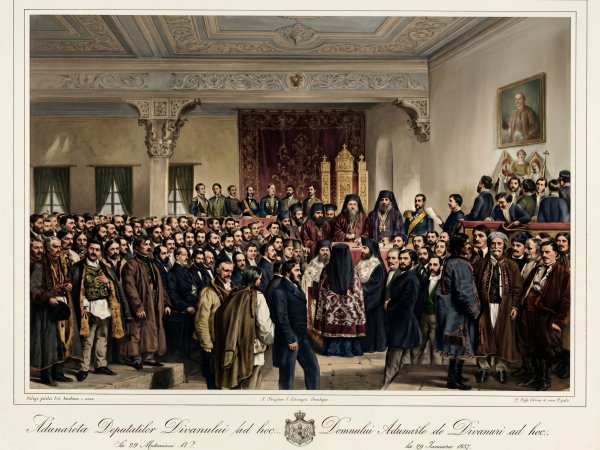
In 1857, when Brătianu returned to Wallachia, he came to the forefront of the unionist struggle. He was elected a member of the ad hoc Divan and of the Elective Assembly in Bucharest, where he would vote for the double election of Alexandru Ioan Cuza. The căuzași in the street and the politicians inside the institutions were, in essence, working on two registers of the same score: some brought the pressure of the city, while the others turned that pressure into a vote.
January 1859: Bucharest, the Metropolitan Hill and popular pressure
The moment when the căuzași entered history with a precise political role was January 1859. In Iași, Alexandru Ioan Cuza had been elected ruler of Moldavia on 5 January, unanimously by the 48 deputies present. In Bucharest, the situation was more complicated. The elections for the Elective Assembly of Wallachia had given the conservatives 46 of the 72 seats, while the National Party was in the minority.
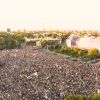
The proceedings of the Elective Assembly opened on 22 January 1859 in a tense atmosphere. The building was surrounded by thousands of people, a sign that political Bucharest had already moved beyond the quiet logic of the salon vote. Popular pressure mattered. It was pressure organized and directed by the unionist leaders, but this is precisely where the change becomes visible: urban public opinion was becoming a political instrument.
On the night of 23 to 24 January, the members of the National Party gathered at Hotel Concordia, located on today’s Smârdan Street. Both the conservative deputies and those of the National Party were looking for a solution. At the proposal of Dimitrie Ghica, the solution of the double election was adopted: Alexandru Ioan Cuza, already ruler of Moldavia, was to be elected ruler of Wallachia as well.
Vasile Boerescu and the vote of 24 January
On the morning of 24 January 1859, the Assembly resumed its work. Vasile Boerescu requested a secret session, argued in favour of the principle of Union and emphasized the legality of the double election in the spirit of the Paris Convention. He then proposed the election of Alexandru Ioan Cuza as ruler of Wallachia.
The deputies swore that they would unanimously vote for the ruler of Moldavia. Returning to the meeting hall, the 64 deputies present elected Alexandru Ioan Cuza ruler of Wallachia. The result was unanimous: 64 votes. Through this political act, achieved without formally violating the Paris Convention, the Union became a political fact.
Here the impact of the căuzași on Bucharest can be seen clearly. They created the link between neighbourhood and institution, between unionist discourse and the voting hall, between popular enthusiasm and parliamentary technique. In a capital accustomed to decisions made from above, they brought pressure from the city. It was guided, calculated and politically amplified pressure, but this exact mixture belongs to political modernity.
Hotel Concordia, Podul Mogoșoaiei and the geography of the Union
The Bucharest of the căuzași can also be read on a map. The Metropolitan Hill, Hotel Concordia, Podul Mogoșoaiei, the printing houses and the homes where political meetings were held form a geography of modernization. It was not a flawlessly ordered capital, with triumphal boulevards and textbook urban planning, but rather a mixed city, with mud, inns, courtyards, shops, boyars and townspeople, where history sometimes entered the meeting hall directly, its boots still dirty.
Hotel Concordia remained in the memory of the Union as the place where the leaders of the National Party adopted the solution of supporting Cuza. The building at 39 Smârdan Street, constructed in 1852, was refurbished and functions as a hotel. The Metropolitan Hill was the space where public pressure weighed heavily. Podul Mogoșoaiei, the future Calea Victoriei, was the symbolic axis of the political and social city, along which carriages, uniforms, rumours, printed sheets and perfectly human vanities circulated.
The căuzași understood that Bucharest could function as a stage, a tribune and a mechanism of moral constraint. It was an age without television, opinion polls and social networks, but a crowd gathered in a key place sent a simple message: the city is watching. And when the city is watching, the deputy votes with a different pulse.
Căuzași Street today: an urban trace of a great cause
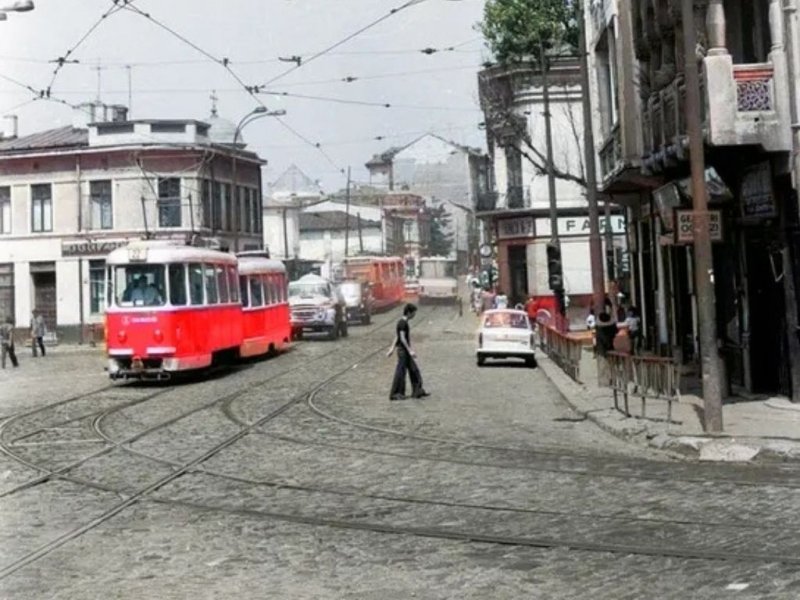
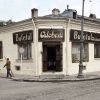
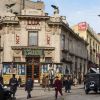
Căuzași Square / Photo: Șerban Lăcrițeanu (1978) / Image restored and colorized using artificial intelligence, preserving the original details.
Today’s Căuzași Street preserves, in a very concrete corner of Bucharest, one of those urban ironies that the Capital cultivates with almost artistic perseverance. The name points to the people of the “cause”, to the unionist fever and to politics made through the press, assemblies, popular pressure and a great deal of backstage energy. The place, however, speaks of another layer of history: old Bucharest, cut through, displaced, demolished piece by piece and redrawn with an administrative brutality that left the city with more than enough scars.
In its current form, Căuzași Street is located in Sector 3, in the old area toward Calea Călărașilor, close to the urban territory that once connected the commercial centre, Calea Văcărești, the old Jewish Quarter and the merchant neighbourhoods of the city. Here, Bucharest had a dense texture, with narrow streets, low houses, shops, institutions, small neighbourhood landmarks and routes that linked the central world to the eastern part of the city. It was a Bucharest less photogenic for official brochures, but highly expressive for anyone who wants to understand real urban life.
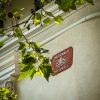
The history of the name has several layers of its own. After 1989, the former Labirint Street received the name Căuzași. Before that, Labirint was known as one of the most winding streets in the Capital and connected Calea Văcărești to Calea Călărașilor. During the interwar period, the same artery bore the name Metropolitan Ghenadie Petrescu. The simple sequence of names says quite enough about Bucharest: a city in which memory changes on the street-corner sign, while the street itself is left to endure every regime, every ambition and every symbolic correction.
The Căuzași area also had a square of the same name, an important junction of old Bucharest. Căuzași Square was located near the intersection of Calea Văcărești with streets such as Bravilor, Labirint, Abram Goldfaden and Pitagora. For the city’s memory, this square matters because it belonged to an urban network that largely disappeared following the communist systematizations. The demolitions of the 1980s massively altered the area, while Unirii Boulevard covered or absorbed important fragments of the old neighbourhood fabric.
Therefore, Căuzași Street functions today as a strange bridge between two histories. The first is the political history of the căuzași, the people of unionist mobilization, connected to 1848, to January 1859 and to the transformation of Bucharest into a stage for civic pressure. The second is the urban history of the place, with Labirint Street, the old Căuzași Square, its proximity to the Jewish Quarter and the drama of the demolitions that irreversibly changed this part of the city. The name on the street sign may seem small, almost discreet, but behind it gather two major themes: the birth of modern politics and the disappearance of a piece of Bucharest.
For today’s reader, Căuzași Street deserves to be viewed without textbook solemnity. It does not offer a monumental setting in the classical sense, with statues raising a finger toward the future and polished façades ready for anniversary photographs, but it comes with something more typically Bucharestian: a trace, an overlap, a small piece of memory caught between traffic, surviving houses, recent buildings and the gaps left by the old city. This discretion is precisely what makes it valuable. In Bucharest, history often appears in the form of a street sign you pass in a hurry, then returns, with a little patience, carrying a story the size of an entire chapter.
The căuzași and the beginning of modern Bucharest politics
The căuzași left Bucharest an important political legacy, showing that the press, clubs, personal connections, urban solidarity and popular mobilization could influence the outcome of a vote. They connected Forty-Eighter radicalism to practical unionism and pushed the city toward the status of political capital of a state in formation.
After 1859, the process of institutional union continued. Cuza’s double election was recognized internationally in 1859. Administrative and political union was accepted in 1861, and in 1862 the first unified government and the first Parliament of Romania were formed; Bucharest was proclaimed the capital of the new state. Later, the radical liberals supported reforms, quarrelled with ruler Cuza, entered surprising alliances, and Ion C. Brătianu played an important role in bringing Carol I to the throne.
For Bucharest, the căuzași represented the moment when politics began to have a public, a press, a street, collective emotion and a national stake. They were the continuers of the young radical liberals of 1848 and the precursors of a modern urban politics, occasionally spectacular, frequently noisy, almost always imperfect, but decisively alive. Around them, Bucharest learned that history could be made in the courtyard of the Metropolitan Church, in a hotel on a merchant street, and in a printing house where the ink smelled of the future.
You may also like: The Frenchman Who Helped the 1848 Revolutionaries: Who Was Edgar Quinet and Why a Street in Central Bucharest Bears His Name