Famous Houses of Bucharest: Take Ionescu’s Villa. The “Golden Mouth” Statesman Sheltered Animals in His Own Home
- Articles
- 29 JUL 26
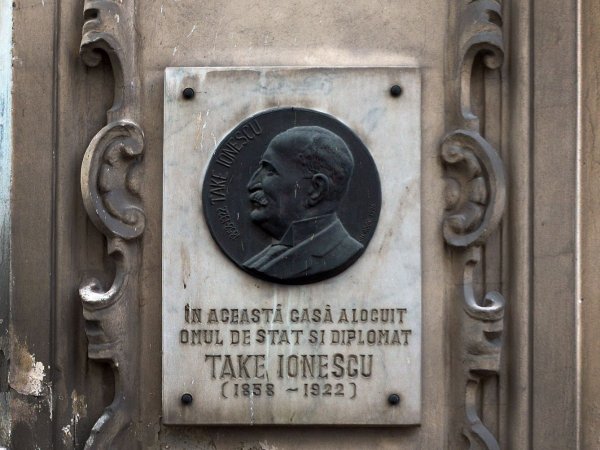
Few historic residences in Bucharest tell a story as spectacular as Take Ionescu’s villa, located near Alexandru Lahovari Square. The building still impresses today through the elegance of its architecture, yet its true value lies in the history hidden within its walls. It was the home of one of Romania’s most brilliant politicians of the early 20th century, an exceptional orator, diplomat, jurist, and Conservative leader who played a decisive role in shaping Romania’s foreign policy during the years of the First World War and the Great Union. Take Ionescu’s destiny is one full of contrasts. To some of his contemporaries, he was a visionary politician capable of anticipating Europe’s great geopolitical transformations and one of the architects of Romanian diplomacy. To others, the decisions and negotiations he conducted around the Paris Peace Conference remained controversial, as he was accused of accepting the partition of Banat between Romania and Serbia. At the same time, his private life was far removed from the austere image of a statesman. His residence was famous for the exotic animals that wandered freely through the garden and even inside the house, astonishing both guests and servants. Today, the building on Tache Ionescu Street remains one of the capital’s most fascinating historic monuments, standing as a witness to important events in Romania’s political and cultural history.
An Elegant Residence Built at the End of the 19th Century
Take Ionescu’s house was built at the end of the 19th century, and in 1897 the politician purchased it for the sum of 83,000 lei, a considerable amount for that period. The building had been designed by the Swiss architect Louis Blanc, one of the most highly regarded architects working in Romania at the time.
Louis Blanc was also responsible for the plans of several landmark buildings in Bucharest, including the Ministry of Agriculture and the Palace of the Faculty of Medicine. His experience is clearly reflected in this villa, designed in a refined French Eclectic style, which was extremely popular at the end of the 19th century.
The façade is richly decorated with rustication, ornamental cartouches, and sculpted vegetal motifs above the windows. The first-floor windows are framed by pilasters and adorned with decorative manories, elements characteristic of French architecture of the period.
The interior was elegant without being ostentatious. On the ground floor were the entrance hall and the office where Take Ionescu received visitors and political collaborators. An impressive library occupied an important place in the room, alongside the portrait of his first wife, Elisabeth Richards, affectionately known as Bessie.
The rooms were decorated with wooden paneling, while a circular staircase led to the upper floor, where the main salon, the music room, the bedrooms, a second office, and the conservatory were located. Interestingly, the house’s tower served not only an aesthetic purpose but also supplied water to the conservatory on the upper floor.
Alterations to the Villa and the Transformations After the First World War
Like many buildings of its era, this residence did not escape the dramatic events of the First World War. During the occupation of Bucharest, German troops devastated part of the house, and the property required extensive restoration work after the conflict had ended.
During the renovations carried out in 1918, the terrace located on the right side of the main entrance was added. At the same time, several areas damaged during the war were restored.
Period photographs show that the villa also featured an elegant gazebo and a conservatory framed by artistic wrought-iron elements. Unfortunately, these structures have not survived to the present day and can now be admired only in historical photographs.
After Take Ionescu’s death, the fate of the property changed dramatically. In 1930, the politician’s second wife, Adina Olmazu, née Cordescu, commissioned the construction of a replica of a Florentine palace in the villa’s courtyard, designed by architect Alexandru Zaharia.
That same year, the Leonida apartment building was erected adjacent to the property, and the replica of the Florentine palace was moved closer to the street. A few years later, in 1935, Take Ionescu’s widow sold the entire estate to the Ministry of Justice.
The building became the headquarters of the Legislative Council until 1950, after which it housed the “Constantin Brăiloiu” Institute of Ethnography and Folklore of the Romanian Academy, a function it still serves today.
From the Son of a Merchant to One of Romania’s Most Influential Politicians
Take Ionescu was born in Ploiești on October 13, 1858, into a family that initially did not enjoy a particularly prosperous financial situation. His father, Ghiță Ioan, later became wealthy by collecting tolls at the entrance barriers of several towns throughout the country.
The future politician began his education in his hometown before continuing his studies in Paris, where he attended the Faculty of Law. His years in France profoundly shaped both his legal thinking and the oratorical style that would later make him famous in Romanian politics.
After returning to Romania in 1881, he became a lawyer and quickly earned an outstanding reputation in the courtroom. His real name was Dumitru Ghiță Ioan, but before entering political life he used several different versions of his name. Eventually, he chose the diminutive “Take” and became permanently known as Take Ionescu.
His political rise was swift. In 1884, he was elected to Parliament as a representative of the National Liberal Party, and in 1891 he became Minister of Religious Affairs and Public Instruction in a Conservative government.
In Bucharest, he acquired two famous nicknames. The first was “Seven Trousers,” because his father had owned a woolen cloth shop in Ploiești whose emblem consisted of seven pairs of woolen trousers hanging at the entrance. The better-known nickname, however, was “Golden Mouth,” earned thanks to his extraordinary talent as an orator.
His speeches in Parliament were regarded as true masterpieces of rhetoric, and contemporaries listened to him with great interest regardless of their political affiliation.
A Man Both Admired and Criticized
Take Ionescu’s personality inspired very different opinions among his contemporaries. Ion G. Duca described him in his memoirs as a charming man, capable of captivating others through conversation and his genuine interest in everything around him.
In Duca’s opinion, the politician’s charm stemmed above all from the warmth of his character and his extraordinary ability to tell stories, recall memorable events, and turn any conversation into an unforgettable experience.
Constantin Argetoianu, on the other hand, had a far more critical opinion. He portrayed him as an extremely skillful politician, constantly preoccupied with behind-the-scenes maneuvering and short-term political advantage, a man who always knew how to emerge from difficult situations without damaging his public image.
These differing views demonstrate the complexity of Take Ionescu’s personality and explain why his public image has remained controversial to this day.
In 1908, he founded the Conservative-Democratic Party, a political movement joined even by Ion Luca Caragiale. The great playwright regarded Take Ionescu as a tireless and wise patriot, admiring both his political intelligence and his devotion to Romania.
The Diplomat Who Anticipated Europe’s Great Transformations
Take Ionescu played an important role in Romania’s foreign policy during the First World War. Before the Crown Council held at Peleș Castle in August 1914, he argued that the war would last for several years and accurately predicted that Great Britain, Italy, the United States, and even Japan would eventually enter the conflict.
At the same time, he declared that the Allies would emerge victorious, that Romania would become a unified nation, and that the world would witness the collapse of empires, the rise of the United States, and major social and economic transformations. He also warned that victory would be followed by a prolonged period of poverty and instability, a prediction that proved to be largely accurate.
Following the Great Union of 1918, Take Ionescu stated that it would be an unforgivable mistake for Greater Romania to be governed according to the same principles as the Old Kingdom.
In the autumn of that same year, he established the Romanian National Unity Council in Paris, an organization dedicated to promoting the interests of Romanians during the international negotiations.
The Paris Peace Conference and the Greatest Controversy of His Career
After the war, Take Ionescu’s name became associated with one of the most controversial issues in Romania’s diplomatic history.
Although he was not a member of the official Romanian delegation to the Paris Peace Conference, the politician conducted negotiations with Serbian Prime Minister Nikola Pašić regarding the delimitation of the border between the two countries.
As a result of these agreements, Banat was divided between Romania and Serbia, while Ion I. C. Brătianu insisted that the entire province should belong to Romania. This episode generated criticism that has endured over time and contributed to the politician’s controversial reputation.
Later, as Minister of Foreign Affairs in General Alexandru Averescu’s government, Take Ionescu made an essential contribution to the creation of the Little Entente, the defensive alliance between Romania, Czechoslovakia, and Yugoslavia, regarded as one of the pillars of regional security during the interwar period.
In December 1921, he fulfilled his dream of becoming Prime Minister of Romania. His term in office, however, was extremely short, as his government fell after only one month following a vote of no confidence in Parliament, bringing an end to the last Conservative government in Romania’s history.
The House Full of Animals That Astonished the Entire Capital
Beyond his political career, Take Ionescu’s personal life was filled with remarkable episodes. While studying in Paris, he met a young Englishwoman named Elisabeth Richards, with whom he fell in love at first sight. They were married in November 1881, first in a civil ceremony in Brighton and then in a religious ceremony at the Greek Catholic Church in London.
Take’s parents did not approve of the marriage because Elisabeth came from a family without wealth, and their son was even disinherited. Nevertheless, the marriage proved to be a happy one.
Bessie, as Take affectionately called his wife, was a great animal lover and founded the Society for the Prevention of Cruelty to Animals. Before long, the Ionescu family villa had been transformed into a genuine refuge for animals.
A bear, a monkey, several deer, and no fewer than ten dogs lived in the house and wandered through the garden. Elisabeth’s favorite was Charlie, a dog who was treated as a true member of the family. Whenever his mistress traveled abroad, Charlie was accommodated at the Joseph Hotel in Sinaia, where the staff respectfully addressed him as “Mr. Charlie.”
Another favorite animal, especially beloved by Elisabeth, was the monkey Armina. She frequently escaped from her enclosure and climbed into the trees in the neighbors’ gardens. The only person who could catch her was the police officer patrolling the neighborhood, who would often return triumphantly with Armina in his arms to Mrs. Ionescu.
Even more spectacular was the bear, named “Mr. Bruni.” The animal had been given to the couple as a cub from the Caucasus Mountains. As it grew larger, the bear roamed freely through the house and the garden, frightening both the servants and the guests who visited the Ionescu residence.
The Final Years and the Legacy of a Remarkable Personality
After thirty-five years of marriage, Elisabeth Richards died as a result of a horseback riding accident. Left a widower, Take Ionescu married Adina Olmazu, née Cordescu, who was thirty-three years younger than he was.
In 1922, after the end of his brief term as Prime Minister, the politician traveled to Italy. While in Naples, he ate contaminated oysters, and the illness he contracted quickly worsened. He died on June 22, 1922, in a sanatorium in Rome from typhoid fever.
At his funeral, held at Sinaia Monastery, the most important personalities of the time were present. Ionel Brătianu acknowledged his contribution to the creation of Greater Romania, while Nicolae Iorga later wrote that Take Ionescu’s funeral had been even more magnificent than that of King Carol I. The monarch himself had repeatedly declared that Take Ionescu was the most intelligent statesman of his reign.
After his death, Adina Ionescu became the heir to his estate, although the politician had already bequeathed his houses to the Romanian Academy in his will. She was entrusted with the responsibility of caring for Take’s grave in Sinaia and Elisabeth’s grave in England. She later remarried Prince Jean Woroniecki of Poland.
Today, Take Ionescu’s villa remains one of Bucharest’s most representative historic residences. Beyond the beauty of its architecture, it recalls the personality of an exceptional statesman, admired for his intelligence and extraordinary oratorical talent, criticized for some of his diplomatic decisions, yet remembered not only for his political achievements but also for the extraordinary story of a home where a bear, a monkey, deer, and dogs shared the same roof with one of the most influential figures in modern Romanian history.
We also recommend: Famous Houses of Bucharest: The Șomănescu Palace, from the Residence of the President of the Agrarian Society to the Embassy of Vietnam in Romania