3 Bucharest neighbourhoods worth exploring on long summer evenings
By Raluca Ogaru
- Articles
- 31 JUL 26
After a day in which the pavement has absorbed the heat, Bucharest usually becomes pleasant again only towards evening. Traffic begins to ease, the shadows of the houses grow longer, and some neighbourhoods reveal details that are easy to miss during the rush of the day.
For a summer walk, you do not necessarily need to choose a large park or a busy tourist boulevard. Cotroceni, the Icoanei area and the Filipescu residential district are three places where quiet streets, historic architecture and stops at cafés or small urban gardens can be combined into an enjoyable route.
Each walk can be followed independently, without a strict timetable. One hour is enough for a short route, although it is worth allowing more time if you want to look closely at façades, take photographs or stop somewhere along the way.
Cotroceni, for quiet streets and houses hidden behind gardens
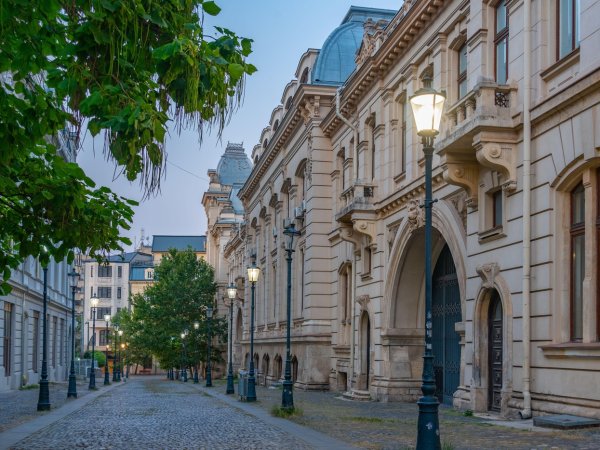
Cotroceni remains one of the most suitable areas of Bucharest for a walk without a fixed destination. Most of the streets are residential, mature trees provide shade, and many of the houses were built during the first half of the 20th century. Neighbourhoods of this kind are best explored on foot, because many architectural details can only be noticed from close range.
A route can begin near the New Saint Elefterie Church and continue along Doctor Lister, Louis Pasteur, Doctor Obedenaru and Carol Davila streets. From there, the walk can be extended towards Romniceanu, Victor Babeș and Doctor Clunet before returning to the Eroilor area.
This section of the neighbourhood is close to the cultural route documented by ARCEN, which follows the stories of houses built during the interwar period and the changes the area has undergone. The organisation’s route includes Doctor Lister, Louis Pasteur, Doctor Obedenaru, Carol Davila, Romniceanu, Victor Babeș and Doctor Clunet streets.
Cotroceni is not impressive because of one single landmark, but because of the atmosphere created by small details: old gates, exterior staircases, rounded windows, leafy courtyards and villas combining Neo-Romanian, modernist and Art Deco influences. In the evening, once temperatures fall, the slow pace of the neighbourhood contrasts sharply with the busier Opera Square area nearby.
For a shorter route, you can finish in Romniceanu Park. For a longer walk, continue towards Cotroceni Palace and the Bucharest Botanical Garden, keeping in mind that entry to the attractions themselves depends on each institution’s opening hours.
The Icoanei area, between gardens, culture and historic Bucharest
The Icoanei neighbourhood is suitable for those who want a central walk but prefer side streets to large boulevards. You can begin on Arthur Verona Street, then continue along A.D. Xenopol and Cristofor Columb towards Ion Voicu Park and Grădina Icoanei.
From there, the route can follow Jean-Louis Calderon, Icoanei, Alexandru Donici, Vasile Lascăr and Maria Rosetti streets. It is an area where historic houses, cultural institutions, bookshops and creative spaces appear close to one another, without making the walk feel like a rigid tourist circuit.
ARCEN describes the Icoanei district as an urban area of significant architectural and cultural value. It still preserves houses hidden behind vegetation, old courtyards, Neo-Romanian buildings and interwar Art Deco architecture. The cultural route documented by the organisation includes Arthur Verona, A.D. Xenopol, Cristofor Columb, Eremia Grigorescu, Jean-Louis Calderon, Icoanei, Alexandru Donici, Vasile Lascăr and Maria Rosetti streets.
Grădina Icoanei and Ion Voicu Park can serve as places to pause rather than simply as destinations. Between them lies one of the most coherent surviving sections of old Bucharest, even though traffic and parked cars still occupy a considerable part of the streets.
The area is also associated with the District 40 cultural project, through which ARCEN sought to activate the community around Grădina Icoanei through events, walking tours, readings, art and interventions in public space.
A walk of around one hour can end in Piața Lahovari or around Piața Romană. The advantage of this neighbourhood is that it offers enough places to stop without losing the feeling of urban exploration.
Dorobanți and the Filipescu residential district, for the elegance of interwar Bucharest
The third option begins in Piața Dorobanților and continues through the area known as the Filipescu residential district towards Piața Victoriei. This route is particularly suitable for evenings when you want to observe the architecture and the way northern Bucharest was developed as an elegant residential area.
You can begin near Andrei Mureșanu Street and explore the roads around the square without necessarily following a straight line. Street names such as Paris, London, Rome, Washington and Athens contribute to the cosmopolitan character of the neighbourhood, but the main attraction is the collection of villas and residences built for the political, cultural and business elites of the period.
The Filipescu development was initiated in 1910 and laid out between 1912 and 1913, becoming one of the most important private initiatives through which Bucharest expanded northwards. The area brings together Neoclassical, Neo-Romanian, modernist and Art Deco buildings, alongside architecture influenced by French eclecticism.
ARCEN included the Filipescu residential district in its series of cultural walking routes, with a circuit beginning in Piața Dorobanților and ending at the Oromolu House in Piața Victoriei. The organisation describes the area as one of the most elegant and valuable neighbourhoods of interwar Bucharest.
This walk offers less shade than Cotroceni, so it is more suitable after 7:30 p.m., when the sun is no longer as strong. Ending in Piața Victoriei also makes it possible to continue towards Kiseleff Boulevard, Piața Amzei or Calea Victoriei.
How to choose the right neighbourhood for a summer evening
Cotroceni is the best choice for tranquillity, greenery and residential streets. The Icoanei area offers the strongest combination of architecture, green spaces and places to stop. The Filipescu residential district is particularly suitable for those interested in villas, urban history and the elegance of early 20th-century Bucharest.
For any of these routes, comfortable shoes and a bottle of water are more useful than a very strict itinerary. It is worth avoiding the hours when the heat is still intense and maintaining a respectful distance from private homes, gates and courtyards.
A walk through these neighbourhoods may not provide the monumental views associated with Bucharest’s main tourist centre. Instead, it reveals a city built on a more human scale, with streets worth observing slowly and fragments of urban life that are best discovered after the day begins to cool.
Photo credit: Profimedia