Famous photographers of Bucharest: Carol Popp de Szathmari, the world's first war photojournalist
- Articles
- 30 JUL 26
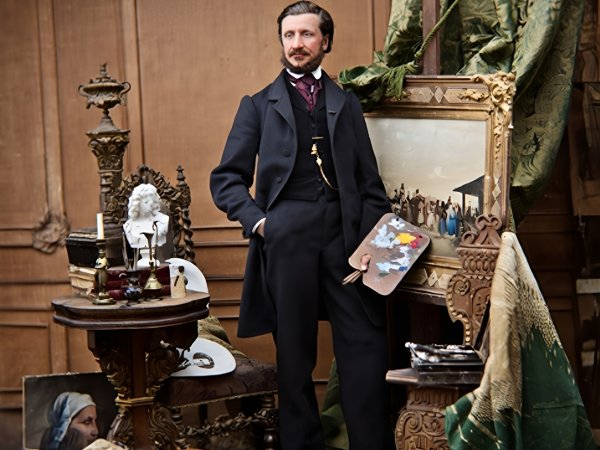
Few personalities have influenced painting, photography, and historical documentation to the same extent as Carol Popp de Szathmari. Considered one of the most important artists of nineteenth-century Romania, he is internationally recognized as the world's first war photojournalist, a pioneer who understood from the earliest days of photography that a camera could become an instrument for documenting history. Long before the major news agencies and illustrated newspapers sent photographers to the battlefields of the world, Szathmari was capturing images of military conflicts, using rudimentary technical equipment and working under extremely difficult conditions. Those photographs would later become part of the universal heritage of photography. His name is also closely connected with Bucharest. The capital of Wallachia became the city where the artist built his career, opened his photographic studio, and created some of the most valuable images of the era. At a time when the city was beginning to modernize and photography was still a novelty, Carol Popp de Szathmari captured the faces of princes, noblemen, soldiers, and ordinary people, as well as the landscapes of a capital undergoing constant transformation. Today, his works represent priceless historical documents. They provide researchers with the opportunity to reconstruct the atmosphere of Bucharest during the second half of the nineteenth century and demonstrate that photography can become a historical source just as important as written documents.
From Cluj to Bucharest, the journey of an exceptional artist
Carol Popp de Szathmari was born on January 11, 1812, in Cluj, into a family of Transylvanian origin. From childhood, he displayed extraordinary artistic talent, and drawing and painting quickly became his main interests.
Unlike many artists of his time, he developed his style largely through self-study. He attended the Academy of Fine Arts in Vienna for a short period, but most of his experience was gained through observation, practice, and numerous journeys.
Szathmari's youth was adventurous. He traveled through various regions of the Habsburg Empire and the Romanian Principalities, fascinated by the diversity of people, traditional costumes, and landscapes. These experiences profoundly influenced his artistic style, directing him toward the faithful representation of reality.
After several journeys across the Carpathian Mountains, the artist decided to settle permanently in Bucharest in 1843. The decision was not accidental. The capital of Wallachia was becoming increasingly attractive to artists and intellectuals, while the Bucharest aristocracy was eager to commission portraits and decorative works inspired by Western European models.
During his first years in the city, Carol Popp de Szathmari gained recognition thanks to the quality of his paintings. Noblemen, wealthy merchants, and members of the administration sought his services to create family portraits and landscapes. His talent, elegance, and professional dedication quickly earned him the appreciation of Bucharest's elite.
Bucharest captured in watercolors and drawings
Although he is best known for his photographs, Carol Popp de Szathmari's early years in Wallachia were devoted primarily to painting and drawing.
Some of the most fascinating works from that period were rediscovered and presented to the public only recently. They consist of a collection of watercolors created in the autumn of 1848, shortly after the Battle of Dealul Spirii, one of the most significant events of the Wallachian Revolution of 1848.
These works possess extraordinary documentary value. They depict the Ottoman soldiers who participated in the events of September 1848, while also preserving rare views of Bucharest during the first half of the nineteenth century. In the background appear buildings, streets, and neighborhoods that would disappear in the following decades as the capital underwent modernization.
For historians, these watercolors represent exceptionally valuable visual testimonies. They complement the written records of the period and make it possible to reconstruct a Bucharest that very few people ever had the opportunity to see.
Before photography became widely accessible, drawing and watercolor painting were the principal means of preserving the image of a city. For this reason, Szathmari's works are now regarded as genuine historical documents.
The favorite artist of high society
Besides his artistic talent, Carol Popp de Szathmari impressed people through his education and refinement. He was an elegant, cultured, and well-mannered man, able to converse fluently in German, French, and Italian. After settling in Bucharest, he also learned Romanian, which enabled him to integrate quickly into local society.
These qualities brought him close to aristocratic circles and the princely family. The artist was welcomed into the entourage of Prince Gheorghe Bibescu and his wife, Maritzica Bibescu, for whom he painted portraits appreciated both for the faithful rendering of their features and for the elegance of the compositions.
His relationship with the ruling family was not an isolated episode. Throughout his life, Carol Popp de Szathmari remained in the service of the rulers of Wallachia and, later, of Romania.
He created official portraits, drawings, engravings, and photographs of them, while also accompanying them at numerous ceremonies, journeys, and important political events. At a time when photography was becoming increasingly important, the images produced by Szathmari helped shape the public image of the Romanian rulers.
His studio in Bucharest became one of the best-known photographic studios in the Romanian Principalities. Members of the aristocracy, diplomats, military officers, politicians, and representatives of the cultural elite all came there to be photographed by the artist who had already earned a respected name throughout Europe.
In 1863, Carol Popp de Szathmari was officially awarded the title of "Peintre et Photographe de la Cour de LL AA SS" ("Painter and Photographer to Their Serene Highnesses' Court"), an honor that confirmed his privileged status and the importance of his artistic work.
During that same period, he created one of the best-known photographic series in Romanian history, dedicated to Prince Alexandru Ioan Cuza and his wife, Elena Cuza. These images would permanently establish the public image of the ruler who had achieved the Union of the Romanian Principalities.
The photographs that defined the image of Alexandru Ioan Cuza
The summer of 1863 marked one of the most important moments in Carol Popp de Szathmari's career. In his Bucharest studio, the artist produced an extensive series of official photographs of Prince Alexandru Ioan Cuza and his wife, Elena Cuza. At that time, photography was becoming a modern instrument for representing political authority, and the images created by Szathmari played a decisive role in shaping the public image of the Prince of the Union.
Cuza was photographed wearing several military uniforms, ranging from that of a mounted Dorobanți officer to a general's ceremonial uniform. The composition of the photographs was carefully designed. The prince stood upright, resting his right hand on a small table, with a heavy curtain hanging behind him, a typical feature of nineteenth-century photographic studios. On his chest he wore several important decorations, including the Orders of Medjidie, Saints Maurice and Lazarus, and The Redeemer, symbols of the diplomatic and military prestige he enjoyed during those years.
Historians believe these photographs were created to establish a single official portrait of the ruler. Until then, different official representations had circulated in Moldavia and Wallachia, while the newly unified state needed a single image symbolizing the political union achieved in 1859. Szathmari's photographs perfectly fulfilled that purpose, providing a model that would later be reproduced countless times.
Only a few months after taking the photographs, the artist submitted a petition to Minister Dimitrie Bolintineanu, offering to transform the images into lithographs. The proposal was accepted, and Szathmari selected the photograph showing Alexandru Ioan Cuza in the full ceremonial uniform of the mounted Dorobanți, the image that the prince himself preferred.
While preparing the drawing for the lithograph, the artist introduced several subtle modifications. Cuza's figure was slightly idealized, with his body portrayed in larger proportions to suggest authority and grandeur. In addition, the princely mantle was added over the uniform, while the Order of Osmanieh, awarded by the Ottoman Sultan following Cuza's official visit to Constantinople in 1864, also appeared on his chest.
The lithograph was produced in Paris by the renowned engraver Joseph-Rose Lemercier, one of the most respected lithographers of the time. The quality of the printing and the elegance of the drawing ensured that Szathmari's image of Cuza became the official representation of the Prince in the Romanian public consciousness.
After Alexandru Ioan Cuza's abdication, the portrait continued to circulate. His supporters printed a new edition in Austria, at J. Löwy's workshop in Vienna. Although the technical quality was somewhat lower than that of the Paris edition, it helped preserve and spread Cuza's image during a politically turbulent period.
The world's first war photojournalist
Carol Popp de Szathmari's international fame is not due solely to the portraits he created in his Bucharest studio. His place in the universal history of photography is primarily connected to his work during the Crimean War, fought between 1853 and 1856.
At a time when photographic equipment was bulky, exposure times were extremely long, and portable darkrooms had to be improvised directly in the field, Szathmari had the courage to travel close to the front lines in order to document the conflict. He photographed military camps, officers, soldiers, supply convoys, and military equipment, producing images unlike anything the world had ever seen before.
These photographs are regarded as the first war photo reports ever created. They were presented at the Paris Universal Exposition and attracted the attention of European leaders, being admired by Emperor Napoleon III and Queen Victoria of Great Britain.
His courage and remarkable sense of observation demonstrated that photography could go beyond artistic expression and become a powerful tool for documenting reality. At a time when illustrated newspapers relied almost entirely on engravings based on sketches, Szathmari's photographs offered the public an authentic view of war.
As a result, the artist born in Cluj and established in Bucharest secured his permanent place in the universal history of photography, being recognized as the world's first war photojournalist.
A legacy that continues to fascinate
Carol Popp de Szathmari was not merely a talented photographer, but a true visual chronicler of the nineteenth century. Through his paintings, watercolors, drawings, engravings, and photographs, he documented the profound transformations experienced by Bucharest and the Romanian Principalities during one of the most decisive periods in the formation of the modern Romanian state.
Today, many of his works are preserved in the collections of the National Museum of Romanian History, the "King Ferdinand I" National Military Museum, the Library of the Romanian Academy, and numerous other museums in Romania and abroad. They are valued not only as works of art but also as primary historical sources, providing essential information about architecture, fashion, military uniforms, official ceremonies, everyday life, and the development of Bucharest.
Looking today at the photographs and watercolors created by Carol Popp de Szathmari, it is impossible not to notice his extraordinary attention to detail and his determination to capture the authenticity of every scene. In his images, Bucharest appears as a city standing between tradition and modernity, where old neighborhoods coexisted with the first monumental buildings and the ambitions of a future European capital.
Nearly two centuries after his birth, Carol Popp de Szathmari remains one of Romania's greatest artists. He was the painter of princes, the official court photographer, a careful observer of society, and, above all, the man who forever changed the way wars and major historical events could be documented. Through his work, he left future generations not only spectacular images but also a genuine visual memory of Bucharest and nineteenth-century Romania, which is why he is rightly regarded as one of the fathers of modern photography and the world's first war photojournalist.
We also recommend: Famous Houses of Bucharest: Take Ionescu’s Villa. The “Golden Mouth” Statesman Sheltered Animals in His Own Home