What Weddings Looked Like in Interwar Bucharest
By Eddie Țone
- Articles
- 21 SEP 26
In interwar Bucharest, people took marriage very seriously. Behind the legends of convertibles, jazz, young women with à la garçonne haircuts, and gentlemen who regarded the top hat as a natural extension of their anatomy stood a city where marriage continued to organize families, fortunes, reputations, and a substantial part of the social calendar.
Municipal statistics published in the press at the time even provide a measure of the phenomenon. In 1924–1925, Bucharest recorded approximately 4,000 marriages, while in the following years the figure rose toward 4,500 and then 5,000. Between 1924 and 1930, most brides were between 20 and 30 years old, while the proportion of women marrying after the age of 25 had increased considerably compared with previous generations. The city was modernizing in this respect as well.
But what did the wedding day actually look like? The answer depended enormously on which street you happened to walk down. The Bucharest of a lawyer living in the city center, that of a merchant on Calea Moșilor, and that of a poor family on the outskirts shared the same city hall and the same sky, but almost everything else looked as though it belonged to three different countries.
Bucharest Residents Married Somewhere Between Tradition and Modernity
The years between the wars caught the city in the middle of rapid social change. Western fashion was gaining ground, women were entering universities and professions in growing numbers, high society became increasingly visible through illustrated magazines, and relationships between women and men were gradually acquiring new rules.
The press captured the change with considerable humor. In 1937, Ilustrațiunea Română even discussed the fragility of Bucharest marriages, while a report published in Realitatea Ilustrată in December 1936 described a civil registrar who performed roughly one marriage every twenty minutes during working hours. Society continued to rank the ceremony very high on its list of important matters, while marriage itself was beginning to acquire a degree of flexibility that grandmothers probably regarded with one perfectly raised eyebrow.
Literature also captured the atmosphere. Mircea Eliade evoked the Bucharest of the 1920s as a world of jazz, cocktails, à la garçonne hairstyles, and greater romantic freedom. His description belongs to literature and should therefore be read as testimony to the atmosphere of the period, while the press and municipal statistics confirm the broader social changes taking place in the background.
The wedding stood precisely at the intersection of these two versions of Bucharest. Parents carried weight. Godparents enjoyed prestige. The Church preserved the ceremony. The photographer was entering the scene with increasing confidence, fashion arrived from Paris, and after the ceremony the city offered restaurants, hotels, and reception rooms to families who could afford such expenses.
A Bride’s Dress Immediately Revealed the World She Came From
Among the affluent urban classes, the white dress, veil, and flowers had become powerful visual symbols of the bride. The Bucharest Municipality Museum preserves an extensive collection of textiles and accessories documenting the fashion of the capital during the first half of the twentieth century, including evening dresses, suits, shoes, hats, gloves, and pieces characteristic of the 1920s. The collection also includes accessories associated with wedding ceremonies, such as the bridal sachet, or small bag. Some of the garments and accessories worn by the elite came from European workshops in Paris, London, Vienna, or Rome.
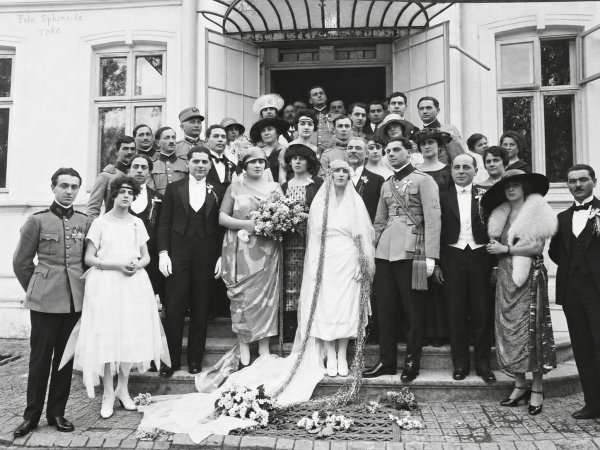
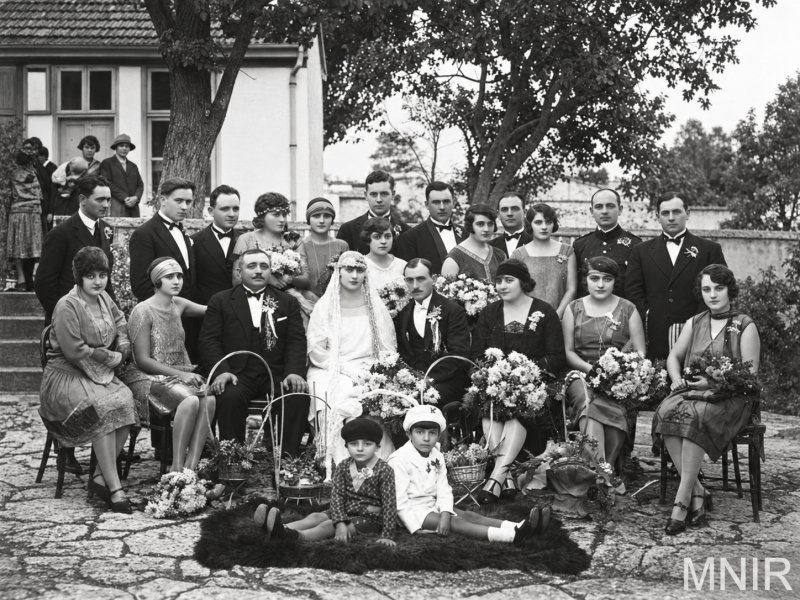
Interwar fashion radically changed the female silhouette. The 1920s brought straighter cuts and short hair, while the following decade reintroduced the contours of the body in a style closer to Hollywood elegance. Wedding photographs from the period frequently show long dresses, expansive veils, and generous bouquets.
Under the older rules of Bucharest urban etiquette, the bride wore white, with a veil and floral wreath, while groomsmen could appear in tailcoats and white gloves. The Bucharest Municipality Museum documents such prescriptions through etiquette manuals that helped shape modern high-society ceremonial behavior. The interwar period inherited some of this grammar and filtered it through the fashions of the new age.
Wedding Photography Had Become a Small Social Declaration
 / Image restored using artificial intelligence, preserving the original details.
The surviving photographs complete the picture beautifully. The Museum of the History of the Jews in Romania, for example, preserves an image of Irena (Nina) and Marcel Froimescu, photographed as newlyweds in Bucharest in 1936. Family collections reveal the same concern with clothing, posture, and the solemnity of the portrait.
The serious expressions seen in these photographs are partly explained by the fact that having one’s picture taken was still a formal occasion, and the resulting photograph was expected to remain in the family for decades. The broad smile, two fingers raised in the air, and a glass of prosecco in the frame still had several generations to wait.
The interwar years also coincided with the spectacular development of illustrated photography in Romania. Iosif Berman, one of the great photographers of the period, documented life in the capital from official ceremonies to its peripheral neighborhoods.
An extraordinary series preserved in the Archive of the National Museum of the Romanian Peasant comes from a Roma wedding held in 1927–1928 in the Valea Plângerii area, on the southern outskirts of Bucharest. Berman photographed the bride being prepared outdoors, surrounded by relatives and a taraf of lăutari musicians. The photographs accompanied a report published in Realitatea Ilustrată in October 1928. The site lay near the Cocioc marsh and Bellu Cemetery; several decades later, the area would become part of Tineretului Park.
Berman’s series provides a useful antidote to the mythology of “Little Paris.” Interwar Bucharest contained luxury and poverty at surprisingly short distances from one another. In one part of the city there was Parisian fashion and elegant reception rooms; only a few neighborhoods away, the ceremony took place under the open sky, with clothes prepared by the family and music played by lăutari.
Photography therefore became a social document. The bride from a wealthy family entered a studio and posed in front of a carefully constructed backdrop, while the bride from the outskirts might find herself in the lens of a photojournalist. Almost a century later, both images tell the story of the same city.
The Civil Registry Already Operated at the Pace of a Modern Institution
An interwar Bucharest marriage involved a relationship between the civil act, the religious ceremony, and the social celebration. The press in 1936 described the constant flow of couples appearing before the civil registrar, while municipal statistics show a city in which the number of marriages had increased sharply from the 1920s onward.
The religious ceremony continued to provide the theatrical element, in the best sense of the word. The candles, the godparents, the wedding crowns, and the moment when the bride and groom walked around the ceremonial table formed a structure immediately recognizable to participants. The popular expression “Isaia dănțuiește” — “Isaiah dances” — even appears in the ironic statistics of a 1934 article discussing Bucharest residents who had reached their third marriage.
Within the capital’s Jewish communities, the ceremony followed its own religious and family rules. Interwar Bucharest had a significant Jewish population and a highly active community life, and archives preserve family and institutional photographs from that world. The Jewish Public Library Archives preserves an album containing 57 photographs documenting Jewish life in Bucharest around 1938, while Romanian museum collections retain engagement and wedding portraits.
The expression “a Bucharest wedding,” therefore, covered several traditions. Orthodox Christians, Catholics, Jews, and the city’s other communities entered marriage through different ceremonies, but the family photograph and the festive meal had become almost universal urban languages.
Where the Celebration Took Place
For prosperous families, a restaurant or hotel reception room was a natural solution. Bucharest already possessed a sophisticated hospitality infrastructure, and major hotels regularly hosted dinners, balls, and receptions.
Athénée Palace had opened in 1914 and became one of the landmark addresses of central Bucharest during the interwar period. Today, the hotel lays claim to a tradition of more than a century in hosting events and ceremonies, and its historic reception rooms have continued to serve this purpose.
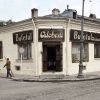
Caru' cu Bere, which moved into its current building on Stavropoleos Street at the end of the nineteenth century, represented another type of urban space: large, spectacular, with both a restaurant and wine cellar, and associated throughout its history with private celebrations and family events.
Documents preserved from restaurants tell us far more about the life of the establishments themselves than about the identity of every couple who held their wedding meal there, so a rigid list of “the most popular wedding restaurants in 1934” would go beyond the available evidence. What can be stated with confidence is the broader context: Bucharest in the 1930s had a highly developed restaurant culture.
One delightful example, even if it belongs to everyday and high-society life more broadly, is the Bufetul Automat on Calea Victoriei, which opened in 1930. The press described a world of sandwiches and șpriț bought with tokens, inside an interior later modernized in the Art Deco style. A city that was already buying its aperitifs from a vending-style buffet clearly understood what it meant to go out on the town.
There Was Music at the Wedding, and the Lăutar Remained a Central Character
Music could mean a salon orchestra in elegant circles or a taraf of lăutari at more popular celebrations. Interwar Bucharest was living through an extraordinary period of urban musical life.
Grigoraș Dinicu was one of the great stars of the period. In 1935, his taraf received a prize of 5,000 lei at a competition for urban lăutari ensembles, an event recorded by the press of the time. The world of popular music also produced wedding songs collected during those years by researchers such as Harry Brauner; one of them entered Maria Tănase’s repertoire in 1937.
In the photographs Berman took at the Roma wedding in Valea Plângerii, the taraf appears right beside the family. Music was part of the ceremony, and the proximity between musicians and guests reveals a highly participatory celebration, with dancing at the center of the evening.
Jazz completed the picture in fashionable circles. Bucharest in the 1920s and 1930s consumed fox-trot, tango, and cabaret music, while Western dances entered the urban repertoire. Depending on the family and the venue, the same social gathering might bring together waltzes and tangos alongside lăutari music, because Bucharest residents have always had a remarkable ability to turn a foreign influence into a local affair.
Godparents, Gifts, and the Dowry Carried Real Weight
Behind the elegance of the photograph lay the economic side of marriage. The dowry had a long history in Romanian society, and the Bucharest Municipality Museum preserves objects and documentation concerning dowry chests and their role in wedding ceremonies. Textiles formed an important part of the property brought into the marriage by the young wife.
For earlier periods in Bucharest, historical sources record gifts of money, jewelry, and textiles offered to the newlyweds, with a particularly important role played by the godparents. Museum literature devoted to Bucharest wedding ceremonies shows that jewelry, valuable fabrics, and money held a substantial place among matrimonial gifts.
The interwar period inherited this system and adapted it to an increasingly urbanized society. A gift could serve either a practical or sentimental purpose. A text published in the press in 1935 even tells the story of an object received by a couple from a grandmother and preserved as a wedding gift with the value of a family talisman — a beautiful example of how objects passed from one generation to another.
Godparents retained their ceremonial prestige, while the relationship between family, property, and marriage remained strong. For many families, a wedding represented the public presentation of a new alliance, and in a city deeply invested in reputation, such matters carried considerable weight.
The Bride Stepped Out of One Photograph, and Bucharest Entered Another
Perhaps the most interesting image of the interwar wedding emerges precisely from its contrasts. In a studio in the city center, two young people stood motionless beneath the photographer’s lights, dressed according to European fashion. On the southern outskirts, Iosif Berman photographed a bride being prepared outdoors, surrounded by relatives and lăutari musicians. Between those two frames stood the whole of Bucharest.
The city was modernizing the ritual, while the ritual kept the city connected to earlier generations. The dress became Western, photography became almost obligatory for those who could afford it, restaurants gained ground, and the press began turning marriage into a subject of statistics, fashion, and social gossip.
The figures tell the story: approximately 4,000 marriages in 1924–1925, followed by steadily rising numbers; thousands of brides aged between 20 and 30; hundreds of women entering a second marriage. Interwar Bucharest regarded marriage with solemnity and, at the same time, with an increasingly urban realism.
Then the wedding album went into a drawer. A long dress, a veil, a gentleman in an extremely serious suit, and a group of relatives lined up with the precision of a board of directors. Beyond the photographic paper, however, stood a living, unequal, cosmopolitan city caught between old ceremonial traditions and new social freedoms. That is precisely where the real interwar Bucharest begins.
You may also like: What the neighborhoods of interwar Bucharest looked like and what the social differences between them were