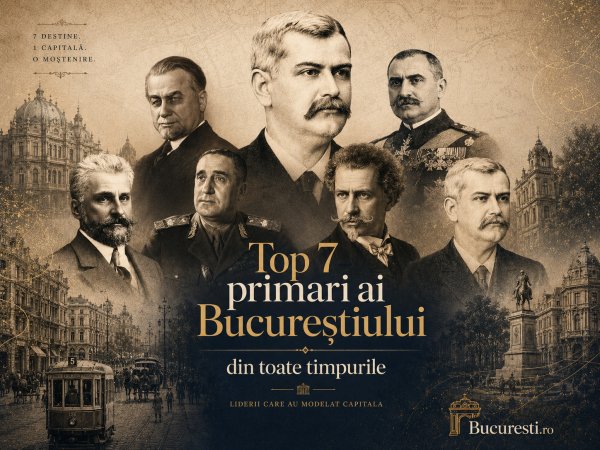
Top 7 Greatest Mayors in Bucharest’s History
By Eddie Țone
- Articles
- 02 JUL 26
Bucharest has always been an urban experiment governed by chance and driven by Balkan passions. Anyone walking today along its crowded boulevards, past eclectic buildings, communist apartment blocks and glass insertions, might get the impression that the city was born from a series of fortunate coincidences or simple electoral stubbornness. Yet the history of the Romanian capital shows that, from time to time, people with a clear vision reached the helm of this settlement filled with dust and ambition—people capable of turning muddy lanes into arteries worthy of European maps.
The transformation from a patriarchal market town, dominated by boyars and Oriental rhythms, into a metropolis in constant motion required monumental efforts, epic budgets and, quite often, courage bordering on madness. Among the dozens of figures who occupied the mayor’s chair, several names left deep marks, still visible today in the city’s street geometry and in the everyday habits of Bucharest residents.
The city’s present-day map bears the direct imprint of administrators who understood that a capital requires sewage systems, light, public transport and parks, beyond political speeches delivered in cafés. Looking back at the city’s most effective mayors offers a fascinating perspective on how Bucharest’s urban identity was built.
However, we have not included the mayors who served after 1989, as they were far too politically beholden and shadowed by various scandals still fresh in the memory of Bucharest’s residents. Nor have I included the communist-era mayors, of whom it cannot be said that they made major decisions on their own initiative, since Bucharest’s urban development was dictated from “the centre.”
1. Pache Protopopescu and the bold leap toward Western standards (1888–1891)
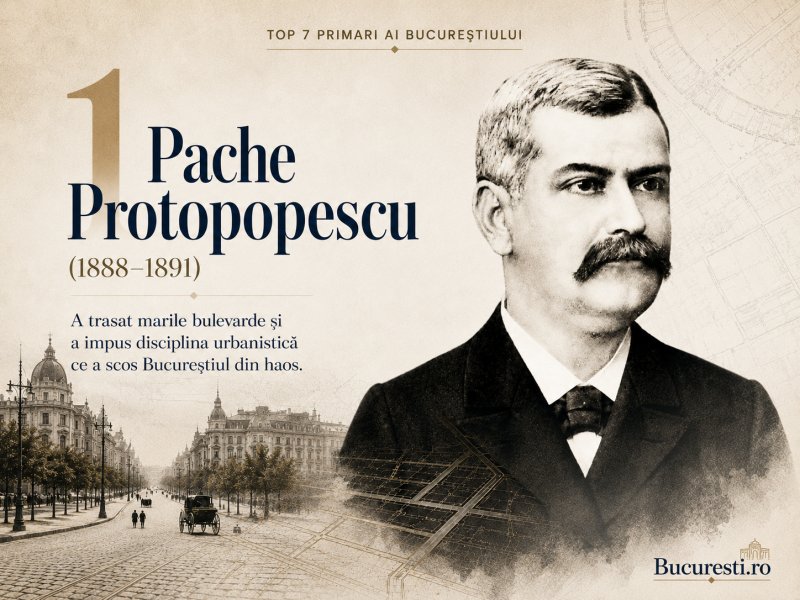
Emanoil Pache Protopopescu comfortably occupies the leading position in this municipal chronicle, having given the city a clear urban direction during a term of only three years. Often regarded as the model mayor, the foreign-educated lawyer arrived at City Hall with boundless energy, determined to give Bucharest proper alignments, straighter streets and a level of construction discipline the city had previously avoided with remarkable talent.
At the time, Bucharest was still a maze of winding side streets, where houses appeared according to the logic of individual owners rather than that of the city itself. Pache Protopopescu’s term is linked to the development of major traffic arteries, including the boulevard that now bears his name, as well as to works that strengthened the east–west route through the capital.
It was not a discreet operation. Expropriations, street alignments and demolitions brutally reshaped the fabric of the old city. Teams of workers, carts and the machinery of the period cut a more orderly line through the suburbs, and Bucharest began to take on the appearance of a city that wanted to be taken seriously by Europe.
Pache Protopopescu supported street paving, the expansion of urban infrastructure and firmer enforcement of building regulations. During his administration, investments in schools, public services and the modernization of the central area also continued. Not every transformation began or ended during his three-year term, but few mayors have remained so closely associated with the idea of a Bucharest governed by urban discipline.
2. Dem I. Dobrescu and the radical energy of the “Pickaxe Mayor” (1929–1934)
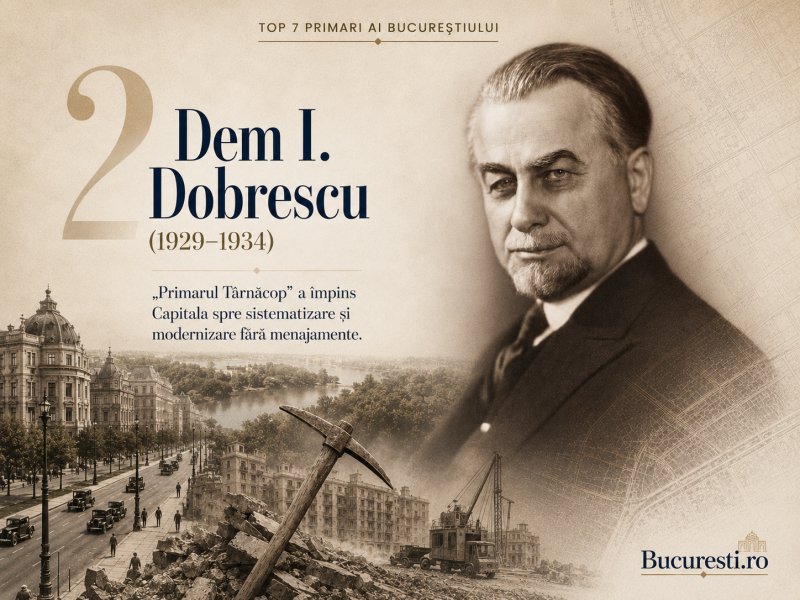
Second place rightfully belongs to the most volcanic personality of the interwar era: the idealistic and courageous lawyer remembered by the striking nickname “the Pickaxe Mayor.” Dem I. Dobrescu understood that the city could no longer grow chaotically and that the structure of a former medieval market town had to be broken apart by force to make room for a modern metropolis, adapted to the rise of the automobile and the dynamism of the twentieth century.
Dobrescu embraced conflict with enthusiasm and launched an energetic campaign against illegal construction, kiosks choking the pavements and areas considered unsanitary. His term coincided with an intense phase of urban restructuring, during which Bucharest tried to widen its arteries and improve hygiene on its outskirts without entirely losing control of its own margins.
One of the great themes of the period was the development of the lakes in the northern part of the capital. Herăstrău, Floreasca and Băneasa gradually moved from being seen as wetland and peripheral areas to becoming part of a modern leisure and urban-planning system. Dem I. Dobrescu did not carry out this transformation alone, but his administration was one of those that pushed the city decisively in that direction.
He supported street modernization works, interventions in central areas and social projects aimed at the very poor. The nickname “the Pickaxe Mayor” came not only from the era’s taste for strong images, but from the way Dobrescu entered municipal conflicts directly, preferring the construction site, the illegal fence and the blocked pavement to polite phrases spoken in council meetings.
3. Nicolae Filipescu and the city entering the electric age (1893–1895 and 1899)
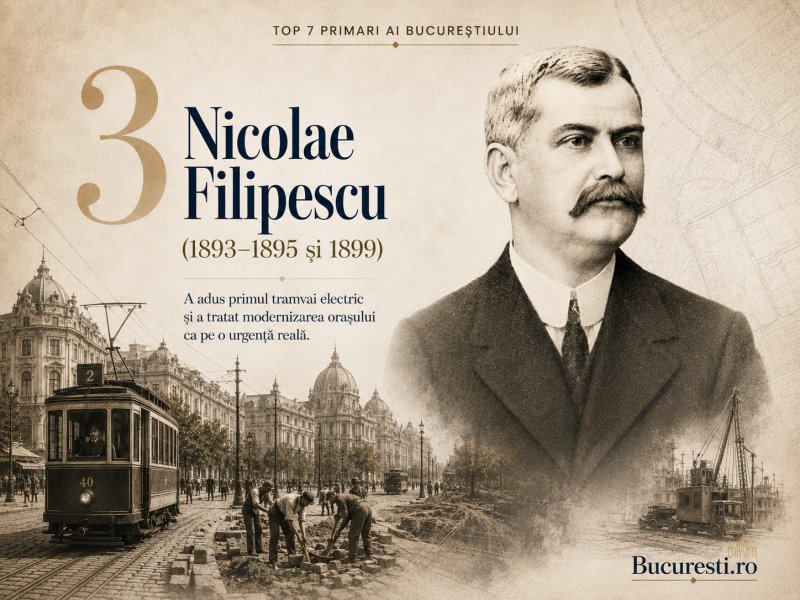
Nicolae Filipescu became mayor of Bucharest in February 1893, at the age of only thirty, in a city desperate to look modern but still tripping over mud, debt and its own inadequate infrastructure. He was young, conservative, combative and ambitious enough to treat City Hall not as a temporary office, but as a platform from which he could push Bucharest forward.
His term, which ended in 1895, was short but dense. He inherited an administration burdened by debts and projects begun without secure financing. He insisted on strengthening municipal revenues and using loans for visible projects: paving, sewerage, sanitation, markets and water supply. Not all his plans reached completion, and the drinking-water problem remained one of the capital’s great weaknesses. Yet Filipescu deserves credit for treating it as a public emergency rather than an unavoidable inconvenience of life in Bucharest.
During his term, on 9 December 1894, Bucharest’s first electric tram entered service on the line between Obor and Cotroceni. For a city accustomed to horse-drawn trams, the arrival of the electric carriage carried the weight of an official announcement: Bucharest had finally entered the age of speed and electricity.
Filipescu also supported paving works on dozens of streets, the development of drainage channels and improvements to sanitation services. In 1894, he presented the plan for Traian Market Hall and proposed Colței Boulevard, a north–south artery intended to absorb part of the pressure already placed on Calea Victoriei. The idea was far from modest: Bucharest was beginning to understand that it could not depend indefinitely on a single elegant street, clogged by carriages, commerce and social ambitions.
Nicolae Filipescu was neither a quiet mayor nor a decorative one. He was among the people who viewed the city as a technical, financial and political problem at the same time. He left behind not only projects, but also the clear sign of an administration that had begun to believe Bucharest could function through something other than improvisation.
4. Vintilă Brătianu and the financial architecture of modernization (1907–1910)
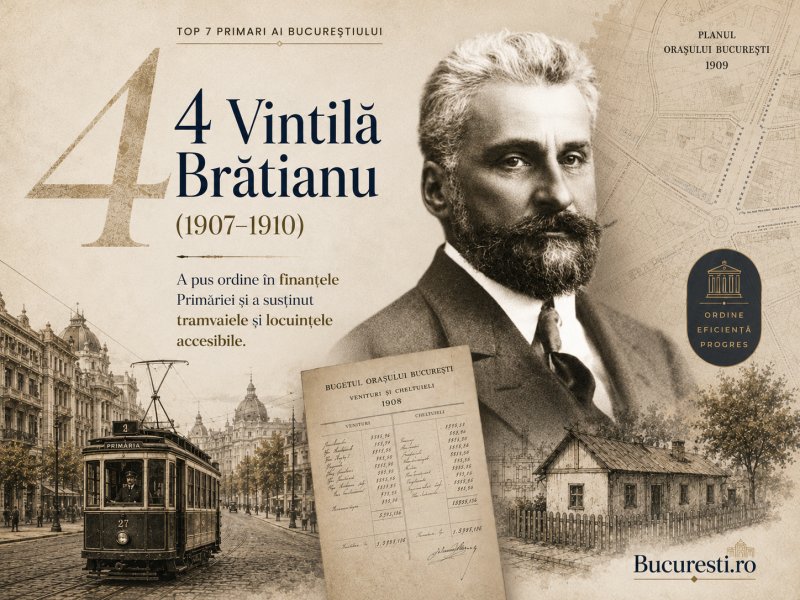
A member of one of the great political families of modern Romania, Vintilă Brătianu ranks fourth thanks to his economist’s mind and a vision that went beyond the small interests of the moment. Before his arrival, City Hall often struggled with deficits, loans and urgent expenses. Brătianu tried to turn the administration into a more coherent mechanism, capable of supporting major projects without collapsing at the first bill.
During his administration, important initiatives were developed for public transport and affordable housing. In 1909, the Municipal Company for the Construction and Operation of Trams in Bucharest was established, one of the institutions that laid the foundations for the later development of municipal public transport.
Another major direction was the construction of affordable housing for workers and civil servants. The subdivisions and modest garden houses developed in several parts of the city represented a serious attempt to provide an alternative to cramped and insecure living conditions in the suburbs.
Vintilă Brătianu also supported the modernization of municipal services, from the slaughterhouse to gas-lighting networks. His administrative style was sober, technical and entirely lacking in any taste for spectacle: exactly the sort of man who would have considered an inauguration with a brass band less useful than a pipe that actually worked.
5. General Victor Dombrovski and the city between war and reconstruction (1938–1940 and 1944–1948)
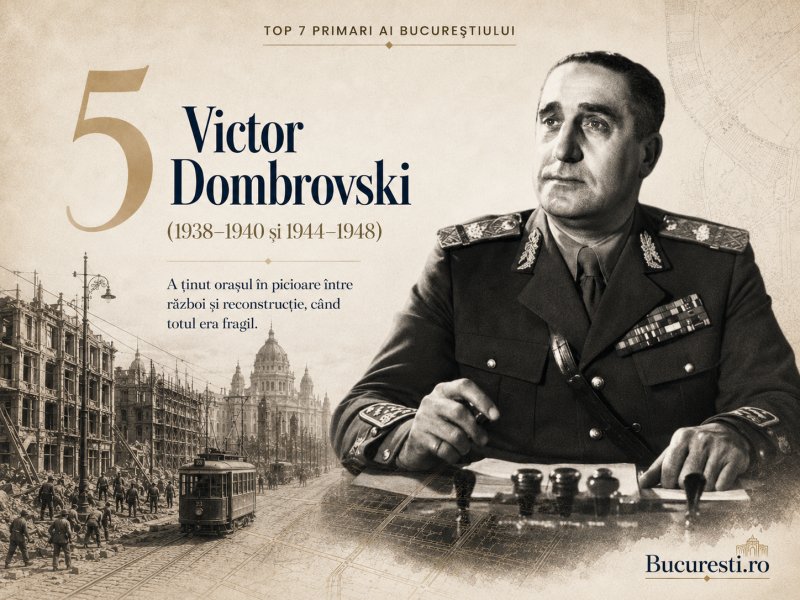
Fifth place belongs to the military administrator who had to manage a capital caught between war, political crises and the beginning of a difficult reconstruction. General Victor Dombrovski served as mayor during two challenging terms, the first before the war and the second after 23 August 1944.
In the first period, Bucharest was still in the midst of interwar urban restructuring. Major projects begun earlier continued, while the city reorganized its northern districts, arteries and infrastructure against the backdrop of rapid population growth. The development of Herăstrău and the northern area were long-term processes, involving contributions from several administrations, but Dombrovski’s mandate clearly belongs to this phase of transformation.
After returning to City Hall in 1944, Dombrovski had to govern a Bucharest struck by war and brutal political changes. Water and electricity networks, transport, hospitals and the city’s supply system became matters of administrative survival rather than simple meeting-room topics.
There was no need for theatrical gestures to make the situation appear dramatic. The capital had damaged buildings, affected districts, overstretched institutions and a future nobody could clearly predict. Dombrovski remained one of the administrative figures associated with continuity in a city trying to function while history was pulling the floor out from beneath its feet.
6. George Manu and the great escape from the mud of old Bucharest (1873–1877)
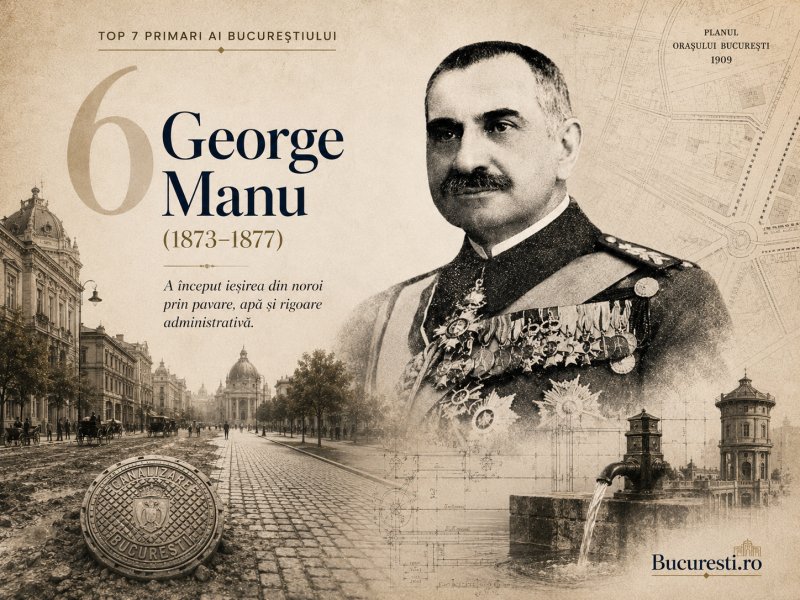
The penultimate place in this ranking goes to a pioneer, the man who took over City Hall shortly before the War of Independence. General George Manu brought to the administration a military rigor the city had chronically lacked.
Bucharest in the 1870s was still struggling with old wooden bridges, mud, streets difficult to maintain and an infrastructure that seemed designed to survive only until the first serious rain. During Manu’s term, paving and asphalt works were carried out on several important arteries, part of a broader process through which the city gradually began to abandon the improvisations of the old market town.
Manu also understood the importance of water supply. He did not solve by himself the problem of a capital still dependent on water carriers, wells and inadequate solutions, but his administration belongs to the period when water supply and urban hygiene became central issues of local government.
The city’s memory retained him as a severe leader, with military instincts and little patience for poorly executed work. Perhaps the stories of dawn inspections and scolded contractors grew, like all administrative legends, from one generation to the next. Yet the core idea remains: George Manu led Bucharest at a moment when the city was beginning to understand that modernization was not achieved merely through plans, but through stone, water, workers and bills paid on time.
7. Barbu Ștefănescu Delavrancea and the city that wanted to modernize (1899–1901)
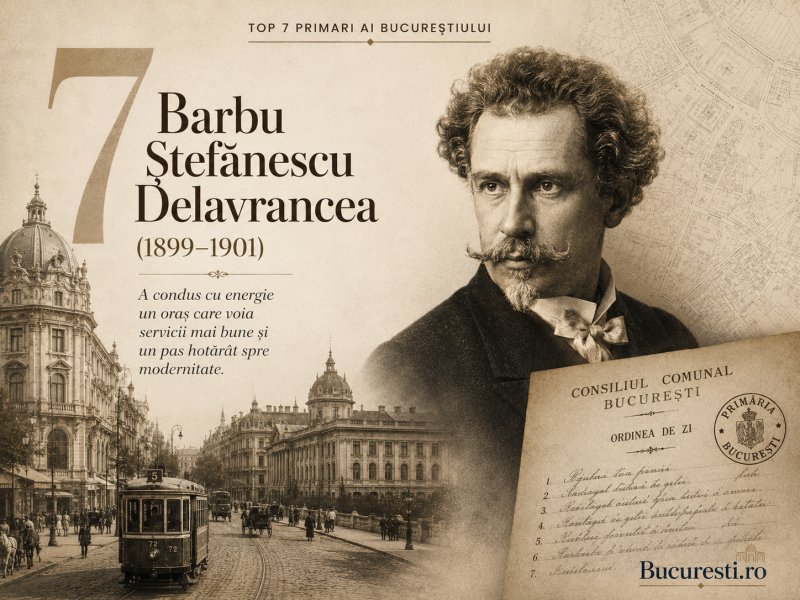
The ranking concludes with the celebrated writer, lawyer and orator, whose appointment at the head of such a complicated community inevitably raised questions. Barbu Ștefănescu Delavrancea nevertheless demonstrated administrative energy and rhetoric powerful enough to turn every council meeting into a mix of politics, theatre and verbal duelling.
It must be stated clearly: Bucharest’s first electric tram, the famous Line 14 between Obor and Cotroceni, entered service in 1894, before Delavrancea became mayor. He cannot be credited with introducing this technological leap, although his term took place during a period when electric transport was beginning to radically change the city’s rhythm.
His administration had to manage the classic problems of Bucharest at the beginning of the twentieth century: hygiene, supply, taxes, municipal services and the constantly tense relationship between citizen, merchant and civil servant. Delavrancea was not the kind of mayor who went unnoticed. He had the talent to turn an administrative problem into a public cause and a budget dispute into a scene filled with memorable lines.
Today’s Bucharest, with its virtues and flaws, was built on the determination of leaders who understood that effective administration leaves behind better streets, safer water, functioning transport and public spaces people can actually use. Everything else, including political glory, usually evaporates faster than a pothole hastily covered before an election.
You may also like: Pache Protopopescu, the mayor who had the courage to reshape Bucharest