The Merchants of Old Bucharest, the City Where Streets Were Named After Their Wares
By Eddie Țone
- Articles
- 12 AUG 26
In days gone by, you could read old Bucharest through its shop signs, its smells and, above all, the names of its streets. One lane advertised beads, another saddles, another furs, while Lipscani promised goods arriving from Central Europe. Trade drew its own map, with a clarity that contemporary urban planning might regard with a touch of envy. When you entered the aba-cloth merchants’ quarter, you knew what kind of fabric you would find; when you reached the grocers, the spices made the introductions.
For centuries, merchants shaped Bucharest: they gave streets their names, built churches, financed inns and turned the centre around the Princely Court into a bustling commercial organism. The documents collected and discussed by Constantin C. Giurescu in Istoria Bucureștilor (The History of Bucharest) preserve a very tangible world of rents, debts, advertisements, tax privileges and quarrels between established traders and competitors arriving with their goods piled into carts. In other words, a fully fledged urban economy—except that the accounts were written with a quill and customer reviews circulated at the coffeehouse.
The City’s Earliest Known Businesses
The earliest documentary references to Bucharest merchants date back to the fifteenth century. On 14 June 1476, Laiotă Basarab wrote to the people of Brașov on behalf of two men from Cetatea Nouă—the name then used for Bucharest—whose goods had been seized. The voivode demanded that the merchandise be returned and threatened to exact double compensation from the Brașov merchants. Commercial diplomacy, as we can see, came with brief courtesies and highly persuasive accounting.
In another letter, dated by historians to sometime between 1474 and 1476, the same ruler announced that a Turkish merchant had arrived in Bucharest with “good and plentiful merchandise.” Buyers from beyond the mountains could send their people to bargain directly in the citadel. The episode reveals a Bucharest connected early on to trade routes crossing the Carpathians and descending towards the Ottoman world.
Slavonic documents called merchants cupeți, a term related to the Slavic verb kupiti, meaning “to buy.” The word also appeared in Romanian documents from the seventeenth and eighteenth centuries, while its linguistic relative, precupeț, survived for far longer. The term neguțător, inherited through the Romance linguistic line and later simplified to negustor, also appears in Bucharest records. A document dated 2 January 1664 even speaks in the name of the “neguțători” who were to sign a deed concerning a shop.
One Trade, One Type of Merchandise, One Street
A Bucharest merchant carried his specialisation in his name. The băcan sold food and spices, the mărgelar offered beads, ornaments and clothing accessories, the mătăsar dealt in fine fabrics, while the sticlar sold window glass and vessels. Other names indicated where the goods came from. The brașoveni brought merchandise from Brașov, the udricani from Adrianople, the lipscani from Leipzig and the gabroveni from Gabrovo.
This organisation by specialisation was directly visible in the city. Ulița cea Mare, the “Great Street,” contained rows of abagii, mărgelari and șălari—dealers in coarse woollen cloth, beads and saddles—with each group occupying an identifiable section. A document from 1710 mentions a shop “on the Great Street, among the bead merchants,” while other records refer to the rows of the cloth merchants and saddle-makers. The streets operated like search filters built out of wood, stone and a great deal of mud.
Traces of this occupational geography can still be read today in street names such as Lipscani, Gabroveni, Șelari and Blănari. Behind them lay a practical rule of the medieval and early modern city: related trades occupied the same area. Customers found their goods more easily, merchants kept an eye on the competition, and the guild defended its standards and privileges.
Grocers’ Shops, a Paradise of Expensive Temptations
Grocers appeared early in the life of Bucharest. The Romanian word băcan comes from the Turkish bakkal, itself of Arabic origin, and referred to a merchant selling foodstuffs. Alongside local products, grocery shops offered lemons, pomegranates, figs, olives, oil and Eastern spices. Their shelves might also hold dyes, including the red dyewood known as băcan, used for colouring eggs, as well as saffron for yellow.
Documents mention a certain “Gheorghe the grocer” in 1636 and a grocery shop sold by “Iane the grocer” in 1693, together with a small house across the bridge, near the bathhouse. During the reign of Constantin Brâncoveanu, Rizea appears as vătaf, or head, of the grocers—a sign of a guild important enough to have its own leadership.
An advertisement published in Vestitorul românesc on 30 January 1857 offers one of the most delightful glimpses into the tastes of Bucharest’s elite. The Martinovici and Asan grocery shop, located on Lipscani at the Golden Cross, advertised tea, coffee, cocoa, Verona salami, Emmental and Parmesan cheeses, truffles, anchovies, Italian macaroni, Bordeaux and Champagne wines, liqueurs, dental-care products and hair pomades.
The shop combined delicacies, cosmetics and household goods with all the self-assurance of a small shopping centre avant la lettre. The list speaks volumes about the cosmopolitan tastes of its customers—and the distance between the ordinary city dweller’s table and the menu of the well-heeled boyar class.
Bead Merchants, Silk Merchants and a Church Built with a Commercial Fortune
The mărgelari sold beads, ornaments and finery—the fashion sector of their day. One of the best known was Costandin, the son of Maxim the cupeț, himself also a bead merchant. Costandin’s will, dated 6 February 1735, stipulated that a substantial part of his estate—consisting of houses, cellars and shops—be sold and that the proceeds finance the construction of a stone church in Bucharest. His executors carried out his wish, and the result was the Old Church of Saint Eleutherius, one of the notable places of worship of the eighteenth century.
Silk merchants, in turn, maintained a solid presence. A deed from 1631 or 1632, dated according to the Byzantine calendar, lists among its witnesses Costandin, Enache and Necula the silk merchant. The silk trade was also linked to the production of borangic, raw silk fabric, practised during the eighteenth century in the Mătăsari and Popa Nan neighbourhoods. The privilege granted to the dyers’ guild in 1824 mentions Armenian silk merchants separately, indicating the ethnic and professional diversity of commerce in Bucharest.
The abagii, astaragii and bogasieri also belonged to the textile trade. The abagii sold aba, a thick woollen cloth; the astaragii traded in fabric used for linings; and the bogasieri offered starched and polished cotton cloth, along with other textiles.
In September 1820, the 48 bogasieri grouped into 24 fiscal units paid 720 thalers, a sum higher than the contributions of the grocers and general merchants. The figures reveal the economic weight of cloth in a city where clothing announced a person’s rank before its wearer had spoken.
The Lipscani Merchants and the Route of Goods from Leipzig
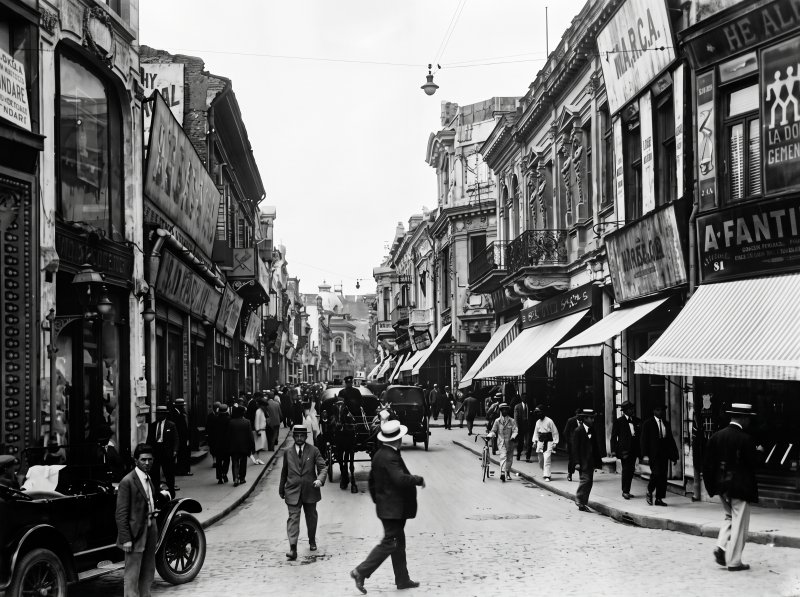 Lipscani Street, in 1930 / Image restored using artificial intelligence, preserving the original details.
Lipsca was the Romanian name for Leipzig, one of Central Europe’s major commercial centres. Bucharest merchants began travelling directly to its fairs, shortening the chain of Saxon intermediaries. Anton Maria Del Chiaro, secretary at the courts of Constantin Brâncoveanu and Ștefan Cantacuzino, mentioned merchants who returned twice a year carrying Bohemian crystal and other goods. A document dated 16 August 1726 records eight wagons loaded at Leipzig’s spring fair.
The Lipscani merchants gave their name to the city’s principal commercial street in the eighteenth century. They had an odaie—a room or chamber—on land belonging to the Princely Church, probably serving as a guild headquarters or warehouse, and their company received privileges confirmed in 1824 by Grigore Ghica. Its members imported goods from Leipzig and other European regions, paid the treasury 45 thalers each per year and were represented by four elected epitropi, or trustees.
The street’s prestige grew along with its shops. In 1855, Austrian captain Ștefan Dietrich described Lipscani as the most beautiful and cheerful street in Bucharest, with shops comparable in richness and splendour to those of Vienna. The comparison came from a Viennese, a detail that lends it weight—and a pleasant hint of local pride.
Meanwhile, the gabroveni brought thick, durable woollen cloth from Gabrovo, a Balkan town known for its textile manufactures. Their shops lined what is now Gabroveni Street, next to Lipscani and pressed against the old enclosure of the Princely Court. By the end of the eighteenth century, the street had become one of the busiest commercial thoroughfares in the city centre.
The Wooden Shop, the Stone Cellar and the Fear of Fire
Bucharest’s earliest shops were built largely of wood. Records frequently refer to the “timbers” of a shop, elements that could have a different owner from the land itself. In 1719, for example, the sale of a shop plot excluded the structure erected on it because the building material had been paid for by the buyer. With surprising precision, the local property market separated the land from the building.
Market stalls were smaller and carried lower rents, while Târgul Dinlăuntru—the Inner Market—also contained structures called samari or cesimale, though the differences between them remain difficult to establish. A typical shop had a street frontage of about three metres. Space was tight, goods had to be displayed intelligently, and the merchant next door could hear every negotiation.
Masonry cellars were often worth more than the small shops perched above them, especially when they stored wine. A deed from 1655 describes a property as “a cellar with five shops, on the Great Street,” the order of the words betraying the order of economic priorities.
In the first half of the eighteenth century, masonry structures began to replace wooden shops. After the fire of 1804, regulations issued on 14 September required shops to be built of masonry, a measure intended to limit the spread of fire. In a dense city built of wood and lit by flame, fire acted as a brutal urban planner, completing its projects in a single night.
Guilds, Taxes and the Aristocracy of the Twenty-Four
Merchants organised themselves into guilds or “companies,” received charters, paid taxes and defended their rights. Some groups had a staroste, vătaf or epitropi—guild heads, overseers or trustees—while others negotiated a lump-sum levy, known as a ruptoare, directly with the treasury. The system blended professional autonomy with the ruling authority’s fiscal vigilance, a remarkably durable combination in the history of administration.
In the second half of the eighteenth century, 24 leading native merchants formed the commercial elite of the capital. Constantin Ypsilantis’s charter of 1 June 1803 presented them as an old company of the princely seat. They participated in legal proceedings, account settlements and auctions concerning public affairs, enjoyed tax exemptions, and could pass their position on to their heirs. Trade had thus come to confer hereditary status: an aristocracy complete with shop, cellar and treasury ledger.
Rents confirm the value of a prime commercial location. In 1793, Bănică the bead merchant paid 125 thalers a year for a shop in the Inner Market. In 1791, two passementerie shops and a warehouse behind them cost 300 thalers a year. Following the Treaty of Adrianople in 1829, which expanded freedom of trade on the Danube and the Black Sea, business and rents rose sharply.
Water Carriers, Itinerant Vendors and Commerce That Came to Your Door
Some of the city’s trade moved through the streets. The apari, or sacagii, delivered water in barrels mounted on two-wheeled carts, collecting it from the Filaret and Mărcuța springs as well as from fords along the Dâmbovița. A document from 1664 mentions “Neagul the water carrier,” while the tariff of 1802 set the price at four paras for a barrel of water in the city centre administered by the Agie and five paras in Dealul Spirii. The price difference turned the slope itself into an economic unit.
Towards the end of the eighteenth century, marchitani appeared: itinerant merchants who carried their goods in carts and sometimes accompanied armies. In 1812, shopkeepers complained that these vendors displayed their wares directly outside established shops and left their horses in people’s gardens. The Divan ordered them to move into inns or rented premises. The dispute bears a striking resemblance to conflicts between traditional commerce and mobile platforms, except that the competition’s vehicle ate oats.
The boccegii carried textiles, handkerchiefs, ornaments and trinkets on their backs. The best known among them was Cilibi Moise, who was born in Focșani in 1812 and died in Bucharest in 1870—an itinerant merchant, humourist and author of parables and aphorisms. He dictated his writings, and his little books circulated alongside the merchandise in his bundle. An edition of his works, now held by the Central University Library of Iași, shows how naturally street commerce and popular literature once met.
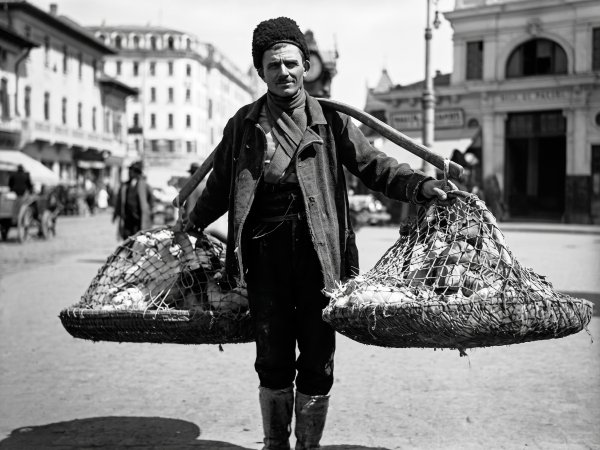
The city was also familiar with Oltenian vendors carrying goods in shoulder yokes, sellers of bragă and salep, carpet merchants and buyers of old clothes. Constantin C. Giurescu captures this bustle as a tapestry of sound stretching from morning until evening, with every type of merchandise having its own cry. Commercial Bucharest lived at pavement level, in a continuous negotiation between need, desire, price and reputation.
The City Preserves the Merchants’ Memory in Its Very Layout
The merchants of old Bucharest left behind a map, several churches, fragments of cellars and an entire vocabulary. Lipscani recalls the road to Leipzig, Gabroveni preserves the connection with Balkan manufactures, while Șelari and Blănari continue to point to trades that organised the city centre for generations.
The documents also reveal the people themselves, with their ambitions, fortunes, disputes and highly specific tastes. Costandin the bead merchant transformed his estate into a church. Grocers in 1857 promised truffles, Champagne and toothpaste. The Lipscani merchants elected their trustees and compared their shops with Vienna’s. The marchitani parked their carts in front of the competition, much to the exasperation of established shopkeepers. Beneath caftans, anterie robes and hats, commercial behaviour remained astonishingly familiar.
Old Bucharest bought its water, ordered its silk, chose its beads and bargained over its wine in cellars. The city was fashioned out of such everyday transactions, perhaps to an even greater extent than out of grand princely ceremonies. The ceremony passed down the street; the merchant was still there the next day, raising the shutter and opening his shop.
You may also like: Charming Negustori Street, where Bucharest still does business with the past