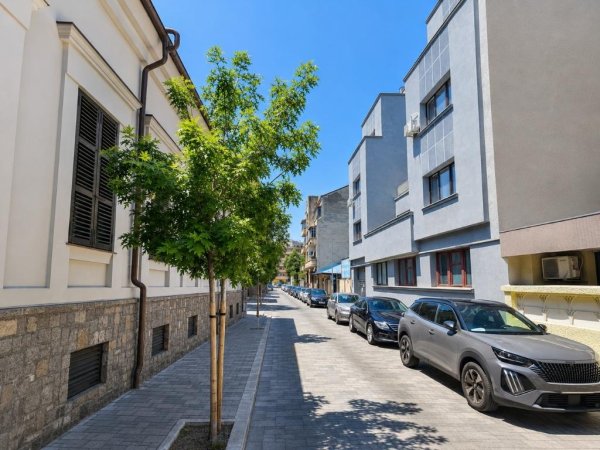
Charming Negustori Street, where Bucharest still does business with the past
By Eddie Țone
- Articles
- 01 JUL 26
Without a doubt, Bucharest has a few streets that should be explored on foot, with your phone in your pocket and your eyes raised toward the façades. Charming Negustori Street belongs in that category. It lies between Hristo Botev Boulevard and the Calea Moșilor area, in an old, dense and mildly stubborn part of Bucharest, where a stuccoed house may stand just steps away from an interwar apartment block, an ivy-covered courtyard and a gate that seems to have witnessed three political regimes, two major earthquakes and a Balkan inheritance dispute.
In practical terms, Negustori Street runs through a corner of Bucharest where neighbourhood boundaries behave with more elegance than maps do. Toward the Armenian Quarter begins the world of houses built by families who arrived from the Caucasus with trade, money and a certain fondness for serious-looking façades. Toward the former Jewish Quarter, traces remain of merchants, workshops and a bourgeoisie that knew how to turn a dusty address into a respectable one. Negustori Street stayed precisely between the two neighbourhoods, Armenian and Jewish, with the air of a relative who refused to choose sides and ended up, instead, with the best stories.
At first glance, Negustori seems like a quiet street, almost removed from the city’s noise. After a few minutes, however, you begin to feel that the place keeps an entire archive beneath its asphalt. You can sense the old Bucharest of commercial mahallas, of families who prospered through trade, of churches built through donations and of architects who later arrived with the far-from-modest idea that the city deserved modernism, Art Nouveau and villas with period façades as well.
Negustori offers one of the most concentrated lessons in urban history in central Bucharest. You cross several centuries in fifteen minutes, provided you look more carefully than the hurried Bucharest resident usually does on the way to their next coffee.
Where the name Negustori comes from
The name comes from the Negustori mahalla, documented as early as 1669. The area developed near Calea Moșilor, one of the major commercial arteries of old Bucharest, the road linking the Princely Court to the Outer Market, meaning today’s Obor area.
In the Negustori mahalla, or Neguțători as it was originally called, people from various social backgrounds settled, but merchants became the dominant figures of the area. The word “merchant” carried serious weight in old Bucharest. Trade meant connections, roads, goods brought from afar, capital and, sometimes, a two-storey house with tall windows and the ambition to look more Western than the neighbour across the fence.
The businesspeople of the era were often also called cupeți, a term of Slavic origin connected to the idea of buying and trading. Prosperous cupeți built houses, supported churches and purchased land.
Their prosperity can still be seen in the structure of the area, because the street preserves low building fronts and deep courtyards, houses built on narrow plots and an architectural diversity that comes directly from the old model of the Bucharest mahalla. There is none of the monumental regularity of ruler-straight boulevards. Instead, there is an older, more organic order, with small deviations, entrances, courtyards and recessed façades that suggest a city built gradually, through negotiation, inheritance and land divided among relatives.
Negustori Church, the spiritual centre of the mahalla
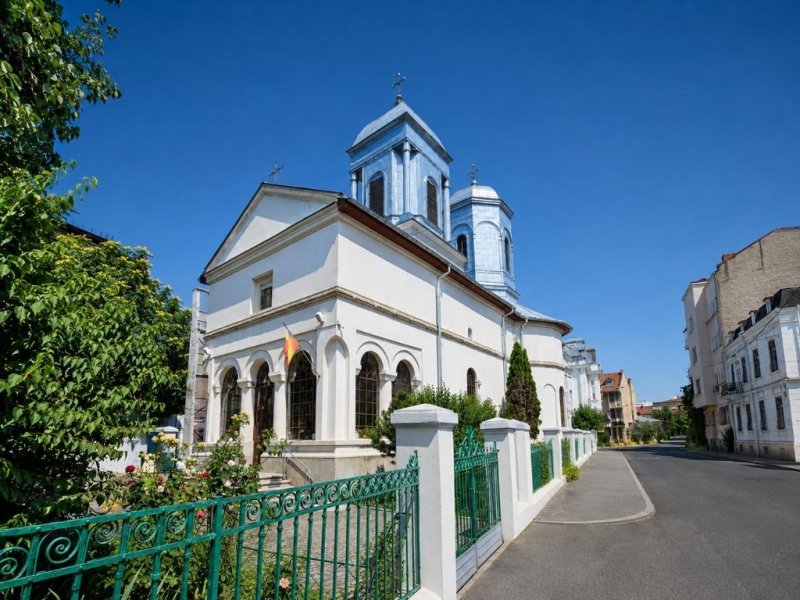
The area’s most important historical landmark remains Saint Nicholas–Negustori Church, now located on Theodor Ștefănescu Street, which runs parallel to Negustori Street. The current brick church was built in 1726 through the contributions of local merchants, on the site of an older wooden church.
The church had been known since the seventeenth century as the “Church of the Merchants,” a logical name in a district where commerce dictated both the economic rhythm and social prestige. Foreign merchants passing through the area stopped here to pray, and over time the church became something of a civic landmark for the mahalla. In old Bucharest, a church served as a community centre, a moral register, a meeting place, a social institution and sometimes even a family archive, as any Bucharest church around which a mahalla developed would do.
Its interior preserves valuable traces of mural painting. Restoration works uncovered paintings attributed to Pârvu Mutu, one of the great painters of the Brâncovenesc period. His work had been covered during the nineteenth century by an intervention carried out by Gheorghe Tattarescu.
The church is also connected to Father Dumitru Stăniloae, one of the major figures of Romanian Orthodox theology in the twentieth century. During the final years of his life, Stăniloae regularly attended services here, preached and remained close to the community. Father Stăniloae Street, nearby, preserves his memory in the geography of the neighbourhood.
Heritage houses on Negustori Street
Negroponte House
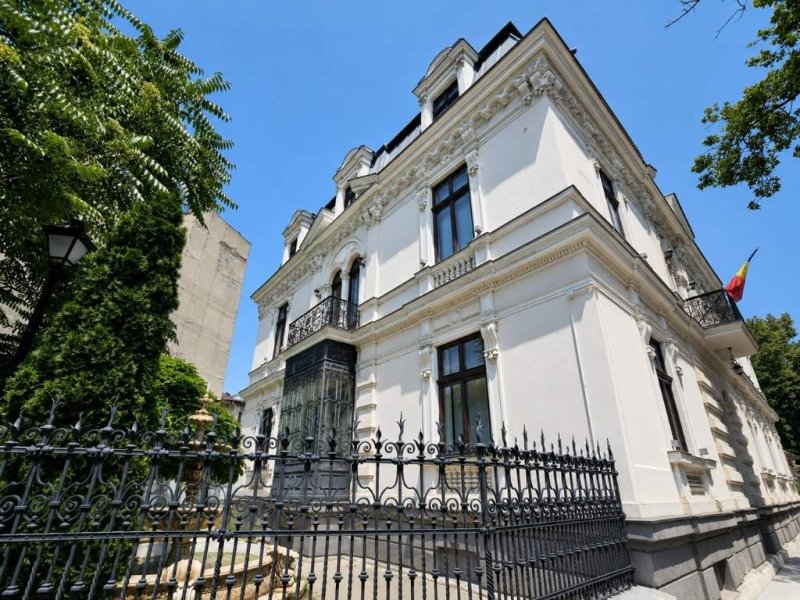
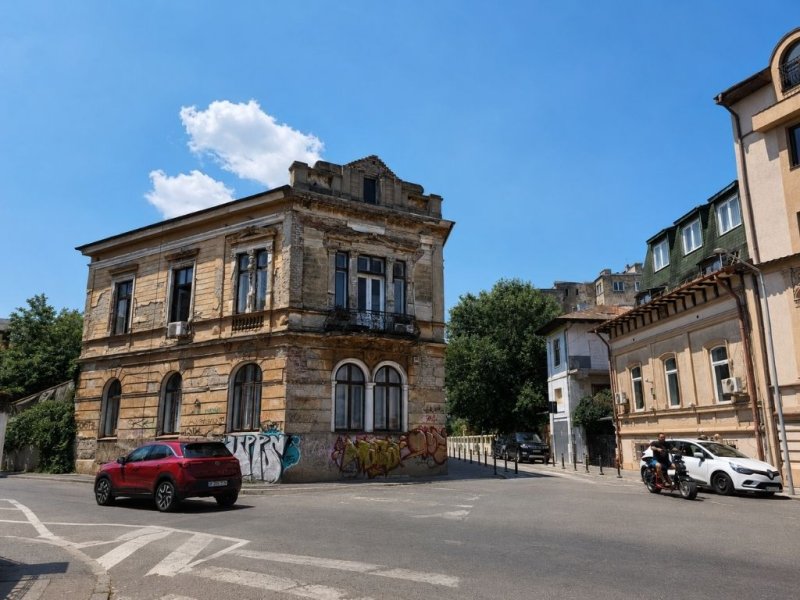
At the Hristo Botev end of the street, at Negustori no. 1A, stands Negroponte House, one of the buildings that immediately draws the eye. Built at the end of the nineteenth century, the house belonged to the Negroponte family and was designed by architect Leonida Negrescu.
The building is eclectic in style, with a ground floor, upper floor and attic, in a formula that says a great deal about the ambitions of Bucharest’s bourgeoisie at the end of the nineteenth century. Eclecticism was, in a way, the official language of people who wanted a residence that was solid, elegant and sophisticated enough to show that its owner had seen the world or, at the very least, had read about it.
The house opens Negustori Street at its intersection with Hristo Botev Boulevard, an area once known as Domniței Boulevard. Its façade has generous proportions, and the decorative details lift the building above the ordinary houses of the old mahalla. It reveals the commercial Bucharest that wanted to become a European capital, with a slightly theatrical urgency but often charming results.
In recent years, Negroponte House has undergone rehabilitation works and acquired a contemporary office function. The transformation always raises the classic question of the old city: what do you do with a heritage house so that it can continue to live? Do you leave it empty, romantic and deteriorating, perfect for melancholy photographs? Or do you give it a new function, at the risk of bringing printers, access badges and Monday morning meetings into a setting designed for receptions and families with famous names? On Negustori, the answer seems to lean toward reuse, and sometimes that is what saves a building.
Crissoveloni House
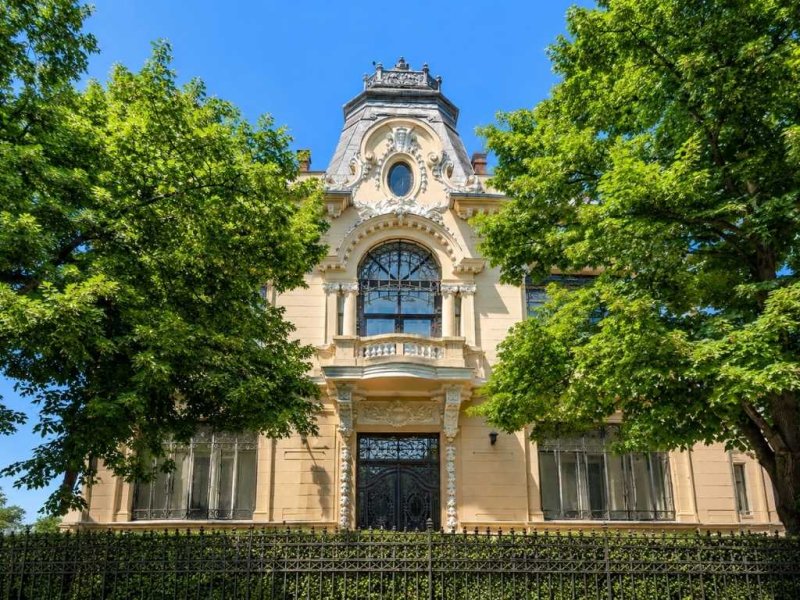
Crissoveloni House, at no. 1B, was built in 1893 by engineer Constantin Colibășeanu as his personal residence, in an eclectic style typical of late nineteenth-century Bucharest. The house entered the Crissoveloni family through Georgette Lakerman-Economu, the builder’s granddaughter, who married Nicolas “Nicky” Crissoveloni there, heir to the celebrated Greek-origin banking family that became Romania’s leading banking dynasty in the early twentieth century.
After nationalisation, the property was confiscated by the state. Paradoxically, its use as the headquarters of public institutions preserved much of the original interior.
Restituted after 1990 to Jean Crissoveloni, Nicolas’s son and the last male descendant of the family, the house was restored and now operates as the Grand Boutique Hotel. It preserves its wooden and wrought-iron staircase, pink marble columns, Art Nouveau stained-glass windows, original parquet flooring, wine cellar and old safe, which had been purchased by the owner’s grandfather from the company belonging to the family of her future husband — an old Bucharest coincidence too good to have been invented.
Dimitrie Bolintineanu House
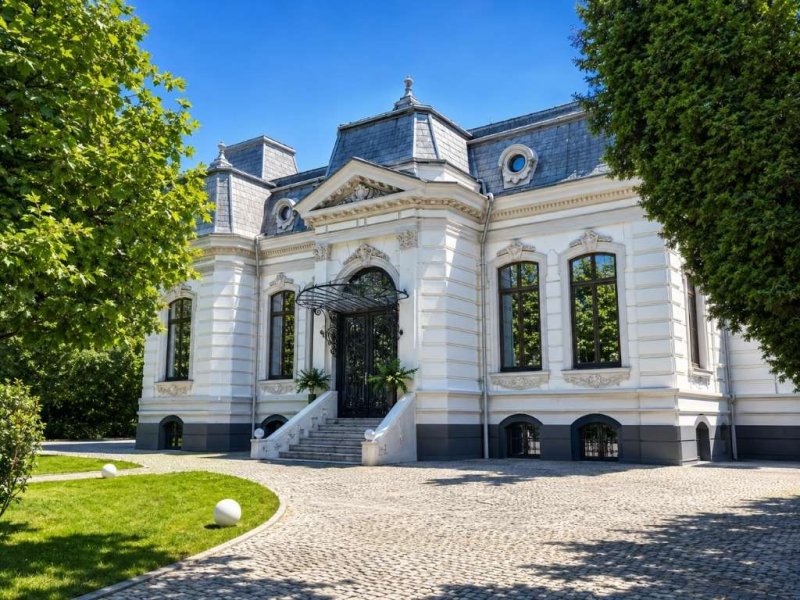
At number 16 stands the house now known as Dimitrie Bolintineanu House. The building is a historical monument and, following restoration, became a venue for private and cultural events.
Dimitrie Bolintineanu’s name immediately lends the place a literary gravity. Poet, diplomat, participant in the 1848 Revolution and author of texts that passed through generations of schoolbooks, Bolintineanu remains one of the major figures of nineteenth-century Romania. The association between the house and his name circulates today through the owners’ communications and cultural press coverage, although publicly accessible documentation offers few clear details about the exact period in which the poet may have lived here or the precise legal relationship between him and the property.
What is certain is that poet Dimitrie Bolintineanu lived here between 1860 and 1872, effectively spending his final years in the house. The building’s current form, however, is linked to 1883, when surgeon Alexandru Racoviceanu hired French architect Paul Gottereau to remodel the residence.
Gottereau, the architect behind landmarks such as the CEC Palace, the Royal Palace and the Carol I University Foundation, gave the house an eclectic Beaux-Arts language, with Parisian elegance adapted to late nineteenth-century Bucharest: high ceilings, elaborate stucco work, rich interior decoration, a glazed conservatory and an inner courtyard that gives the ensemble the character of a refined urban residence.
Extensively restored in 2023 after a two-million-euro investment, the house retains many of its historic elements, from façades and tiled stoves to decorative beams and stucco work. It now operates under the name The Villa Event House and hosts exhibitions, launches, private conferences, parties and various gatherings.
Vlădescu House
Vlădescu House, at number 15, belongs to the same family of buildings that gives the street its architectural density. The building is a historical monument and dates from the late nineteenth century or early twentieth century.
These are the kinds of houses where the difference between an internet photograph and a real encounter becomes very clear. In a photograph, the façade looks like scenery. On the pavement, you notice the texture of the plaster, the marks left by time, the proportions of the windows, the rhythm of the balconies and the details that escaped hurried repainting. Above all, you sense that the former owner wanted to leave something behind, even if only a stucco ornament more beautiful than the neighbour’s.
Jean Fuchs Villa
At number 27 stands Jean Fuchs Villa, designed by the renowned interwar architect Marcel Iancu between 1927 and 1929. For Romanian architectural history, the house has an importance that far exceeds the scale of the street. Marcel Iancu considered it the first modernist house in Bucharest and one of the first authentic expressions of modernism in Romania.
Jean Fuchs, the owner of the house, was a wine merchant, and the fact that a wine trader commissioned one of the buildings that changed the direction of Bucharest architecture only adds to Negustori Street’s charm. Local trade, apparently traditional, financed a radical break from tradition.
The villa appeared in a neighbourhood dominated by historic houses, with simple volumes, terraces and a composition close to the Bauhaus language. For neighbours accustomed to elaborate façades, stucco decoration and visible roofs, the house must have seemed like a fairly bold apparition. A white cube in interwar Bucharest could provoke reactions almost as intense as an electric scooter left diagonally across the pavement.
In recent years, the building has been described as being in a severe state of decay and having undergone an outright dreadful transformation. Its condition reveals the fragility of modernist heritage. A house can become a landmark in architectural history and still be treated as an excessively expensive maintenance problem. Bucharest has many such contradictions, and Negustori compresses them into a small, almost educational space.
A street where the mahalla and modernity still face each other
The charm of the street comes from its mixture of eras. The commercial mahalla of the seventeenth and eighteenth centuries left behind the urban layout and the church. The nineteenth century brought merchant houses and eclectic residences. The interwar period arrived with Art Nouveau, Romanian Revival architecture, modernism and houses that tried to be Western, local and sufficiently imposing for a family on the rise, all at once.
After the war, the area went through confiscations, nationalisations, changes of ownership and brutal transformations in social life. Documents relating to the neighbourhood even mention the case of Edmund Budișteanu, previously known as Edmund Gobel, owner of a property at the intersection of Paleologu and Negustori streets. The building was confiscated during the Romanianisation policies of the wartime period, briefly returned after 1944 and then lost once again through communist nationalisation.
The street remained relatively untouched by the major communist demolitions that transformed other central areas of the city. For this reason, it still preserves the rhythm of the old mahallas, with plots, courtyards and buildings constructed before the Second World War. This gives it rare urban value. On Negustori, you can see Bucharest before the city began behaving as though every empty corner automatically required an apartment block.
How to explore the street
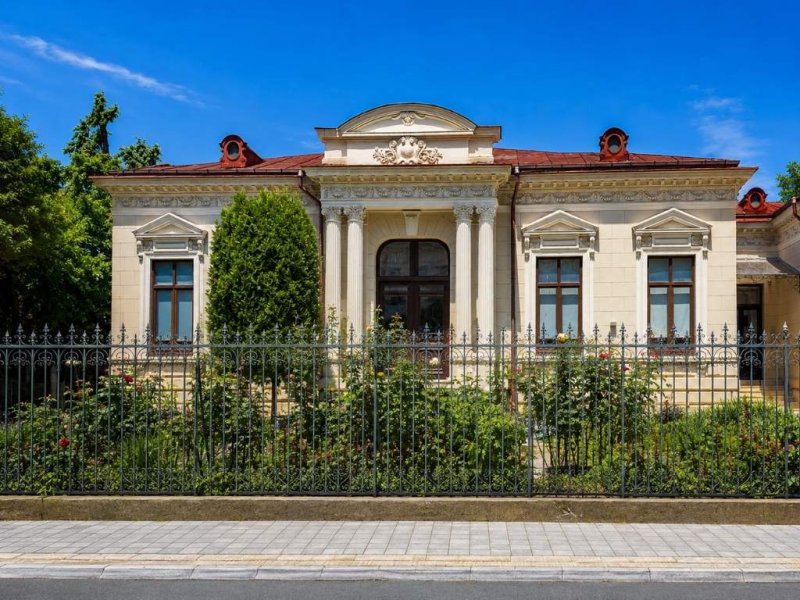
A good walk begins from Hristo Botev Boulevard, starting with Negroponte House. From there, it is worth following the façades around the lower-numbered buildings, the windows, gates, wrought-iron details and courtyards glimpsed through fences, sometimes hidden behind abundant vegetation. The area should be explored slowly, because Negustori punishes haste. Anyone walking with their eyes fixed on a screen will miss half the story.
Near Vlădescu House and Dimitrie Bolintineanu House, notice the transition between homes with a classical language and contemporary interventions. Further up, Jean Fuchs Villa, hidden and deteriorating, changes the register entirely. Suddenly, the street enters the twentieth century with a confidence that still feels bold.
At the end, a small detour toward Negustori Church on the nearby parallel street brings the walk back to the beginnings of the mahalla, tying all the threads together: merchants, the church, wealthy families, interwar modernists, confiscated properties, restorations and the hope that the city can preserve what deserves to be preserved.
Negustori Street remains one of the places where Bucharest explains itself best. Here, the city appears contradictory, elegant, wounded, surprisingly alive and sometimes absurd, exactly as a capital should be after passing through several centuries without ever receiving an instruction manual.
If you have time, make your way to Negustori Street and discover Bucharest as it once was. Especially since the street was recently rehabilitated through a broader programme initiated by the Sector 2 City Hall, which aims to transform several streets in the Armenian and Jewish quarters into areas that define a “daytime old town” — unlike the classic Old Town, with its more nocturnal character.
You may also like: 10 Fascinating Things About the Armenian Quarter in Bucharest