poarta închisă la ora opt How Bucharest's First Dormitory Students Lived: Gymnastics, Tea, and a Gate That Closed at Eight
- Articles
- 10 AUG 26
At the dormitory on Cantacuzino Street, the gate closed at eight in the evening. Whoever arrived late stayed outside, no matter the reason. That was how one of Bucharest's first state-run student dormitories operated in the 1920s, inside a building that used to be a school, with iron-frame beds in the dormitories and a reading room hardly anyone could use because the floor was too weak to hold many people at once.
The story starts officially on August 27, 1919, with Law Decree No. 3668, the first national regulation of student dormitories and cafeterias. The law set up, next to each university, a society called "The Students' Home," tasked with building and running housing and meals for young people who'd come to the capital to study. Money came from enrollment fees, from what students paid to stay and eat, from state subsidies, and from public donations. Starting in 1923, a 78-article regulation spelled out exactly how it all worked: who got priority for a spot, how much they paid, what happened if they failed their exams.
Students fell into three categories. Full-paying students covered the whole fee, half-paying students covered half, and those paying nothing got absolute priority in the allocation, alongside the half-payers. Whatever spots were left went to full-paying students, who still had to pass an annual competition held between October 15 and November 1: a written and an oral exam, on different subjects depending on the year of study. Good grades and regular class attendance kept your spot the following year. Anything less, and you lost it.
Dorms Organized by Faculty, Not by Neighborhood
Interwar Bucharest didn't have a single student campus. It had a scattered network of buildings across the city, each tied to a specific faculty. Medical students lived on Cantacuzino Street. Those studying Sciences, Law, and Pharmacy stayed on Scaune Street. Philosophy and Letters had their dormitory on Sfinții Voievozi Street, moved in October 1929 to Cantacuzino, at number 36. Theology students were housed at the Radu-Vodă Church, and veterinary students on Splaiul Magheru, inside their own faculty building.
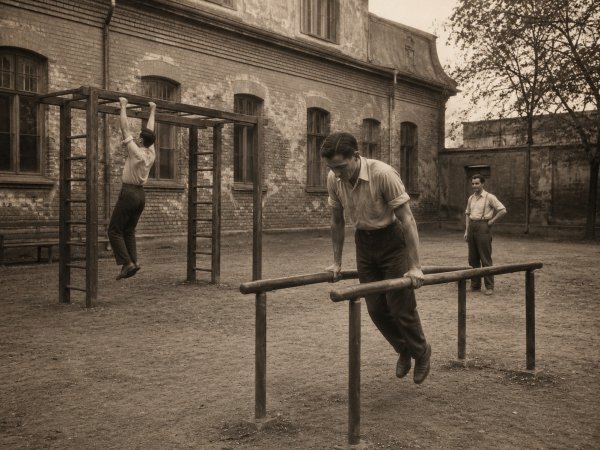
The Cantacuzino dormitory, run by a university lecturer, had 220 beds, but the cafeteria fed nearly 380 people a day, since students who didn't live there also ate there. Dormitories had iron beds, tables, and chairs. The garden had gymnastics equipment installed, and a barber made house calls for 8 lei. Supplies and the general running of the household fell to the director and his wife, helped by delegates elected among the students.
For women, things looked different. The first women's dormitory operated on Sfântul Ștefan Street, in a rented building badly in need of repairs. The 80 students there were grouped by faculty into shared dormitories, most without tables or chairs. They read and wrote in bed, or at a single shared table, taking turns. The same rooms doubled as library, study hall, reception area, and occasionally laundry room. There was no separate library, no infirmary, no gym. The cafeteria, set up in a former gymnasium, also fed 150 to 200 day students who didn't live there. Girls who showed up late often found the food gone, and some split their portion with roommates who'd lost their meal cards.
The Private Dorm Where Things Were Different
The sharpest contrast came from outside the state system. The Spiru Haret dormitory, on Dionisie Street, had operated since 1908 under the direction of Clotilde Averescu, and by the late 1920s it housed 200 boarders and served meals to another 150 day students. Boarders paid between 10,000 and 30,000 lei a year; day students paid between 1,400 and 1,800 lei a month — figures that point to a far wealthier clientele than the average dormitory student.
Clotilde Averescu was no ordinary administrator. Born Clotilde Caligaris, an Italian with a Greek father from a wealthy family, she'd been a soprano at La Scala in Milan before marrying Marshal Alexandru Averescu, the hero of Mărăști and later prime minister of Romania. In Bucharest she stayed consistently involved in charity work: in 1930 she built a rest home in Câmpina for children orphaned by the war, and the Dionisie Street dormitory was one of the ways she put her wealth and her connections to work for students without means. When she died in 1934, her body was laid out first at the Spiru Haret dormitory itself, before being taken to the family estate at Halânga.
At the entrance stood a parlor and an administrative office, along with a register where each student noted, on leaving, where she was going and for how long. Rooms held 3 to 5 beds, work tables, and chairs, and were described as clean and bright. The study hall sat next to a library of more than 5,000 volumes. The cafeteria kitchen ran on electric machines for washing dishes, peeling potatoes, grinding meat, and beating eggs — an unusual level of equipment for the time. The courtyard laundry served students, staff, and outside customers, and the income from that helped cover part of the running costs.
A typical day at Spiru Haret began at a quarter to seven in the morning, with tea or coffee served half an hour later. Students would read in the study hall or the library, get a snack at ten, then have lunch between half past twelve and half past one, always four courses. In the afternoon they went to lectures, labs, or the library, and anyone still at the dormitory at four got tea. Dinner was served at a quarter to eight, and the gate closed at eight sharp. Twice a week they went out to the theater, always as a group.
The Rules That Didn't Bend
No matter the dormitory, a few rules stayed fixed: spotless cleanliness, curfew at 11 p.m. for men and 9:30 p.m. for women, and visitors allowed only during the day, received in the office and nowhere else. Every dormitory had an infirmary for minor ailments, and hygiene was overseen by a medical student capable of giving first aid.
The network kept growing through the 1930s. By September 1931, Bucharest had 26 county-run dormitories, 20 for men and 6 for women, most of them in rented buildings. Private dormitories added to the mix, operating without university approval. Not every project got built: a 1928 donation of a building on Pictor Grigorescu Street was meant to become a dormitory for Sciences and Letters students, but the building still hadn't turned into one by 1940.
Poor conditions led to protests, and in 1937 the dormitories judged unsanitary were shut down. Others were closed by the university's governing board because they'd become hubs of Iron Guard activism. 1944 hit the network directly: some dormitories were bombed, others taken over by Soviet soldiers.
That same year, 1937, saw the completion of Casa Studențească on Calea Plevnei, funded by a public subscription organized by the newspaper "Universul." The building wasn't meant for housing at all — it held a reading room, a library, a restaurant, and a hall for performances and conferences. Under communism it would be renamed the "Grigore Preoteasa" Students' Cultural House. The interwar dormitory system, with all its gaps, remained the skeleton that Bucharest's student housing grew from after 1960, when the first blocks of the Regie complex went up on the banks of the Dâmbovița, in the Grozăvești area.
Courtyard of the Cantacuzino student dormitory, 1920s. Illustrative, AI-generated image.