The History of the Titan Neighborhood. Where the Name “Balta Albă” Comes From, How IOR Park Appeared, and Why the Metro Redefined Its Existence
By Eddie Țone
- Articles
- 06 MAR 26
When you hear the name Titan, two things usually come to mind: either the serious metal used in aircraft and medical implants, or a neighborhood in Bucharest’s Sector 3 where socialist apartment blocks, a spectacular park, a legendary metro station, and a far more interesting urban history coexist behind neat rows of pansies.
Walk through Titan today and you’ll see children on electric scooters, elderly residents carrying market bags, and hipsters drinking specialty coffee precisely where, a few decades ago, apartment blocks rose at a Stakhanovite pace and the final waves of socialist enthusiasm were harvested. You will also notice many—very many, practically endless—red paving stones (though that is another story entirely, and a complicated one). Behind this urban collage lies a surprisingly dramatic story that begins in open fields dotted with pits and factories and leads all the way to shopping malls, park festivals, and apartments renovated with three varieties of “modern” ceramic tile.
To understand Titan today, you must go back to cement, heavy industry, and a handful of individuals who shaped the area—through urban planning, political decisions, or cultural influence.
From Burnt Fields to Cement Dust
Before the cranes of the socialist regime erected the first concrete columns, this area stood at the absolute edge of the city—a kind of no-man’s-land where Bucharest gradually dissolved into the vast plains of Bărăgan.
The name that defines the neighborhood comes from the Titan Cement Factory, established in the early 20th century by industrialist Nicolae Cuțarida. Cuțarida recognized the enormous potential of the area and transformed a barren landscape into an industrial engine that supplied the materials required for modernizing the capital.
At the time, Titan consisted mainly of workers’ barracks, warehouses, and a few modest homes for laborers employed by the factory. Cement dust settled over everything, casting the landscape in a gray haze long before gray apartment blocks became the visual norm of the area. Even so, the factory laid the foundations for a strong working-class identity that would later shape the neighborhood’s demographic profile.
The Grim Legend of Balta Albă
The neighborhood’s past contains episodes that sound as though they were lifted from a rather mediocre Gothic novel—though the historical basis is well documented.
The name “Balta Albă” (White Pond), which today refers to the area adjacent to Titan, originates from the plague epidemic of 1813, during the reign of Ioan Gheorghe Caragea. Faced with an overwhelming number of victims, authorities decided to transport bodies outside the city to a marshy area located where the neighborhood now stands.
The method was simple and macabre: corpses were thrown into mass graves and covered with quicklime to prevent the spread of disease. Rain transformed the lime into a pale paste that coated the entire depression, creating the appearance of a white pond visible from afar.
The transformation of a former plague burial ground into one of Bucharest’s greenest and most desirable residential areas carries a certain irony. Yet the city has a habit of burying its tragedies beneath thick layers of asphalt and carefully landscaped parks.
The Urban Vision of the 1960s
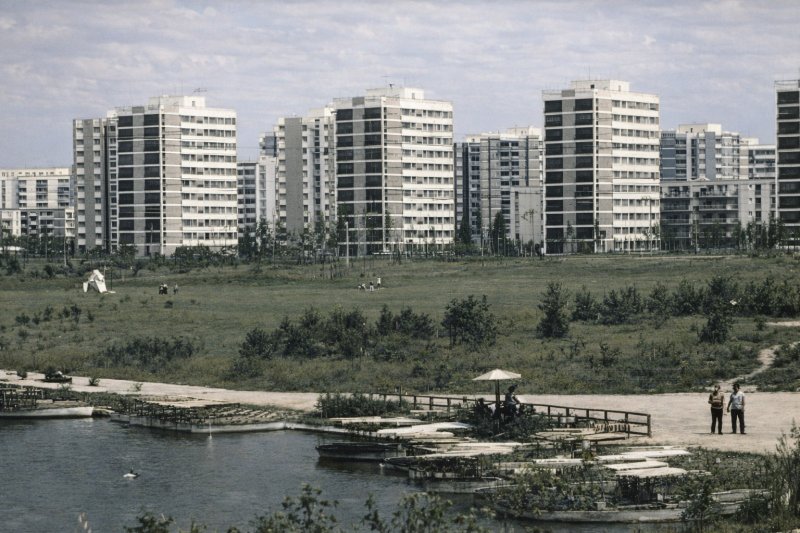
Titan’s great transformation truly began in the 1960s, under the supervision of a team of architects led by P.E. Miclescu. Their plan was ambitious: a residential complex offering everything a modern neighborhood required—generous green spaces, schools, kindergartens, and shopping centers—all organized around a natural core formed by a lake created from former sand excavations.
The architects successfully avoided the suffocating density seen in other districts, leaving generous distances between apartment blocks. This decision still allows residents a rare privilege in Bucharest: the ability to see the sky without staring directly into the windows of neighbors across the courtyard.
Titan was conceived as a “city within a city”, an experiment where the socialist “new man” would live in harmony with both nature and concrete. The radial layout of the streets, converging toward the central park, reflects a logical and orderly vision—one best appreciated when viewing the district from above.
IOR Park and the Transformation of an Empty Plot
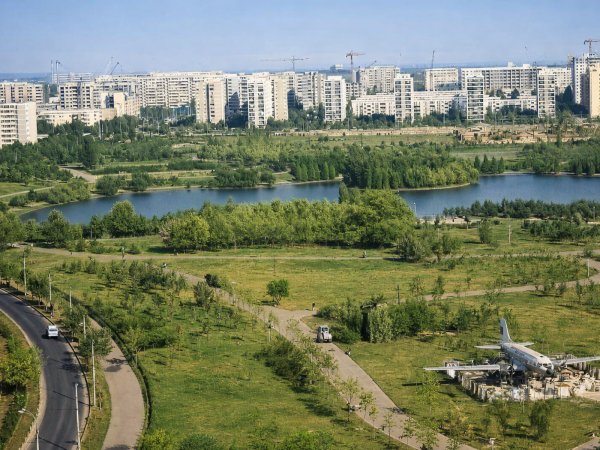
The neighborhood’s central landmark, IOR Park—known officially as Alexandru Ioan Cuza Park, though locals still call it Titan Park—represents the crowning achievement of the urban planners of that era.
Its name derives from the nearby factory Întreprinderea Optică Română (IOR), established in 1936. The park itself was developed around 1970, on the site of a former brick factory.
The lake at the center of the park has a rather accidental origin. It formed after a former sand pit flooded. Instead of filling it in, the authorities decided to turn it into a landscape feature, a decision that spared the neighborhood from aesthetic monotony.
The park took several years to complete as marshland gradually became an oasis with artificial islands and winding pathways. Many of the hills where children sled during winter are, in fact, piles of construction debris from the surrounding apartment blocks, later covered with soil and grass—a surprisingly early example of urban recycling in which building waste became the foundation for future generations’ playground.
Nicolae Ceaușescu and the Obsession with Systematization
Although Titan’s foundations were laid during a relatively relaxed political period, the district later entered the machinery of Nicolae Ceaușescu’s massive systematization program.
His frequent visits to construction sites in eastern Bucharest left clear marks on the area’s layout. Fascinated by the speed with which apartment blocks rose from the ground, Ceaușescu constantly demanded greater housing density.
This pressure led to the construction of tower blocks, the giant “domino pieces” that line major boulevards such as Nicolae Grigorescu Boulevard and Camil Ressu Boulevard.
Titan soon became a showcase of socialist success, proudly presented to foreign delegations as proof of the country’s uninterrupted progress. Ceaușescu even brought U.S. President Richard Nixon here during his 1969 visit to Romania, followed shortly afterward by Mobutu Sese Seko, the dictator of Zaire, in 1970.
Despite these authoritarian interventions, Titan maintained a somewhat more relaxed character than districts such as Drumul Taberei or Militari, likely because of its greater distance from the administrative center of power.
Architecture Between Modernism and Necessity
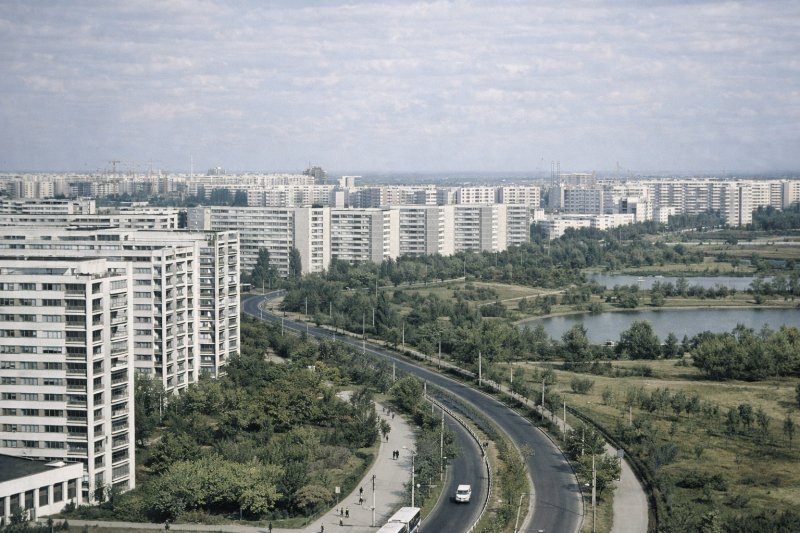
At first glance, Titan’s apartment blocks might appear ordinary. A closer look reveals several interesting architectural details.
The earliest buildings, typically four-story blocks (P+4), have an airy structure and large windows reflecting the influence of late modernism. They were designed to provide thermal comfort and natural light—features that would become rare luxuries during the austerity decades that followed.
Later, the appearance of “comfort 2” and “comfort 3” buildings marked the decline of the earlier idealistic vision, replaced by a more brutal form of utilitarianism. Even so, architects managed to maintain a degree of visual coherence through discreet decorative elements on facades and through the intelligent integration of commercial spaces at ground level.
Titan thus reveals the evolution of socialist thinking about housing—from the ambition to provide “the best for the people” to the urgent need to fit as many residents as possible into limited space.
Cinema Gloria and Neighborhood Culture
One of Titan’s essential landmarks for social life was Cinema Gloria, inaugurated in 1966 with a capacity of 652 seats. Located close to IOR Park and the factory that gave it its name, the cinema served as a window to the world for thousands of Bucharest residents.
Queues for Saturday evening screenings became legendary, and the space in front of the cinema turned into a favorite meeting point for young people.
During the 1970s and 1980s, a trip to Gloria represented a significant social event, requiring appropriate clothing and preparation. Television and later the internet transformed how entertainment is consumed, yet the building remains a cultural symbol of the neighborhood.
Today, renovated and converted into a multifunctional cultural center with 406 seats, it continues to serve the community, demonstrating Titan’s ability to preserve its landmarks while adapting them to contemporary life.
The Metro Changes Everything: Titan After 1981
A decisive moment in the neighborhood’s history arrived in 1981, when the first section of Metro Line 1 opened between Timpuri Noi and Republica. Titan Station became one of the key nodes in the network, and the neighborhood suddenly emerged from isolation.
The journey to the city center became dramatically shorter, access to workplaces and institutions improved, and Titan entered the ranks of Bucharest’s well-connected districts.
Titan metro station stands as a remarkable example of communist-era engineering aesthetics. The space distinguishes itself through the absence of supporting columns, a technical achievement made possible by freezing the water-saturated soil in order to excavate a vast open vault.
The resulting dome appears to float above the central platform, creating a sense of space and freedom unusual for underground transport. Light plays across the curved ceiling, revealing the architects’ ambition to create a visual landmark that mirrors the modernist vision of the neighborhood above.
For many years after its inauguration, residents from other parts of Bucharest traveled specifically to see the station, widely considered the most beautiful in the city’s metro network.
The metro transformed Titan into a destination rather than merely a dormitory district. The park became easier to reach, local shops attracted additional visitors, and the area consolidated its position as a strong urban hub.
Revolution and Transition: The Neighborhood Changes Face
The events of December 1989 found Titan in a state of agitation. As a densely populated district, it witnessed large demonstrations as residents moved toward the city center.
The transitional period that followed brought the chaotic proliferation of street advertising and metal kiosks that appeared on nearly every corner. Yet the neighborhood’s underlying structure proved resilient.
During the 1990s, green spaces experienced temporary decline, though civic pressure from residents pushed authorities to prioritize park restoration. Titan also became one of the first Bucharest districts to undergo large-scale thermal rehabilitation, which dramatically altered the visual landscape.
The once-gray apartment blocks gained pastel-colored facades. Urban planners sometimes criticize these colors for lacking aesthetic discipline, yet they introduced a sense of liveliness into the cityscape.
Personalities Who Shaped the Spirit of the Area
Over time, Titan has hosted many prominent figures from Romanian culture and sports, including composer Marius Țeicu, saxophonist Mircea Iordache, and actor Mihai Bendeac.
Perhaps the musician most closely associated with Titan was Adrian Pleșca, known as Artan, frontman of the bands Timpuri Noi and Partizan, who celebrated the neighborhood in his music and remained deeply attached to it until his sudden passing at the end of 2025.
https://youtu.be/azrEZv-woVY
The district also became a reference point for many athletes thanks to its proximity to the Lia Manoliu Sports Complex (technically located in Sector 2). This blend of discreet intellectual life and athletic energy created a cohesive community, proud of belonging to what locals often call the “Republic of Titan.”
Titan Today: A Model of Urban Coexistence
https://youtu.be/90XUvPdVxFo
Walking through Titan today, you notice a natural harmony between generations. Young professionals purchase apartments here because of the park, while longtime residents remember the days when traces of the cement factory were still visible.
Modern mall commerce coexists with neighborhood markets filled with local produce. Titan has learned how to regulate itself, balancing tradition with contemporary urban life.
The neighborhood remains a fascinating example of urban resilience. From the lime-covered marshes of Balta Albă to the green landscape of today, Titan has traveled a long road shaped by political ambitions, industrial needs, and above all the everyday lives of the millions of people who have called it home.
You will not find the opulence of the city center or the interwar elegance of Cotroceni here. Instead, Titan offers an honest urban landscape that quickly makes visitors feel part of its story.
You may also like: IOR Park - Discover the beauty of one of the capital's largest parks