11 major calamities Bucharest has endured over the centuries
By Eddie Țone
- Articles
- 04 JUN 26
Bucharest is a city that changes its face at a speed often suspicious, like a character who keeps stepping onto the stage wearing a different hat but the same hurried air. Over the past 300 years, it has been burned, shaken, flooded, bombed, contaminated, rebuilt, redesigned, widened, demolished and… started all over again. Sometimes with grand plans, other times with improvisations that were not exactly inspired.
The city’s history can also be read through palaces, inns, churches, boulevards, cafés or cinemas that have disappeared. But there is also a harsher map, made up of plagues, earthquakes, fires, overflowing waters, bombs and pandemics. This map says a great deal about Bucharest, about administration, hygiene, urban chaos and the way the city has always survived with a mixture of Balkan fatalism, nervous energy and an almost comic stubbornness.
The list below follows the great calamities that struck Bucharest from the end of the 18th century to our own time. Some caused thousands or tens of thousands of victims. Others changed the city’s infrastructure, accelerated modernization, left buildings in ruins or introduced heavy words into the collective vocabulary, such as quarantine, disaster victims, consolidation and state of emergency. Bucharest endured them all, with the air of a survivor who emerges from the dust, shakes off his overcoat and asks where he can have a coffee.
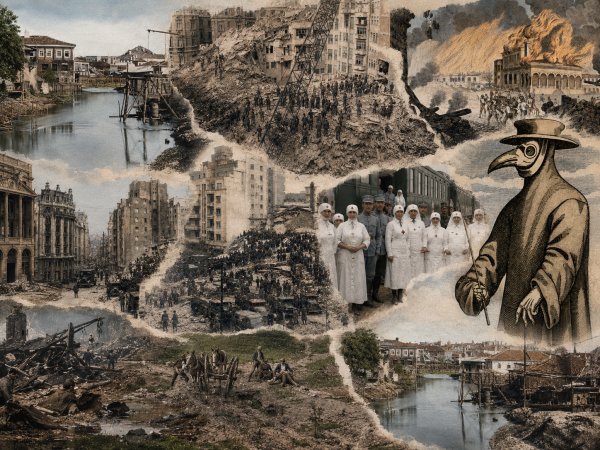
/ Images restored and colorized using artificial intelligence, preserving the original details.
1. The plague of 1792–1793
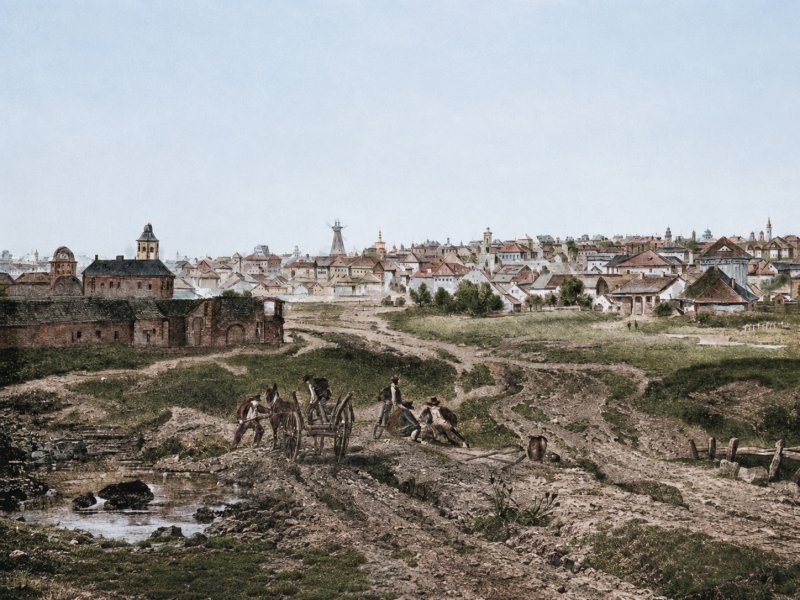
At the end of the 18th century, Bucharest was a lively, dirty, dense and vulnerable city, set in an era when disease circulated much faster than the administration. The plague epidemic of 1792–1793 struck a city with narrow streets, sprawling outskirts, animals kept close to homes, often unsafe water and a kind of medicine that did what it could.
Historical sources show that the epidemic reached Bucharest in 1792 and 1793 and spread beyond the first contaminated neighborhoods, although the surviving information is fragmentary. Some documents mention contaminated areas, the sick, the dead, those who recovered and isolation measures, but they do not allow for a complete and reliable toll for the entire city.
The social mechanism of the epidemic was already familiar. Families fled contaminated areas, the sick were isolated, and fear spread almost as efficiently as the disease. In a city accustomed to trade, inns and the movement of people, isolation became a form of urban punishment. The plague struck the body, but also the city’s routine.
2. The earthquake of 1802
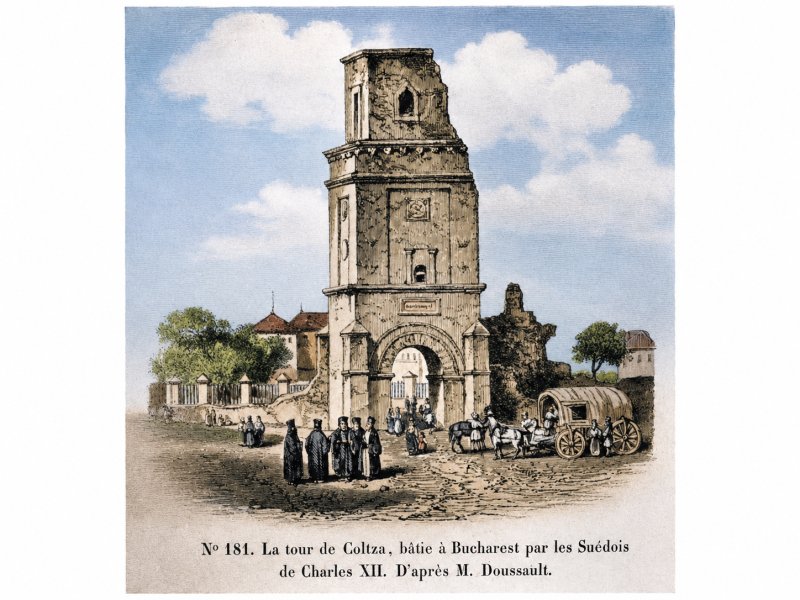
The earthquake of October 26, 1802, produced in the Vrancea region, is considered the strongest known Vrancea earthquake of the historical era. Modern estimates place it approximately in the 7.9–8.2 range, while accounts speak of an unusually long duration, around two and a half minutes. For Bucharest at the time, built from vulnerable masonry, towers, domes and boyar houses, the earth delivered a short and memorable lesson about the fragility of human constructions.
The symbol of the disaster became the Colței Tower, one of the city’s ornaments, severely damaged by the earthquake. Some accounts also mention the death of a street merchant after the partial collapse of the tower. The exact human toll remains difficult to establish, but the material damage and the image of fallen domes entered the city’s memory.
Dozens of buildings were seriously affected, as were numerous churches — Sf. Ilie completely, Sfinții Apostoli, Mihai Vodă, Stavropoleos, Sărindar and others — as well as the Văcărești and Cotroceni monasteries.
The 1802 earthquake revealed the Capital’s vulnerability to Vrancea earthquakes. Bucharest would receive this lesson several more times, in increasingly modern and costly versions. In 1802, explanations were linked to fate, sins or the capricious nature of the earth. Later, engineering explanations would sound colder and more uncomfortable.
3. Caragea’s plague, 1813–1814
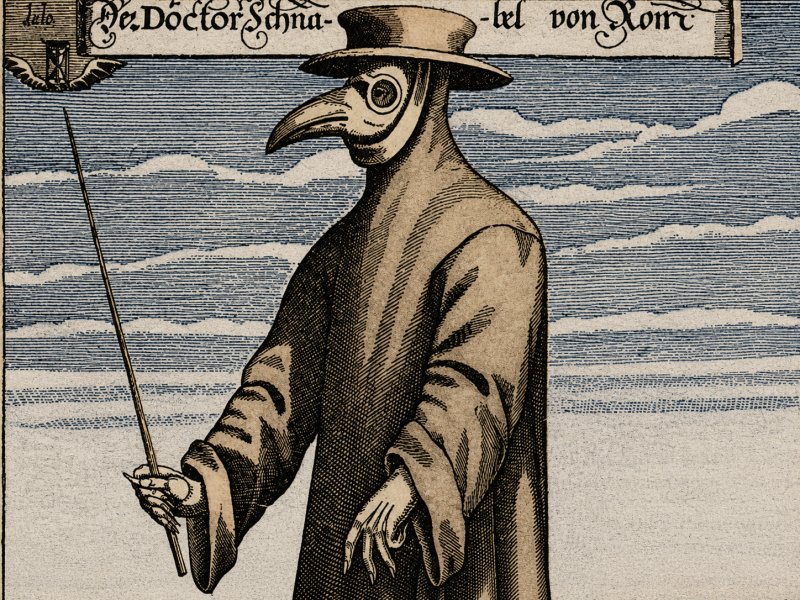
Caragea’s plague remains one of the most terrible epidemics in the history of Bucharest. It struck the city during the reign of Ioan Gheorghe Caragea, the penultimate Phanariot ruler, and turned his name into a funerary label. In popular memory, Caragea remained tied to the epidemic, although any Phanariot ruler would have preferred an association with palaces, reforms or at least a successful feast. But the disease was apparently brought by a servant from the court, who had carried it from Istanbul, then Constantinople, which at the time was ravaged by plague.
Estimates vary greatly. Some historical sources speak of 25,000–30,000 deaths in Bucharest, with averages of 300 per day, while other calculations give lower figures for documented intervals. That is precisely why the toll must be read as an estimate. What is certain, however, is that the epidemic struck a city with a population of several tens of thousands, and the scale of the disaster was enormous.
A sinister figure of the period was the cioclu, the man charged with collecting the dead and managing, in the manner of the time, corpses and contaminated houses. Stories of theft, abuse and horror gathered around the ciocli, some probably amplified by panic, others persistent enough to remain in chronicles. The city operated under a regime of fear, and fear brought to the surface solidarity, greed and administrative improvisation alike.
On the other hand, there was also a positive figure: Dr. Constantin Caracaș, head of the Capital’s physicians, who worked at Pantelimon Hospital, one of Bucharest’s two hospitals, alongside Colțea Hospital. He had the strength to lay the foundations of a third hospital, which he named Filantropia, and which contributed greatly to ending the plague epidemic in Bucharest. As a curious and ironic detail, Dr. Caracaș would die 14 years later because of the cholera epidemic.
4. The cholera epidemic, 1824–1831
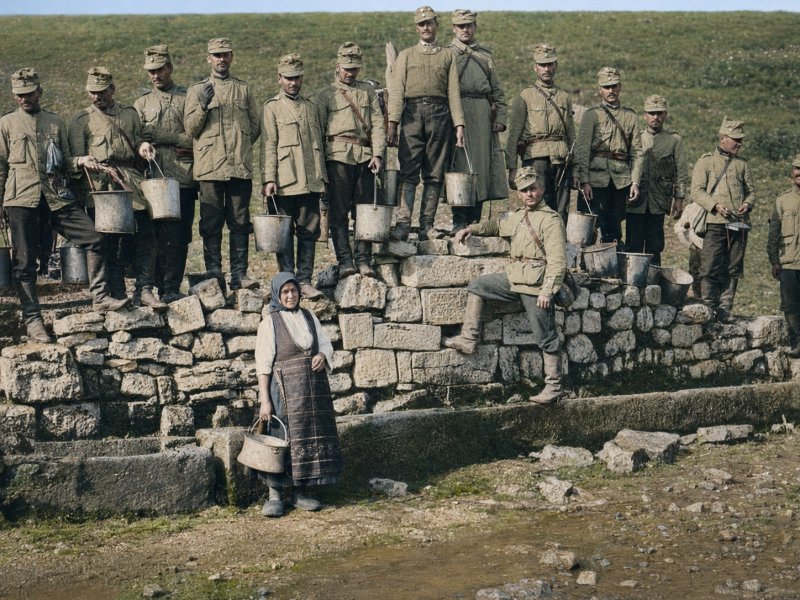
Cholera reached the Romanian Principalities in a complicated context, with Russian administration, institutional reorganization and sanitary measures imposed from above. In 1831, Bucharest entered the harsh logic of quarantines, inspections, isolation and medical instructions. General Pavel Kiseleff, a central figure of the period, coordinated firm measures to limit the epidemic, in a manner that combined public health with military discipline. A total of 20,218 people died in Wallachia and Moldavia out of 33,560 recorded patients.
For Bucharest, the separate toll is difficult to determine precisely, because the reports of the time lacked the rigor of modern statistics. The impact on the city was strong enough, however, for cholera to enter the series of great urban fears of the 19th century, gradually pushing the administration toward stricter sanitary rules, quarantines and more consistent concern for urban hygiene. Bucharest learned this lesson with difficulty, like an intelligent pupil who constantly turns in crumpled homework, yet still makes progress.
5. The Great Fire of 1847
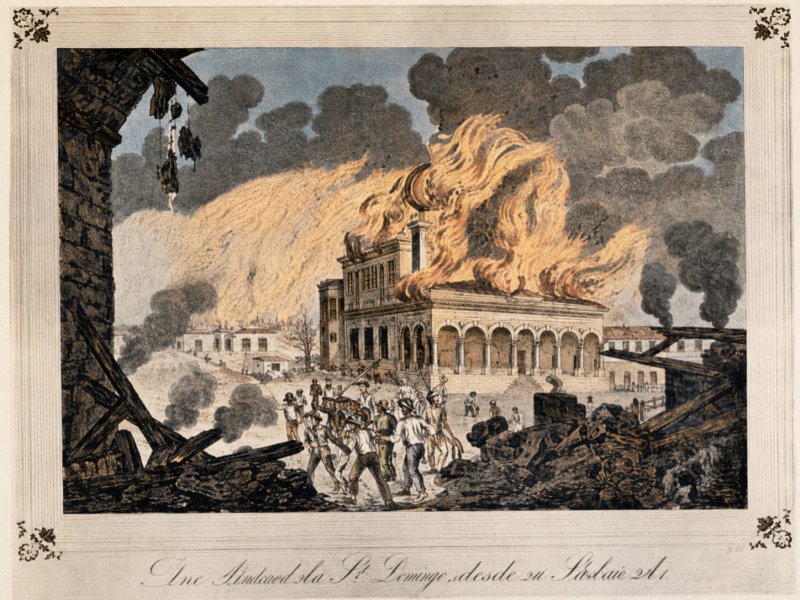
The Great Fire of March 23, 1847, broke out on Easter Day itself and remained the largest fire in the history of Bucharest. The city was full of vulnerable houses, cramped shops, flammable materials and streets that helped fire move with terrifying speed. “The Great Fire,” as it was called, broke out, according to historical accounts, in the area of the house of clucereasă Zoița Drugăneasca, near Sf. Dimitrie Church, the story linking it to her son playing with a pistol fired in a barn full of hay.
Official data indicate 15 victims, many other injured people and around 1,850 affected buildings. These included houses, shops, inns and churches. The fire struck an essential commercial area of Bucharest, around the Old Court, the merchants’ streets and the craft center. It burned an important part of the trading city, with its goods, registers, savings and hopes packed in dry wood. In practical terms, a quarter of Bucharest ended up in flames.
After the fire, the authorities discussed measures regarding the alignment of streets and safer buildings. The reconstruction of the central area contributed to changing Bucharest’s commercial appearance. Modernization did not arrive overnight, but the fire of 1847 became an argument that was hard to ignore.
6. The floods of the Dâmbovița in 1865
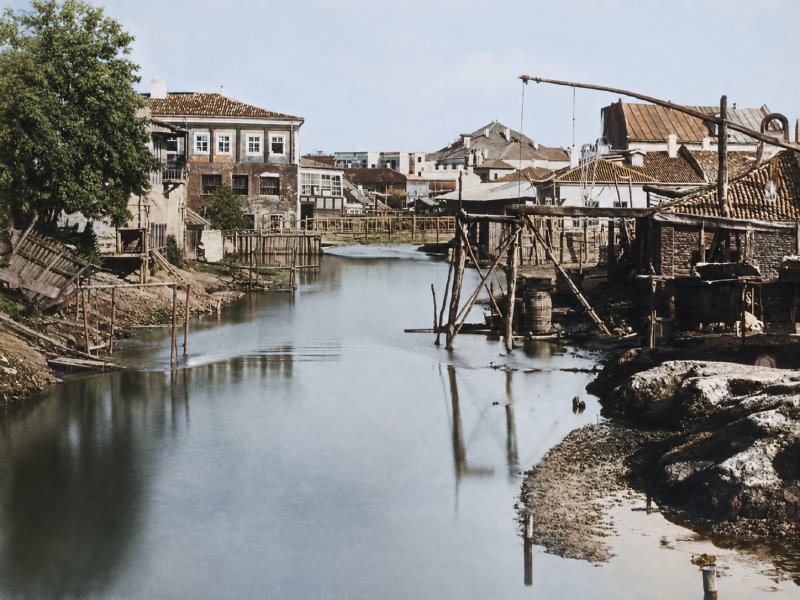
In March 1865, the Dâmbovița overflowed after the sudden melting of snow and covered large areas of the Capital. According to historian George Potra, between March 13 and 20, the course of the Dâmbovița from Grozăvești to Vitan was covered by waters that, in some places, reached about three meters. Areas such as Radu Vodă, Manuc’s Inn and Calea Rahovei were caught in the disaster. The Dâmbovița had overflowed so much that it is said the waters reached as far as the former National Theatre, near today’s Telephone Palace.
People took refuge in attics, traffic was blocked, and the supply of water and food became a serious problem. The number of disaster victims was large, and the disaster increased pressure on the authorities to regulate the Dâmbovița. Under Cuza, this need was discussed more insistently, laws were passed, including for the demolition of mills that choked the course of the Dâmbovița, but the major regulation works would take shape somewhat later.
The Dâmbovița, now tamed between concrete banks, sometimes seems like a river with reduced working hours. In the 19th century, it was an unpredictable presence, capable of turning the outskirts into marshland and the city center into a survival exercise. The flood of 1865 was a wet, cold and hard-to-ignore argument for the modernization of infrastructure.
7. The Spanish flu, 1918–1919
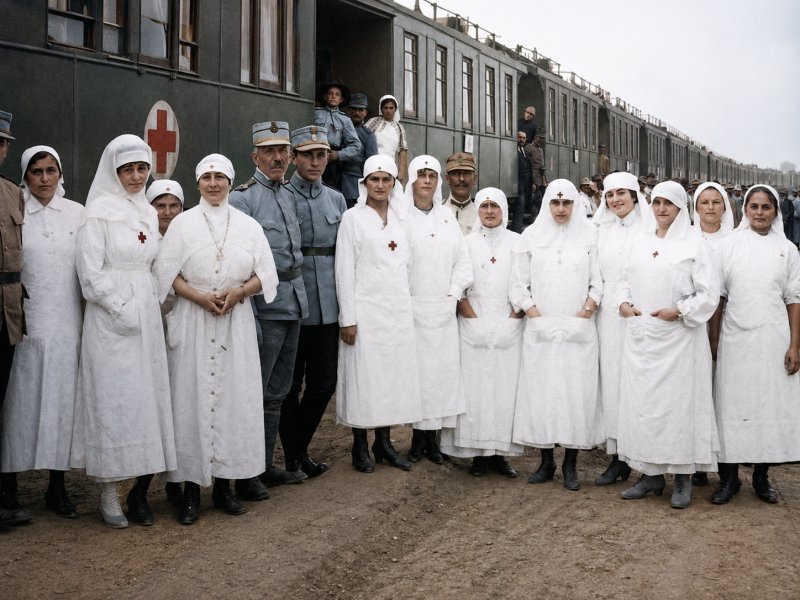
The famous Spanish flu epidemic, which ravaged the whole world, reached a Bucharest exhausted by the First World War, occupation, shortages, migrations and social tensions. Unlike the great epidemics of previous centuries, this pandemic came into a world with newspapers, modern hospitals, trains, fronts and armies returning home. The virus circulated rapidly through a tired Europe, and Bucharest was caught in that general exhaustion, with overburdened hospitals and a weakened population.
Globally, the Spanish flu killed, according to the most frequently cited estimates, at least 50 million people, with some assessments rising toward 100 million. For Bucharest, the exact toll is difficult to separate from the general mortality of the period, marked by war and related crises. The local impact was real, especially through the pressure placed on the medical system and through the way the disease struck already vulnerable communities.
Queen Marie herself, returning from the front in 1918, suffered for days from the Spanish flu. One of the victims of the flu was General Eremia Grigorescu, nicknamed “the hero of Mărășești and Oituz.”
The name of the pandemic is misleading. “Spanish flu” received this label because the press in Spain, a neutral state in the war, wrote freely about the disease. The major belligerent powers had censorship, and news about the epidemic circulated in filtered form. The name remained, although the origin of the disease is still debated.
8. The earthquake of 1940
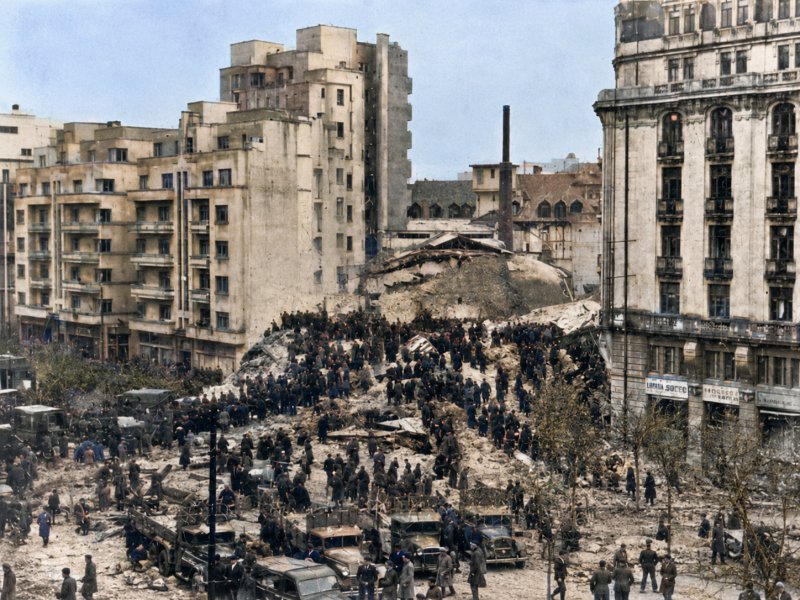
The earthquake of November 10, 1940, struck Romania in a tense context, with the war already under way in Europe and the country in political crisis. The earthquake, produced in Vrancea, had a magnitude of 7.4 on the Richter scale and lasted approximately 45 seconds. It caused major damage in Bucharest, southern Moldavia and Muntenia and was felt across a very wide area.
In the Capital, the symbol of the tragedy was the collapse of the Carlton Block, one of the most modern and tallest buildings of interwar Bucharest. Official data indicate 593 dead and 1,271 injured nationwide, of whom 140 dead and 300 injured were in Bucharest, at the Carlton building. It is considered, however, that the real toll may have been higher, affected by censorship and the context of war.
The 1940 earthquake also produced an important technical legacy, showing that modern Bucharest, with tall apartment blocks and a dense urban structure, was entering a new relationship with seismic risk. The low houses of the old city gave way in one manner, but modern blocks could collapse dramatically, vertically, with many lives trapped between floors. The lesson would return in 1977, this time amplified.
9. The bombings of 1944
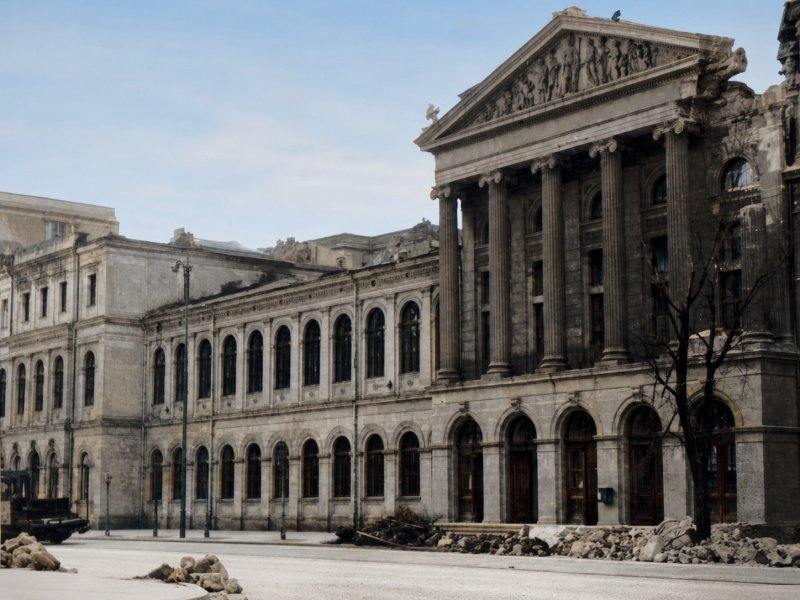
The year 1944 brought Bucharest one of the most violent experiences of the 20th century. Allied bombings targeted railway and industrial infrastructure, especially the North Station, the railway yard and the Grivița Workshops. The raid of April 4, 1944, was carried out by several hundred American B-17 and B-24 bombers, escorted by fighter planes. The targets were military and logistical, but the real city, with homes, streets and people, lay underneath. The attacks continued, with British involvement as well.
In total, there were 17 air raids, involving 3,640 bomber aircraft. The cold statistics offer terrifying figures: 5,524 dead, 3,373 injured and 47,974 people left homeless.
The North Station, the main target because the aim was to destroy the railway transport network, and the surrounding neighborhoods were heavily hit. Bucharest then experienced aerial warfare, in which death comes from above, at precise hours, with maps, calculations and bombing errors turned into neighborhood tragedies.
Bucharesters were taken by surprise by these raids, convinced they were witnessing a military exercise, and therefore did not rush to the anti-aircraft shelters. Calea Victoriei was also bombed, the National Theatre near the Telephone Palace was destroyed, as were Magheru Boulevard, Băneasa Station and other areas.
The city remained marked by these attacks, and their memory was complicated by the political changes after the war. During the communist decades, the story of the bombings was filtered ideologically, depending on the propaganda usefulness of the moment. Beyond this fog, the harsh reality remains: a city struck head-on.
10. The earthquake of 1977
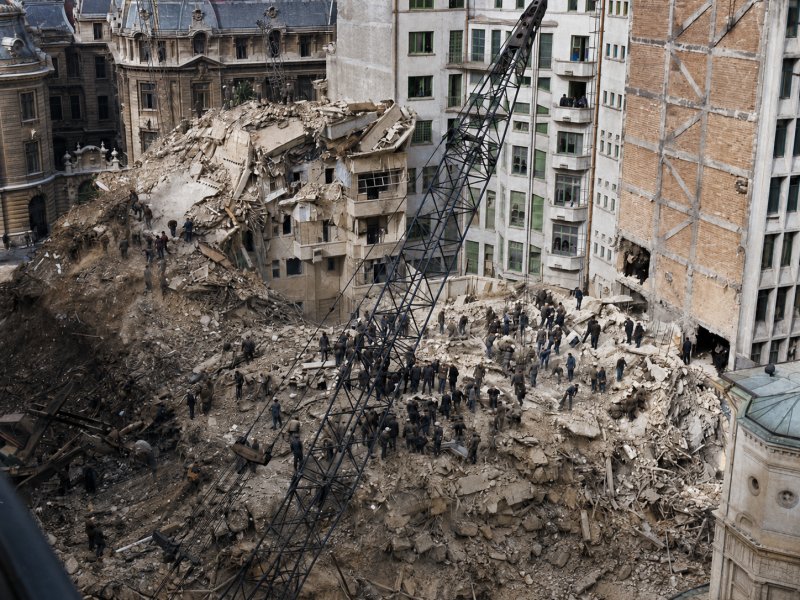
The earthquake of March 4, 1977, became the major seismic trauma of contemporary Bucharest. It occurred in the evening, around 9:22 p.m., had a magnitude of 7.4 on the Richter scale and lasted approximately 55–56 seconds. For the city, that minute meant the collapse of dozens of buildings, the death of more than 1,400 people in the Capital and the injury of thousands more. Nationwide, the toll was approximately 1,570–1,578 dead, depending on the statistical source used.
A large part of the collapsed buildings were interwar constructions, many made more vulnerable by the 1940 earthquake; however, some postwar buildings were also seriously affected. Well-known names from Romanian culture died then, including Toma Caragiu, Doina Badea, Alexandru Ivasiuc and Anatol E. Baconsky. The tragedy had a deeply urban dimension, because it struck apartment blocks, cinemas, flats, service staircases and many families taken completely by surprise.
After the earthquake, Bucharest entered a stage of demolitions, reconstructions and interventions controlled by the Ceaușescu regime. Some consolidations were carried out, others postponed, and the memory of the earthquake remained caught between pain and propaganda. Today, buildings at seismic risk carry forward the story of 1977 in a bureaucratic, discreet and unsettling form. A future earthquake larger than magnitude 7 could be devastating for central Bucharest.
11. The COVID-19 pandemic, 2020–2022
The COVID-19 pandemic caught Bucharest in a strange posture. A city accustomed to crowds, traffic, full cafés and traffic-light nerves suddenly moved to empty streets, self-declaration forms, masks, isolation, remote work and disciplined supermarket queues. For a city with anarchic reflexes, sanitary discipline was an almost anthropological experience.
During several stages of the pandemic, Bucharest had the highest absolute number of reported cases, explained by its population, density, mobility and economic role. During the waves of autumn 2021 and early 2022, the incidence reached very high values; in February 2022, the Capital even exceeded 30 cases per thousand inhabitants. Beyond the figures, the pandemic changed the rhythm of the city, the way people worked, socialized and viewed public space.
COVID-19 brought old words back into the vocabulary under modern packaging. Quarantine, isolation, epidemic wave, restriction, certificate, testing and vaccination became daily topics. The difference from the old plagues was technology. Fear now circulated through notifications, charts, apps and press conferences.
A city that falls, burns, coughs and rises again
Seen as a whole, these calamities reveal a Bucharest that is always vulnerable, yet hard to knock out of the game. Bucharest survived the blows, but each calamity left traces. Some are visible in streets, buildings, alignments and consolidation works. Others remain in archives, photographs, statistics, family stories and in the way the city carries its anxieties. The Capital has a strange memory, sometimes short, sometimes stubborn. It quickly forgets what makes it uncomfortable, but keeps in its walls exactly the things it would prefer to forget.
Perhaps that is why Bucharest fascinates so much. It is a city that has passed through fire, water, disease, earthquake and war, yet continued its life with a slightly absurd haste. From this haste come both its charm and its danger. The great calamities of the past say, with uncomfortable clarity, that the city saves itself through memory, rules, public care and a little less trust in luck.
You may also like: What happened in Bucharest during the November 10, 1940 earthquake — a part of history erased forever