Suter Palace, the architectural jewel on the Capital’s Filaret Hill. From King Carol I’s exhibition to today’s luxury hotel
- Articles
- 17 JUL 26
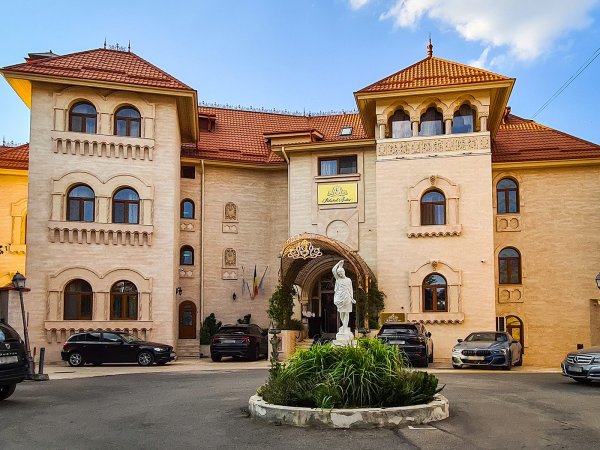
Few buildings in Bucharest manage to combine history, elegance, and architectural heritage as harmoniously as Suter Palace. Built on the highest point of Filaret Hill, the edifice impresses not only through the refinement of its construction, but also through the fascinating story that surrounds it. Over nearly 120 years, the palace has been a private residence, a meeting place for the aristocracy, the headquarters of important institutions during the communist period, and today it is one of the most exclusive boutique hotels in Romania. Its destiny is closely linked to the name of the Swiss architect Gustav Adolf Suter, the man who dedicated an important part of his life to the development of Bucharest and who decisively contributed to the transformation of Filaret Hill into an elegant district, inspired by Western urban planning. The story of Suter Palace is, at the same time, the story of the modernization of the Capital at the beginning of the 20th century, during a period when Romania was consolidating its status as a modern European state under the reign of King Carol I.
The birth of a royal project that changed the face of Bucharest
The end of the 19th century represented a period of accelerated development for Bucharest. King Carol I aimed to transform the Capital into a modern city, comparable to the great European metropolises. In this context, in 1890, the sovereign initiated an extensive program for the development of the area around Filaret Hill and the Metropolitan Church.
The plan provided for the draining of marshy lands, the systematization of the entire area, and the arrangement of a park intended to host the Romanian General Exhibition. The event was meant to mark four decades of King Carol I’s reign and a quarter of a century since his coronation, being conceived as a demonstration of the economic, social, cultural, and military progress of modern Romania.
The exhibition was to attract numerous visitors from the country and from abroad, becoming one of the most important events ever organized in Bucharest up to that moment. To carry out this ambitious project, the king turned to prestigious specialists from Switzerland, a country he appreciated for the professionalism and rigor of its builders.
Gustav Adolf Suter, the architect who fell in love with Bucharest
Among King Carol I’s guests was also the architect Gustav Adolf Suter, originally from the canton of Basel-Campagne, located in northwestern Switzerland. Together with the landscape architect Édouard Redont, he was tasked with participating in the systematization and development of the new urban area.
Redont was responsible for the landscape arrangements of the future Carol Park, while Gustav Adolf Suter received responsibility for the urban planning and construction projects. Contact with Bucharest was to change his life completely.
Fascinated by the beauty of Filaret Hill, covered at that time with vineyards and orchards, the Swiss architect decided to establish his residence here. In 1892 he bought a property located on the highest point of the hill, a place from which a spectacular panorama over the city opened up.
The choice was not accidental. The area offered peace, fresh air, and a privileged position, and Suter sensed the urban potential of the place, later contributing to its transformation into one of the Capital’s most elegant districts.
The construction of Suter Palace and its inauguration together with the Romanian General Exhibition
Between 1900 and 1906, the works for the arrangement of Carol Park and the organization of the Romanian General Exhibition were carried out at a sustained pace. Meanwhile, Gustav Adolf Suter began his own personal project: the construction of an impressive residence on the summit of Filaret Hill.
The palace was built between 1902 and 1906 and reflected both the Western architectural education of its creator and his respect for Romanian culture. The building combined the elegance of European architecture with elements inspired by the Brâncovenesc style, resulting in a harmonious, refined construction perfectly integrated into the local landscape.
The interior was arranged with materials of the highest quality, in the spirit of Swiss precision, and every detail was designed to convey elegance and durability.
The palace was inaugurated simultaneously with the opening of the Romanian General Exhibition, on June 6, 1906, when Queen Elisabeth cut the symbolic chain of flowers prepared for the official ceremony. During that period, Gustav Adolf Suter’s residence quickly became one of the most exclusive meeting places of Bucharest’s aristocracy.
Elegant receptions, balls, and gatherings were organized here, attended by members of European princely families, diplomats, politicians, businessmen, and numerous cultural personalities who came to visit the Capital.
The Swiss district created by Gustav Adolf Suter
The influence of the Swiss architect was not limited to his own residence. Gustav Adolf Suter played an essential role in the urban development of the entire area around Filaret Hill.
He became involved in land drainage, parceling, and urban design works, contributing to the emergence of the Gramont district, considered by contemporaries a true Swiss district in the southern part of Bucharest.
The alley leading up to his palace was lined with elegant villas, built in an architectural style inspired by Austrian, Swiss, and French models. Many of these were designed by his collaborator, architect F. Schmidts, who respected the stylistic harmony imposed by Suter.
The result was an urban ensemble remarkable for that period, appreciated for its order, elegance, and the quality of its constructions. Gustav Adolf Suter’s name is also linked to the development of other important districts of the Capital, such as Filaret, Colentina, and Ștefan cel Mare, his contribution being one of the most important in the process of modernizing Bucharest at the beginning of the 20th century.
A palace that crossed wars and political regimes
The life of the Swiss architect was to be marked by two important losses. In 1914 King Carol I died, his main supporter, and two years later he lost his wife, Elise Cremer-Suter.
After these dramatic events, Gustav Adolf Suter decided to sell his residence and return to Switzerland.
The palace was bought by a Greek banker who, after 1940, gave it as a gift to his French mistress. Later, the building changed owners several times, and the end of the Second World War completely changed its purpose.
After the establishment of the communist regime and the nationalization of 1950, the former aristocratic palace was successively used as an operations center of the Soviet MGB/KGB services, headquarters of the Communist Party, and later headquarters of ICRAL Sector 4.
The years spent under state administration severely affected the building, and the lack of investment and successive alterations brought the monument close to ruin.
In 1991, the rightful heirs began the procedures to recover the property, the process being completed through its restitution in 2001.
The restoration that brought back to life one of the Capital’s most beautiful buildings
The advanced state of degradation in which Suter Palace found itself did not seem to leave much hope for its salvation. However, in 2003, a Romanian-German family of investors bought the monument and launched one of the most spectacular restoration projects carried out in Romania after 1990.
The works lasted approximately three years and involved an investment of more than four million euros. Teams made up of architects, restorers, and craftsmen from Romania, Italy, Austria, and Germany collaborated to bring the palace back to its former splendor.
The façades were restored, the gardens were rearranged, and the interiors were rebuilt using precious materials and finishes of the highest quality.
In 2007, the building reopened its doors under the name Carol Parc Hotel, becoming a five-star boutique hotel and a member of the prestigious Small Luxury Hotels of the World network.
At that time, the impressive Murano crystal chandelier was also installed, made from more than 2,000 Venetian crystal rods. Considered the longest chandelier of its kind in Europe, it represents an artistic reinterpretation inspired by Constantin Brâncuși’s famous sculpture “Endless Column” and today constitutes one of the palace’s most spectacular decorative elements.
The quality of the restoration was officially recognized the following year, when the project received the distinction for the best restoration and design project in Romania, awarded by the Romanian Order of Architects.
SUTER PALACE Heritage Boutique Hotel, the symbol of contemporary elegance
A new chapter in the building’s history began in 2017, when Suter Palace was bought by the current owners, a family of Romanian entrepreneurs.
They initiated an extensive process of consolidation, renovation, and complete redecorating, while preserving the historical and architectural identity of the monument.
At the end of 2018, the building reopened its doors under its current name, SUTER PALACE Heritage Boutique Hotel, becoming one of the most exclusive luxury hotels in Romania.
In 2019, the hotel was awarded the title “Best Design Hotel,” a distinction granted at the Termalia Gala by professionals from the hotel, spa, and wellness industry.
Today, the hotel offers an experience that combines historical heritage with contemporary comfort, being appreciated by both Romanian and foreign tourists for the elegance of its spaces, premium services, and the aristocratic atmosphere it preserves.
Gustav Adolf Suter’s legacy continues to define Filaret Hill
Few foreign architects have left such a strong mark on the development of Bucharest as Gustav Adolf Suter. His contribution goes far beyond the construction of his own palace, as he took part in the design of important districts and in the urban modernization of the Capital during a decisive period for the city’s evolution.
Today, the street leading up to the impressive building bears the name Adolf Suter, a symbolic gesture through which Bucharest continues to honor his memory.
The architect passed away on January 1, 1921, in Zurich, but the press of the time paid him a moving tribute. The newspapers Universul and Adevărul emphasized that his name would remain forever linked to the creation of one of the Capital’s most elegant, clean, and luxurious districts.
Seen today from its gardens or from the terrace overlooking the city, Suter Palace represents much more than a luxury hotel. It is a symbol of Bucharest of old, a testimony to the era when the city was nicknamed “Little Paris,” and a remarkable example of how heritage can be saved and brought back to life. Its story shows that historical monuments are not only spectacular buildings, but also living pages in the history of a capital that continues to rediscover its values and identity.
We also recommend: Spayer Palace in Bucharest – the story of the residence of Herman Spayer, the son-in-law of Mauriciu Blank