Parcul Liniei, the largest park built in Bucharest after the Revolution. How an abandoned space was transformed into a new urban landmark
By Raluca Ogaru
- Articles
- 22 APR 26
Bucharest has undergone significant changes over the past decades, yet large-scale green space projects have been relatively rare. In this context, the development of Parcul Liniei marks one of the most important urban regeneration initiatives in the city after 1989.
Built along the route of a former industrial railway line in the Militari area, Parcul Liniei is considered the largest park created in Bucharest after the Revolution. The project represents more than just a new green space—it reflects a shift in how neglected urban areas can be reimagined and brought back to life.
From industrial infrastructure to a space for relaxation
The area that now hosts Parcul Liniei was, for many years, unused. The former railway line once served several industrial platforms, but after their decline, the infrastructure was left abandoned.
Transforming this space into a park meant more than adding pathways and planting vegetation. It involved reconnecting fragmented urban areas and giving them a new purpose. Similar projects are common in major European cities, where former industrial zones are converted into modern public spaces.
Parcul Liniei follows this model, designed as a green corridor that connects neighborhoods and offers residents an alternative to traditional recreational areas.
A linear park adapted to urban lifestyles
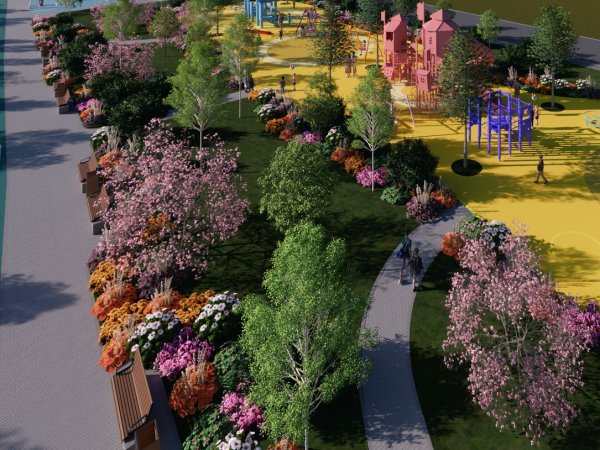
Unlike traditional parks, Parcul Liniei is built along a long and narrow route, making it ideal for walking, running, or cycling.
The concept of a “linear park” is increasingly popular in modern urban planning, as it allows green spaces to be integrated into dense areas without requiring large, compact land surfaces.
In Bucharest’s case, this approach provides a practical solution for crowded neighborhoods with limited open space. The park includes:
- pedestrian pathways
- cycling lanes
- relaxation areas
- spaces for sports and recreational activities
Vegetation also plays a key role, helping improve air quality and reduce the urban heat island effect.
Why this project matters for Bucharest
The importance of Parcul Liniei lies not only in its size, but also in how it redefines the use of urban space.
In a city where many plots have been either overbuilt or abandoned, transforming former industrial infrastructure into green space is a strong example of urban reconversion. Such initiatives are also encouraged at the European level, as they contribute to more sustainable cities.
At the same time, the project responds to a real need: access to green spaces close to home. In densely populated areas, this type of intervention can significantly improve quality of life.
A model for future urban projects
Parcul Liniei is seen by urban specialists as a model that could be replicated in other parts of Bucharest. The city still has many underused spaces—former railway lines, industrial land, or degraded areas—that could be turned into public green zones.
This type of development requires not only investment, but also a shift in mindset. The focus moves from building more structures to creating a balance between built environments and green spaces.
Bucharest, between its industrial past and a greener future
The evolution of Parcul Liniei reflects, in many ways, Bucharest’s broader transformation. The city is gradually moving from an industrial model toward one focused on quality of life and sustainability.
For residents, projects like this mean more than just a place to walk. They offer spaces for socializing, relaxation, and physical activity, contributing to a more balanced lifestyle.
In a city often perceived as crowded and lacking sufficient green areas, Parcul Liniei shows that solutions exist. It stands as proof that Bucharest can evolve not only through new construction, but also through the smart reuse of its urban past.