Are Apartment Building Trash Chutes Disappearing? Bucharest’s New Plan Promises a Change Delayed for a Decade
- Articles
- 03 JUN 26
For decades, the trash chute was an unavoidable fixture in Bucharest apartment buildings. That narrow, dimly lit space, with its persistent smell and overflowing bin, started as a stopgap solution and became, through sheer habit, an accepted norm. Now, a new City Hall document charts, for the first time in a coherent and time-bound way, the path to its permanent removal.
Bucharest's medium and long-term sanitation strategy has entered public consultation on the City Hall website, with a planning horizon stretching to 2033. Among its proposals: the abolition of waste chutes in apartment buildings, replaced by separate collection points organized by material type — paper and cardboard, plastic and metal, glass, and biodegradables.
The timeline is, this time, specific. District councils and homeowner associations would implement the measure in stages: 30% of chutes closed within one year of the strategy's adoption, 60% within two years, and 100% within three.
A Promise Ten Years in the Making
Bucharest's 2015 sanitation strategy already called for the removal of trash chutes and their replacement with selective collection areas. The deadline passed, and the measure remained largely on paper.
Mihai Mereuță, president of the Homeowners' Associations League, describes the situation as an odyssey stretching back to 2000: legislation drafted without groundwork, without years of public education, and without funding for the necessary infrastructure. Homeowner associations find themselves caught between obligations they cannot meet alone and a local administration that, in many districts, went no further than sending written notices.
Experts point out that sanitation is a public service, and building the infrastructure it requires is the responsibility of authorities — not private operators or homeowner associations, which have no legal right to set up collection points on public land.
What Changes for Residents
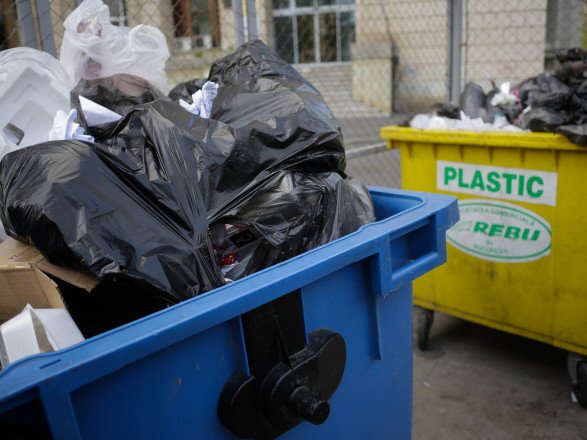
The most visible impact for an apartment block resident will be a simple one: instead of a single bag, they will have to come downstairs with several, one for each type of waste sorted at home. Dedicated containers are to be placed near the building, replacing the former chute. The new strategy also introduces a "pay as you throw" principle for residual waste, a fee calculated based on the actual amount of non-recyclable garbage produced. Separate collection would be organized into at least five fractions, with differently colored bins for each category.
The model already exists and works, at least partially, in District 6. The local authority is installing pre-collection points across the entire district — specifically underground bins — a project covering 886 collection points, 743 of which are underground. The total investment amounts to 130 million lei, largely funded through non-reimbursable European grants.
On the other hand, in District 3, building chutes were closed approximately four to five months ago across a significant number of residential blocks. The alternative infrastructure had not been put in place beforehand, and residents found themselves without a functional waste disposal solution. The result was disorderly dumping of garbage in the street and widespread dissatisfaction among those affected.
Why It Matters Now
The European context makes action urgent. Romania ranks last in the European Union for recycling rates, at just 12.4%, against an EU average of roughly 50%, according to a European Commission report from June 2025. Of the 303 kilograms of household waste generated per person each year, 74% goes directly to landfill.
EU targets — a 50% recycling rate by 2020 and 55% by 2025 — have both been missed. Environmental experts warn that the risk of substantial fines through infringement proceedings is growing.
The Question That Remains
Compared to earlier documents, the current strategy is more detailed, better structured, and arrives at a moment when European pressure has increased considerably. The fundamental questions, however, are the same as in 2015: who pays for adapting the spaces in apartment buildings, who provides the containers, who persuades the resident on the eighth floor to carry three separate bags downstairs?
Authorities acknowledge that some decisions will be unpopular, including converting parking spaces into collection areas in densely built neighborhoods. Experts insist that no technical system, however well designed, works without a solid public information and education component.
The trash chute will disappear when every resident understands why three bags are better than one. This strategy could be the first serious step in that direction — if, this time, someone actually follows through.
Photo: Inquam Photos /George Călin