From Welded Steel to Rubber Tiles: How Bucharest's Playgrounds Changed Over the Last 50 Years
- Articles
- 13 JUL 26
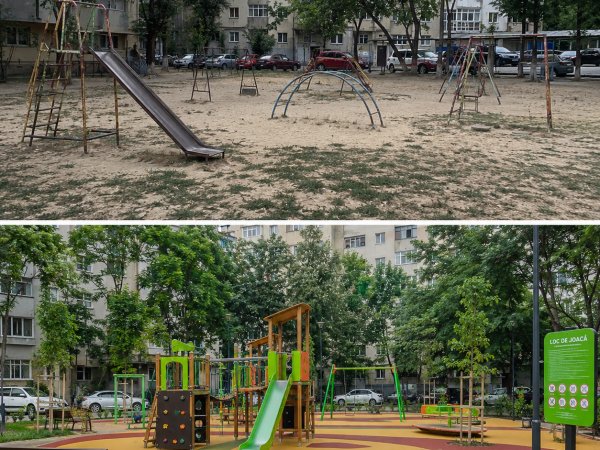
In the block neighborhoods built during the 1970s, a playground usually meant a swing made from welded pipe, a slide with rusting rails, and a climbing frame built for durability rather than for children. The sand around it mixed with dirt within a season, and the paint chipped off in the first year. Kids who grew up there don't remember the equipment as safe. They remember it as present, sitting in the courtyard between blocks, next to the carpet-beating rack and the old men's chess tables.
After 1990, many of these spaces fell into a kind of administrative limbo. The factories that had once sponsored neighborhood sports facilities lost their economic footing, city halls were still finding their feet, and playgrounds kept the same metal structures for years, growing more worn each season. The open courtyard between blocks, the unfenced space where children built routes through drying racks and makeshift garages, got swallowed gradually by parked cars. An architect who documented these in-between spaces of Bucharest's blocks for a photography project put it plainly: the old gangs of neighborhood kids disappeared as non-stop traffic between the buildings took over ground that used to belong to them.
The 2000s: plastic structures arrive, slowly
With the first wave of private investment and somewhat steadier city budgets from the mid-2000s on, colored plastic replaced metal. Yellow and green slides, combined platform-and-climber structures became the new standard, but installation was uneven across the city: some districts got new playgrounds next to freshly insulated apartment blocks, others kept their communist-era structures with little more than a fresh coat of paint. The ground under the equipment stayed, in most of the city, the same mix of sand, packed dirt, and occasional concrete slabs.
The recent years: rubber surfacing, accessibility, and competition between districts
The real shift came with the systematic rehabilitation programs launched by district administrations, most visible from 2023 onward. Sector 6 went furthest: it counts 110 playgrounds outside its ten major parks, and 85 of them have already been fully modernized with permeable shock-absorbing rubber surfacing, so the spaces stay usable after rain or through winter without turning to mud. The playground on Rușețu Street has a miniature road course, complete with traffic signs and pedestrian crossings, meant to teach kids the rules of the street through play — the only one of its kind in the city. Alongside standard playgrounds, the district added three pump tracks, also the only ones in Bucharest, a skatepark, and four fenced dog runs.
Sector 5 followed a similar model on a smaller scale: the playgrounds on Malcoci Street and Inginer Dumitru Teodoru Street were fully dismantled and rebuilt with new equipment, expanded protective surfacing, and LED lighting, alongside tree planting and an automated irrigation system for the surrounding green space. The same standards, code-compliant equipment, accessible for children with disabilities, safe surfacing year-round, now show up in Sector 6's newest rehabilitations too, where playgrounds recently finished in Giulești, Crângași, Militari, and Drumul Taberei use equipment sourced from the US, Sweden, and Spain.
Playgrounds move into larger park projects
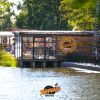
The most visible construction site right now is Insula Îngerilor, on Lake Herăstrău, under rehabilitation since February 2025 and, as of late May 2026, roughly 70 percent complete. The project pairs playgrounds with floating islands, docks, a beach area on green space, and a fountain, with a targeted opening by the end of July 2026. In parallel, on Lake Morii in Sector 6, the recreation area on the island is due for handover on July 20, and work has already started on a linear park along the lake's northern shore.
What changed isn't just the material the slides are made of. A playground is no longer designed as an isolated patch of metal dropped between apartment blocks, but as part of a park, with green space, lighting, sports courts, and, increasingly, explicit thought given to children with disabilities. What's still unclear is how quickly that standard reaches the neighborhoods still waiting their turn, with their tired 2000s-era equipment.
Also recommended From Vacant Lots to Playgrounds: Growing Up in Bucharest Over the Past 30 Years