More Than a Month's Wages, in a Single Night: The Money Behind Crucea de Piatră
- Articles
- 07 JUL 26
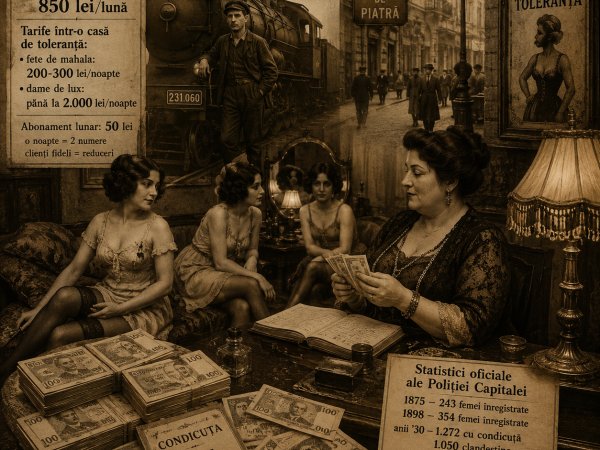
A locomotive engineer, one of the best-paid workers in interwar Bucharest, earned around 850 lei a month. A sought-after prostitute from the same period could take home more than double that in a single good night. A month's wages against a few hours of work: that comparison says more about the economics of "the oldest profession" than any description of atmosphere ever could.
A Pyramid of Earnings, Not a Fixed Rate
Interwar prostitution didn't run on a single price. It worked as a layered market, priced according to who was offering the service and to whom. At the bottom sat the "mahala" girls from neighborhoods like Crucea de Piatră, charging rates anyone could afford, between 200 and 300 lei a night. At the top, the most sought-after women reportedly reached 2,000 lei a night, according to a single source found so far, more than twice a locomotive engineer's monthly salary. That figure hasn't turned up in a second independent source yet, so treat it as plausible rather than confirmed.
A monthly subscription at a licensed brothel cost 50 lei, according to a surviving archival document, roughly the price of two kilograms of pork at the time. The subscription covered a set number of "numbers" (visits), with a simple house rule: a full night counted as two numbers, and regular clients got a discount. For an encounter with multiple rounds and an overnight stay, the price could climb to about half a skilled worker's monthly wage.
Taken together, period estimates put average earnings for a legally registered prostitute at 7 to 8 times the average national salary per month. The figure shows up consistently in period press and gets repeated by historians today, though the exact method behind it stays unclear. One source gives a different absolute number, 7,500 lei a month, for a slightly earlier stretch of the 1920s, without explaining whether the two calculations are even comparable.
Where the Money Actually Went
The raw numbers hide something important: most of that money never stayed with the women taking the risk. Every licensed brothel was run by a matroana, the owner of the establishment, sometimes called the "administratoră." Sources agree, in general terms, that she kept the largest share of the earnings, though none give an exact split. The rest went toward rent and upkeep. In the luxury segment, the rendez-vous houses, that spending often included the cost of protection from someone with influence, a police officer or a well-connected figure in the city.
A few women still managed to save enough to leave the business behind. A museum curator interviewed by România TV described, prefacing it herself with "it's said that," women who, after two or three years of steady work, bought a property and moved into a more conventional trade. That's a single account, not yet backed by an independent archival source, so it reads as plausible oral tradition rather than documented fact. For most women, real upward mobility was, in all likelihood, the exception rather than the rule.
An Industry with Official Records
What sets this phenomenon apart from similar ones in other eras is the sheer amount of administrative paperwork behind it. Bucharest's police kept a running count of registered women: 243 in 1875, 354 in 1898, and by the late 1930s, 1,272 registered prostitutes holding health cards, alongside another 1,050 working outside any registry at all. A licensed, taxed, and medically supervised market existed side by side with a fully informal one. Those inside the regulated system paid in fees and checkups; those outside it skipped the costs, but also the protection the system offered in return.
Also recommended The Stone Cross, forbidden love and the brothels of interwar Bucharest. The “sweet girls” read, spoke foreign languages and had good manners
AI generated picture