Did you know... that 6 Triumphal Arches were built in Bucharest?
By Raluca Ogaru
- Articles
- 31 MAR 26
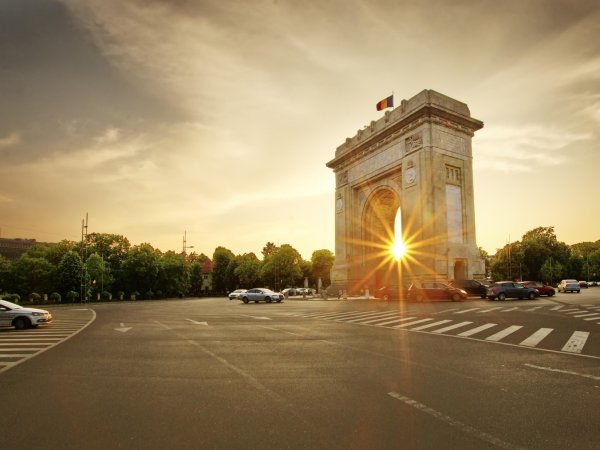
When you say "Arc de Triumf," your mind immediately flies to the imposing monument at the intersection of Kiseleff Road and Constantin Prezan Boulevard. It is the symbol of victory and national unity, but few Bucharesters know that the stone structure we admire today is actually the sixth version erected in the Capital. The history of this monument is one of radical transformations, from wood and painted canvas to the Deva granite that grants it immortality today.
Bucharest began exercising its "Little Paris" pride as early as the mid-19th century. The first step was taken in 1846, also on Kiseleff Boulevard. It wasn’t a permanent construction, but one rushed into existence made of wood to honor the Prince of Moldavia, Mihail Sturdza, during an official visit. Although ephemeral, this first arch established a tradition: the great moments of our history needed a symbolic gateway to glory.
From Independence to the Coronation of King Ferdinand
Live the moment when the Romanian troops returned victorious from south of the Danube! In December 1877, Carol I was greeted at the gates of the Metropolitan Church by a second Triumphal Arch, also made of wood. Less than a year later, in October 1878, the army that had won Romania's independence marched under a third structure, erected at the entrance to Victoria Square by engineers Cerchez and Cucu. These constructions were "alive," improvised to celebrate the emotion of the moment, and were demolished as soon as the echo of the military marches faded.
However, the real challenge came in 1922, following the coronation of King Ferdinand in Alba Iulia. Bucharest needed something grandiose, so architect Petre Antonescu designed a monument on the site of the current one. Unfortunately, haste and limited resources led to a compromise: a solid concrete foundation, but a superstructure made of wood, stucco, and lath-and-plaster. Although the bas-reliefs were impressive, the weather quickly turned the monument into an unsightly ruin, forcing the authorities to make a radical decision during the interwar period.
The Monument We See Today and the Marks Left by Communism
Between 1935 and 1936, Bucharest decided it was time for a definitive construction. The current Triumphal Arch was dedicated to Romania's participation in the First World War, inaugurated on December 1, 1936, in the presence of King Carol II and Queen Marie. From a legal and historical perspective, the monument is protected as a national heritage asset, yet the communist regime did not hesitate to "mutilate" it ideologically. The texts of King Ferdinand's proclamations were erased, and the faces of the royals, created by sculptor Alexandru Călinescu, were destroyed and replaced by two anonymous stone flowers.
Breathe a sigh of relief—history began to be repaired after 1989! The stone flowers disappeared, making way for bronze medallions featuring the faces of King Ferdinand and Queen Marie. Although the original inscriptions on the side panels have not yet been fully reinstated to reflect the exact 1936 version, the monument remains the most important witness to the city's modern history.
The next time you pass through Triumphal Arch Square, look closely at the details on the southern facade. You aren't just looking at a granite construction, but the summary of six attempts to define the free and conquering spirit of this city. Bucharest does not forget, even if it sometimes takes a century to set its history in stone.