Bucharest Holds Three World Records — and Somehow None of Them Are Something to Brag About
- Articles
- 13 MAY 26
There is a paradox at the heart of Bucharest that few people dare to say out loud: Romania's capital holds Guinness-certified world records, leads European rankings, and generates statistics that leave visitors speechless — only some of those statistics are flattering, while others ought to keep the city's conscience awake well past midnight. The superlatives are real. The question is what we do with them.
The Building That Weighs as Much as a Small Mountain
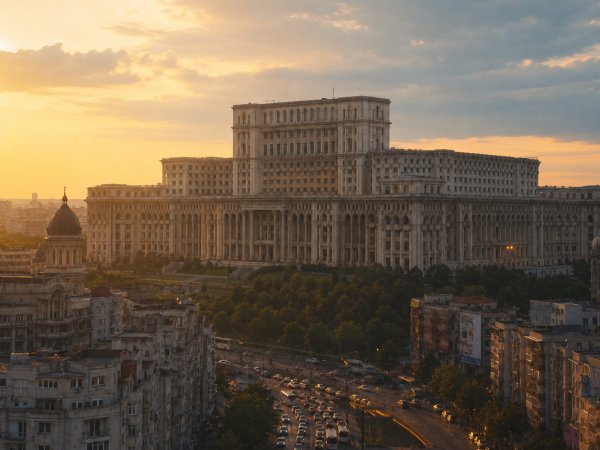
Any conversation about Bucharest and records must begin, inevitably, with the Palace of the Parliament — a structure that entered the Guinness World Records with no fewer than three simultaneous titles. With a floor area of 365,000 square metres, a weight of approximately 4.1 million tonnes, and a cost estimated at four billion euros at the time of its 2020 valuation, the Palace of the Parliament is, all at once, the largest civilian administrative building in the world, the heaviest, and the most expensive of its kind — an architectural trifecta that no other capital on earth can claim.
The raw numbers are already staggering: to raise it, the workers — more than 20,000 people labouring in round-the-clock shifts — poured one million cubic metres of marble, 700,000 tonnes of steel and bronze, 3,500 tonnes of crystal glass and 900,000 cubic metres of timber, all sourced from within Romania. Lead architect Anca Petrescu was 28 years old when she took on the project, overseeing a team of 700 architects — a figure that, placed in context, surpasses anything Western Europe had mobilised for a comparable construction in the post-war decades.
And yet the most revealing statistic about this building has nothing to do with its dimensions, but with what hides behind them: roughly 70 percent of the Palace of the Parliament remains unused. Of a total of 1,100 rooms, only 400 have been finished and put to use. The rest — corridors, protocol halls, antechambers designed for a power that vanished in December 1989 — exist in a strange suspension, neither ruin nor residence. The Independent once described the building as "hideous but also sort of impressive," placing it third on its list of the world's most remarkable structures — a backhanded compliment that, for all its irony, says more about the character of Bucharest than any tourist brochure ever could.
A Skyline Taller Than London
Few people realise that looking up at the Bucharest sky, they are facing a cathedral taller than Notre-Dame de Paris, taller than Saint Isaac's Cathedral in Saint Petersburg, and taller than Saint Paul's Cathedral in London. The Cathedral of the People's Salvation, with its main spire reaching 120 metres, quietly — or rather, monumentally — joins the ranks of the tallest Orthodox churches in the world, built on a site that, seen from the air, redraws the symbolic map of an entire national project.
Above it, on the corporate skyline of the city's north, Sky Tower stands at 137 metres as the tallest secular point in Bucharest — a column of glass and steel raised from 50,000 cubic metres of concrete, around which an entire business district has assembled itself over a few decades, one that the Bucharest of the 1990s could not have imagined. The Floreasca–Barbu Văcărescu corridor now concentrates a density of office towers comparable to the financial districts of far larger capitals, and is, in the same breath, one of the sharpest illustrations of a city that has reinvented itself without a plan, but with considerable energy.
1.6 Million Cars and Air That Is Paid for in Health
There is a second category of Bucharest records — less prominent on tourist brochures, but every bit as real. According to 2024 data, Romania's capital has 1,645,316 registered vehicles for a population of approximately 2.2 million — a ratio that places Bucharest among the most motorised capitals in Europe relative to its population. Sixty percent of those vehicles are more than ten years old, and more than a third run on diesel. The effect is measurable as well as felt: road traffic accounts for 60 percent of the air pollution in Bucharest.
The direct consequence is that, as of 2025, Bucharest ranks first among the most polluted capitals in the European Union, with an average PM2.5 concentration of nearly 15 micrograms per cubic metre — three times the limit recommended by the World Health Organisation, and occasionally four times that threshold in the city's busiest neighbourhoods. Athens and Warsaw follow in the ranking, at some distance. It is a record that none of Bucharest's mayors has treated as an urgent enough priority, for long enough.
The City That Leads — for Better and for Worse
CITY INDEX 2025, the comparative analysis of Romania's 41 county-seat municipalities, places Bucharest first across the greatest number of indicators — 14 out of 51 — including access to services, economic infrastructure and connectivity. It is, without question, the country's economic engine: more than half of the companies in Romania's Top 100 most performant firms of 2025 are headquartered in the capital.
But Bucharest's superlatives always carry this double texture — grandiose and heavy at once, built by both hands of history. A building with three world records, 70 percent of it standing empty. A cathedral taller than Notre-Dame, funded with public money over 14 years and still missing its deadlines. The most motorised and most polluted air among EU capitals, produced by a city that keeps growing without ever stopping to breathe.
Perhaps this is, in the end, the definition of Bucharest: a place that manages to come first at things it never planned for, and to fall short of things it promised itself. A city of involuntary superlatives, which deserves to be understood exactly as it is — with all its records, flattering and damning, past and still to come.
Also recommended: The Museum of Romanian Records, an impressive collection of objects unique in the world: schedule, tickets, exhibitions