Why the Arch of Triumph is the site of the December 1st parades: historical, symbolic and urban context
By Bucharest Team
- Articles
- 01 DEC 25
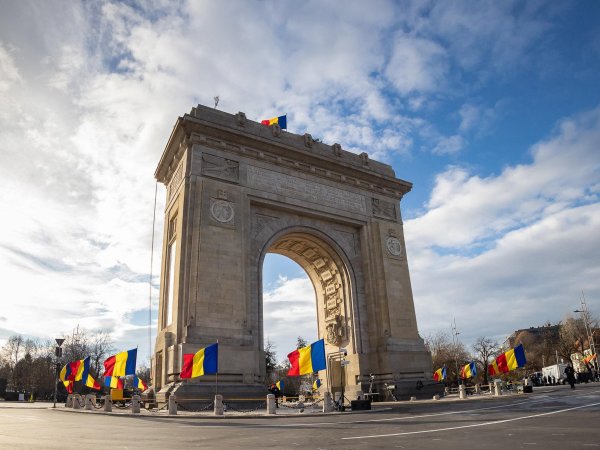
Each year on December 1st, Bucharest centres its public attention around the Arch of Triumph. On the surface, the choice looks straightforward: a monument placed along a broad axis, naturally suited for a military procession. But this positioning is not the result of administrative habit. It formed gradually, as the city’s history, the state’s symbolic repertoire and the urban structure began to overlap. After 1990, when Romania redefined the meaning of its National Day, the Arch of Triumph emerged as the place capable of supporting both the memory of the Great Union and the public display of the modern army — and Bucharest progressively fixed this space as the central stage of the ceremony.
The first systematic uses of the Arch of Triumph in public ritual date back to the interwar period. The Kingdom was then accelerating the modernization of its army, and the May 10th parades (the National Day of the Kingdom) required an urban setting able to accommodate large formations, heavy equipment and substantial crowds. Kiseleff offered the advantage of a straight route, enough width for military vehicles and an architecture that produced a coherent public backdrop.
After 1947, the communist regime reshaped the symbolic calendar. The national parade moved to August 23rd, and the Arch of Triumph lost its central ceremonial role. The regime favoured newly built, ideologically aligned boulevards (especially the area of today’s Unirii Boulevard), where it could fully control the aesthetics and logistics of events. Even so, the Arch remained a discreet reference to the pre-communist past, without major public function.
Its return to prominence began after 1990, when the state’s identity was being recalibrated. Once Romania adopted December 1st as the National Day, the authorities needed a location capable of linking three historical layers: the memory of the First World War, the Great Union, and contemporary military representation. The Arch of Triumph met all these criteria simultaneously. As an architectural symbol consecrated to the victory of 1918, it aligned naturally with the day celebrating the territorial unification of Romania.
Beyond symbolism, there is an urban logic. The area around the Arch allows for a parade with varied military equipment in an open, logistically manageable space, without excessively disrupting central traffic. Kiseleff maintains the axial structure required for a military procession, while the adjacent parks absorb the flow of spectators. Unlike University Square or Constitution Square, the Arch offers a stable urban scenography, unlinked to protest culture, immediate politics or the monumental architecture of the communist regime.
As Bucharest modernized, the Arch of Triumph solidified its position in the visual imagination of National Day. All components — historical, urbanistic, technical and symbolic — point to the same conclusion: it is the only place in the city that can sustain a national-level military parade without distorting the meaning of the celebration.
This is why December 1st in Bucharest is not geographically negotiable. In the logic of the post-1989 Romanian state, the Arch of Triumph has become the natural stage of the ceremony — a space where historical memory, institutional representation and urban form align without conflict.
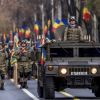
Photo: Facebook/ Mapn