Bucharest, Cluj or Timișoara — Where Is It Cheaper to Live with a Family in 2026?
- Articles
- 06 MAR 26
Romania has three major urban economic engines — and a growing number of families are asking themselves whether staying in the capital still makes sense, or whether relocating to another city would mean, in concrete terms, a better quality of life for the same money or even less. It's a legitimate question, particularly in a context where rents have risen sharply, the cost of private education has surged and the financial pressure on families with children has intensified considerably over the past few years.
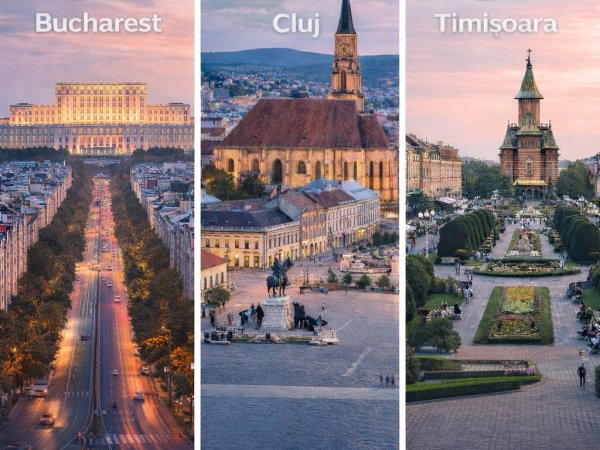
Bucharest, Cluj-Napoca and Timișoara are the cities that concentrate the largest number of professional opportunities, the best medical and educational infrastructure and, inevitably, the highest cost of living in the country. But not equally so. There are significant differences between them — in rent, in kindergarten fees, in average salary and in what actually remains in your pocket at the end of the month — and for a family with two children, those differences can amount to several hundred euros every single month.
Salaries — Where You Start From
Before talking about expenses, what you earn matters. And here the differences are significant.
The highest average net salaries are recorded in Bucharest — 6,978 RON/month, followed by Cluj at 6,335 RON and Timiș County at 5,755 RON. In other words, if you work in IT, finance or engineering and can choose your city, Bucharest pays the most, Cluj comes right after, and Timișoara trails by almost 1,300 RON compared to the capital.
But a higher salary doesn't automatically mean more money left over after expenses. What matters for a family is what remains after rent, kindergarten and groceries.
Rent — The Biggest Difference Between the Three Cities
Rent is, in most cases, a family's largest monthly expense — and this is precisely where the difference between the three cities is most visible.
In Bucharest, the average rent for a new two-bedroom apartment has reached 780 euros per month, representing 57% of the average net income. Timișoara remains the city with the best ratio between income and rent — an average rent of 500 euros represents 43% of the monthly salary.
Rent prices in Cluj-Napoca are, on average, 13.5% higher than in Bucharest — which places it first nationally in terms of rent burden relative to income. Rents in Cluj range from 250 euros for a studio in Florești to 800+ euros for premium apartments in the city center, with a standard two-bedroom in central areas reaching 600–700 euros/month.
The conclusion on rent is clear: Timișoara wins by a wide margin. A family renting a two-bedroom apartment saves between 200 and 400 euros per month compared to Cluj and Bucharest — money that adds up significantly over time.
Private Kindergarten — Where You Pay the Most
For families with young children, private kindergarten is often the second-largest expense after rent. And here too, there are notable differences between the three cities.
Cluj and Bucharest frequently exceed 2,000 RON per month for private kindergarten, with some Cluj institutions listing educational fees of 3,100 euros per year. In Bucharest, the average monthly fee for a standard private kindergarten program is 1,800–2,500 RON, with an enrollment fee of 500–800 RON and additional optional activities on top.
Timișoara sits below both Bucharest and Cluj on pricing, with fees ranging between 1,200 and 2,300 RON/month depending on the program and profile.
State kindergarten differences virtually disappear across all three cities — costs are nominal everywhere, but spots are limited and waiting lists can be long, particularly in Cluj and Bucharest.
Day-to-Day Costs — Food, Transport, Utilities
Estimated monthly costs for a family of four in Bucharest, excluding rent, sit at approximately 12,080 RON. In Cluj-Napoca, the same family needs around 11,970 RON per month without rent, and a meal at an inexpensive restaurant costs 55 RON compared to 60 RON in Bucharest.
The difference in daily living costs between the three cities is smaller than one might expect. Food, public transport and utilities are relatively similar across the board — Timișoara holds a slight edge, but nothing dramatic. Where the difference is felt is in restaurants and services, where Bucharest remains the most expensive of the three.
Public transport deserves a separate mention: for certain categories of commuters, free public transport in Cluj can meaningfully reduce monthly costs. Timișoara also has a well-developed and affordably priced public transport network.
Quality of Life with Children — What Doesn't Show Up in Spreadsheets
The numbers tell part of the story. The other part is what daily life actually looks like with a child in each of these cities.
Bucharest offers the widest range of options — private schools, specialized medical centers, extracurricular activities, large parks, cultural events. The price of this diversity is traffic, pollution and the city's relentless pace, which wears residents down more than most of them admit.
Cluj has a high quality of life — a compact city, less congested than the capital, with an active cultural scene and easy access to the mountains. The major drawback in 2026 is that Cluj-Napoca risks becoming inaccessible for young people and middle-income families, as rents have risen consistently over the past several years.
Timișoara likely offers the best balance between cost and quality of life for a family. The city is calmer, more affordable, with solid infrastructure and a long-standing multicultural community. The disadvantage compared to Cluj and Bucharest is a narrower job market in certain sectors and fewer options in the private education segment.
Which City Wins?
There's no universal answer, because it depends on your family's income and priorities. But if we're being honest about the overall picture:
Timișoara is the most accessible choice for a middle-income family — lower rents, cheaper kindergartens and a more favorable income-to-expenses ratio than the other two cities. If you can work remotely or have a solid local job, Timișoara likely leaves the most money at the end of the month.
Bucharest has the highest salaries and the greatest diversity of opportunities, but the expenses match. It makes financial sense if you work in a well-paying field and if you value access to services and opportunities the other two cities simply can't offer at the same scale.
Cluj was long the answer to "where do you live well without paying Bucharest prices" — but that advantage has visibly eroded. It remains an attractive city, particularly for above-average income families, but it is no longer affordable by any reasonable definition of the word.
Also recommended Bucharest Job Market 2026 — Salaries, Trends & Key Sectors