Beer in Bucharest in the middle of summer? An old-time tradition, a modern-day pleasure
By Raluca Ogaru
- Articles
- 27 JUN 26
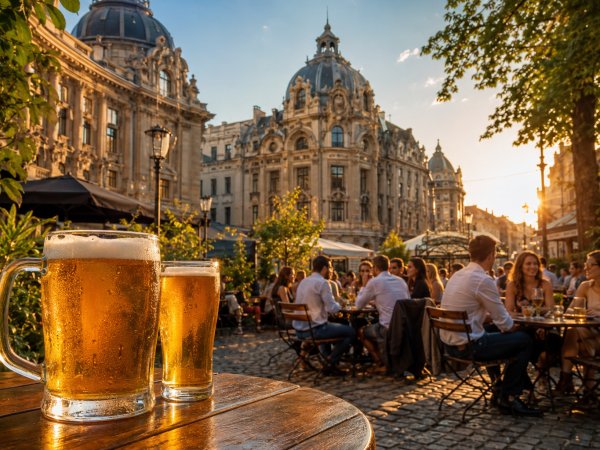
In Bucharest, summer has its own sound: misted glasses, full terraces, fans slowly turning, tables set out on the street and conversations stretching late into the night. Among all these small urban rituals, a cold beer has remained one of the city’s simple pleasures. It is not just a seasonal drink, but part of the way Romania’s capital has lived its summers, from the old beer halls of the 19th century to today’s venues in the Old Town, parks, repurposed industrial halls and modern taprooms.
The story of beer in Bucharest does not begin with colourful advertising and today’s crowded terraces, but with a city that was modernising, with merchants arriving from Transylvania, with factories built on the outskirts of the capital and with beer halls that became meeting places for traders, artists, journalists, actors and passers-by. In a city where the café, the tavern and the summer garden have always had a social role, beer found its natural place: popular enough for everyday meals, but also urban enough for long summer evenings.
How beer became part of old Bucharest
Bucharest in the 19th century was a city in transition. Its streets were beginning to take on a European air, new buildings appeared, trade developed and urban tastes changed along with the people arriving from the Austro-Hungarian Empire, the German-speaking world or Transylvania. Beer, long associated with German and Central European influence, gradually entered the life of the city not only as a product, but also as a reason to socialise.
One important landmark is the Luther Brewery, founded in 1869 by German industrialist Erhard Luther. Goethe-Institut describes the history of this brewery as part of an impressive industrial culture that stretched over more than a century. The Luther Brewery, later also associated with Grivița, was one of the signs that beer was no longer just an urban curiosity, but an industry with serious roots in Bucharest.
At the beginning of the 20th century, beer production was linked to large factories, powerful entrepreneurs and neighbourhoods that were then on the edge of the city. The former Luther Factory produced, according to the platform dedicated to the history of the property on Calea Griviței, four million litres of beer per year in 1902 and was the largest beer producer in the country, information recorded on the Fosta Fabrică website. Such places changed not only consumption habits, but also the urban landscape: wherever there was a factory, workers, warehouses, gardens, roads, habits and a small beer economy appeared around it.
At the same time, the beer halls in the city centre were becoming places with memory. They were not only spaces where people drank beer, but real stages of the city. Business was discussed there, friends met, the news of the day was commented on and that Bucharest atmosphere we now look for in old photographs was created: wooden tables, tankards, hurried waiters, elegantly dressed people, but also a lively, popular air, without too many pretensions.
From Caru’ cu Bere to Gambrinus, the beer halls that made history
One of the best-known stories is that of Caru’ cu Bere, which remains a symbol of touristic Bucharest today. According to the history published by Caru’ cu Bere, in 1879 there was a beer hall on Calea Victoriei, at number 2, called “La Carul cu bere”, run by Transylvanian Ion Căbășanu. The name came from a very concrete image: the beer was brought to the tavern in horse-drawn carts.
The venue that can be seen today on Stavropoleos Street also became famous thanks to its spectacular neo-Gothic building. According to the same source, the story of the Mircea family and of the beer hall is connected to the end of the 19th century, when Bucharest was gaining more and more public places with a strong identity. For today’s tourist, Caru’ cu Bere is a visual attraction. For old Bucharest, it was a meeting place and a mark of the city.
Another beer hall that entered local legend is Gambrinus, associated with Ion Luca Caragiale. Its story is important not only for the history of beer, but also for the cultural history of Bucharest. According to a material published by B365, the beer hall existed before Caragiale, as early as 1897, and the writer bought it in 1901. The fact that a beer hall could be linked to the name of a major playwright says a lot about the role these places had in the public life of the city.
Bucharest’s beer halls were not only places of consumption. They were spaces for conversation, oral news, humour, everyday politics and social observation. In a city of cafés and newspapers, beer was often enjoyed with a story, a remark, irony and a certain rhythm of the evening. This is perhaps where the difference between beer as a product and beer as an urban habit can be seen most clearly.
Summer gardens and beer as social refreshment
Before air conditioning became part of city life, Bucharest residents looked for shade, courtyards, gardens, terraces and places where they could breathe. Summer gardens were, in this sense, among the most loved spaces in the capital. There, cold beer had a clear role: it refreshed, brought people together and prolonged the evening.
Large beer factories often linked their names to such gardens. Around them, not only consumption was built, but also leisure time. People came after work, with family or friends, ate simple food, listened to music, talked and laughed. Beer was not necessarily a sophisticated gesture, but a common, natural one, part of Bucharest summer life.
This tradition explains why, even today, beer feels best in Bucharest on a terrace. The city has many beautiful indoor venues, but summer moves everything outside: onto pedestrian streets, near parks, into hidden courtyards, at small tables, under umbrellas or beneath trees. If, in the past, summer gardens were the places where the city escaped dust and heat, today’s terraces take over the same function, even if the setting has changed.
The difference is that today’s public has more options. Alongside classic beer, craft beers, alcohol-free varieties, local labels, imports and specialised taprooms have appeared. The tradition has not disappeared, but has split into several styles of consumption, from a cold tankard ordered on a large terrace to tasting a beer produced in small batches.
Where you can drink a good beer in picturesque Bucharest
For a tourist who wants to feel old Bucharest, Caru’ cu Bere remains one of the most obvious stops. It is not only about beer, but about décor, history, architecture and the atmosphere of a symbolic venue. Its location in the Old Town makes it easy to include in a walking route that can continue towards Stavropoleos, Calea Victoriei, Lipscani and Macca-Vilacrosse Passage.
For a summer experience close to water and greenery, Berăria H is one of the best-known contemporary options. The venue presents itself as the largest beer hall-restaurant in south-eastern Europe and has a terrace on the shore of Herăstrău Lake, according to the official Berăria H website. For tourists, the area has the advantage of being easily connected to King Michael I Park, the Arc de Triomphe and the Village Museum, which makes it a very good route for a hot day.
Those interested in craft beer can look for the places that have changed the way beer has been consumed in Bucharest in recent years. Fabrica Grivița talks about craft beer production in Bucharest and keeps, through its name and positioning, an interesting symbolic connection with the city’s old industrial beer history. For a city that once had important factories, the fact that beer is returning to the urban conversation through smaller, more transparent and public-oriented places feels like a natural continuity.
Another direction is represented by specialised taprooms. Hop Hooligans Taproom is located on Jean Louis Calderon Street and presents itself as a place where you can try fresh draft beer in the heart of Bucharest. Zăganu, a Romanian craft beer brand produced independently since 2013, shows that the local public has increasingly started to look for flavours, stories and Romanian labels, not only major brands.
For a walk with a picturesque feel, the route can be kept simple: a historic stop in the Old Town, a beer on a terrace in the Calea Victoriei or Lipscani area, then an evening near a park in the northern part of the city. Bucharest has the advantage of offering several settings for the same ritual: a summer beer can sit on a wooden table in a historic venue, on a modern terrace, in an urban courtyard or by a lake.
What is happening today with beer in Romania and why Bucharest remains relevant
Although beer may seem omnipresent in summer, Romania’s beer market has gone through a difficult period. In 2025, consumption fell to 14.4 million hectolitres, the lowest level in the last 20 years, according to data communicated by the Romanian Brewers Association. This is important information for understanding the difference between beer’s cultural image and the economic reality of the industry.
The decline in consumption does not erase the tradition, but it shows that habits are changing. Some consumers choose beer less often, more carefully or differently. Some look at the price, others at quality, others prefer alcohol-free beer, venues with a story or craft brands. In Bucharest, this can best be seen through the diversity of places: historic beer halls, large restaurants, pubs, taprooms and terraces that function like small summer stages.
For tourists, beer can be an easy way to understand the city. Not through excess, but through ritual: a break after a long walk, a meal in an old venue, an evening in a park, a tasting of Romanian beer or a stop in a place that says something about Bucharest. In this sense, beer remains a form of urban hospitality.
For locals, it is rather a continuity. Bucharest residents do not need to turn every beer into an event, because the gesture is part of the natural rhythm of summer. But precisely this naturalness is interesting for visitors: the city is best seen in its relaxed moments, when people are not rushing, but sitting, talking and letting the evening pass.
A tradition with the taste of the city, from old halls to modern terraces
Beer in Bucharest is not only a story about factories, brands and venues. It is a story about how the city learned to sit together at the table. From old beer halls to summer gardens, from industrial factories to today’s taprooms, beer has accompanied the capital’s moments of pause.
Summer gives this story an even clearer meaning. When the city heats up, people look for shade, outdoor tables, long conversations and cold drinks. It was like this in the past and it is still like this today, even if the scenery has changed. Horse-drawn beer carts have been replaced by digital menus, online bookings and craft beers, but the need for a pause has remained the same.
READ ALSO:
The history of the Grivița brewery and excellence in Bucharest’s brewing tradition
For Bucharest, beer is a small thread of continuity between the old city and the one we know today. It does not explain everything, but it says something essential about it: the capital is best experienced when you give it time, when you sit down at a table and let the stories flow slowly, like on a summer evening.
Beer should be consumed responsibly and only by adults. For tourists, as well as for locals, the charm of this tradition does not lie in quantity, but in context: the place chosen, the people at the table, the story of the building and the simple pleasure of discovering Bucharest without rushing.