Zlătari Church, four centuries of history: founded by Matei Basarab, restored by Mihai Cantacuzino, struck by earthquakes
- Articles
- 07 AUG 26
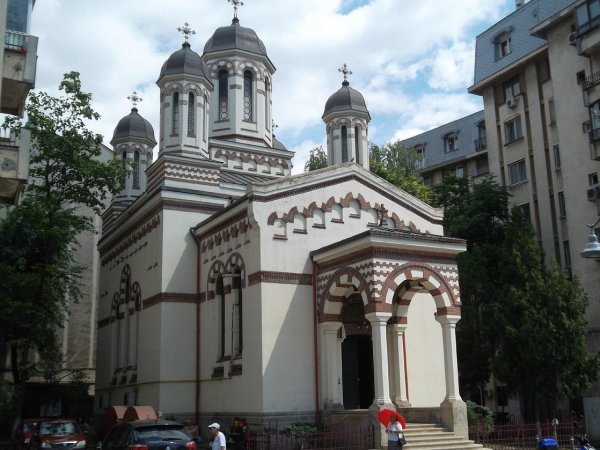
Zlătari Church is one of the oldest churches in Romania's capital, a monument that has survived for nearly four centuries despite fires, earthquakes, demolitions, and the urban transformations that have repeatedly reshaped Bucharest. Hidden today among the modern buildings on Calea Victoriei, the church preserves within its walls the story of a commercial and cosmopolitan Bucharest, where inns, churches, and shops formed the heart of the city's economic and social life. Originally built during the reign of Prince Matei Basarab and rebuilt at the beginning of the 18th century by the Grand Spatharios Mihai Cantacuzino, Zlătari Church was closely connected from its very beginning to one of the most important inns in the city. Throughout its existence, the monument was damaged by the major earthquakes that struck Wallachia, restored by renowned architects, and adorned with the paintings of one of the greatest Romanian artists of the 19th century, Gheorghe Tattarescu. Today, the church is known not only for its historical and artistic value but also because it houses the relics of Saint Martyr Cyprian, one of the most venerated saints of the Orthodox Church.
From the church of the goldsmiths and silversmiths to one of Bucharest's wealthiest monasteries
The history of Zlatari Church begins in the first half of the 17th century, during a period when Bucharest was rapidly developing around the Princely Court. Tradition says that a wooden church originally stood on this site, built by the community of zlatari, craftsmen specializing in the working of gold and silver. The church owes its name to these goldsmiths and silversmiths, a name that has been preserved to this day.
Legend has it that the land on which the church was built came from the estates of Elena, the daughter of Prince Radu Șerban and the mother of the Wallachian branch of the Cantacuzino family. Around this settlement grew one of old Bucharest's important neighborhoods, inhabited by merchants and craftsmen.
In 1635, Prince Matei Basarab, one of the greatest founders of churches in the history of Wallachia, replaced the old wooden church with a masonry building. His reign represented one of the most flourishing periods for Romanian religious architecture, and many churches erected during that time became landmarks of the country's national heritage.
The first documented mention of Zlatari Church dates from August 25, 1667, confirming its existence and importance in 17th-century Bucharest. At that time, the church was dedicated to the Nativity of the Mother of God, celebrated every year on September 8, a patronal feast that it still observes today.
At the beginning of the 18th century, the old church was almost entirely rebuilt by Grand Spatharios Mihai Cantacuzino, one of the most influential noblemen of the era. According to the inscription written in Greek and dated 1709, the new church had been rebuilt from its foundations in 1705.
The founder endowed the monastery with numerous properties, shops, wine cellars, and estates, transforming it into one of the wealthiest monastic settlements in Wallachia. The income generated by these possessions enabled the complex to develop and be maintained for many generations.
During the same period, both the monastery and the inn surrounding it were dedicated to the Patriarchate of Alexandria, during the reign of Prince Constantin Brâncoveanu, on the occasion of the visit paid to Bucharest by Patriarch Gerasimos Palladas.
Zlatari Inn, one of Bucharest's busiest commercial centers
Like many other important churches in old Bucharest, Zlatari was part of a much larger complex. Surrounding the church stood Zlatari Inn, one of the capital's best-known commercial inns.
At the time, such inns played an essential role in the city's economy. Merchants arriving from across the Balkans found accommodation, warehouses, workshops, and shops here. The revenue obtained from renting these commercial spaces financially supported the monasteries and churches to which the inns belonged.
Zlatari Inn occupied a vast area on today's Calea Victoriei, between Lipscani Street and the present-day Stavropoleos Street area, extending as far as the vicinity of the former Post Office Palace, now the National Museum of Romanian History.
Around 1860–1862, the inn consisted of a ground floor and an upper floor and contained nearly two hundred rooms and shops, all of them rented out. The commercial spaces on the ground floor housed grocery stores, merchants' shops, taverns, workshops, and various businesses owned by Romanian, Greek, Armenian, and Jewish traders, illustrating the cosmopolitan character of Bucharest during that period.
Between 1867 and 1887, the upper floor of the inn was occupied by the Ministry of Public Instruction and Religious Affairs, demonstrating both the importance and the impressive size of the building.
In 1870, one of Bucharest's largest and best-stocked grocery stores operated inside Zlatari Inn. It belonged to the merchant Păun Popescu and was renowned for the wide variety of goods imported from both Romania and abroad.
The church remained the spiritual center of this commercial complex, and in 1888 it officially became a parish church, continuing to serve the residents of the city's central district.
Unfortunately, the urban development projects of the early 20th century were to radically transform this area. In 1903, the authorities decided to demolish Zlatari Inn and the bell tower standing in front of the church in order to widen Calea Victoriei.
During these works, important fragments of the old mural paintings and an inscription referring to the monastery's dedication to the Patriarchate of Alexandria were discovered. Unfortunately, the fresco depicting the Nativity of the Mother of God, uncovered at that time, was later lost.
The demolition of the inn permanently altered the appearance of the entire complex. The church, which for almost two centuries had been enclosed by the walls and buildings of the inn, was left standing alone on Calea Victoriei, exposed to the new urban transformations of Bucharest.
Earthquakes put the church to the test, but also made its rebirth possible
The history of Zlatari Church is closely connected to the major earthquakes that struck Bucharest. The devastating earthquakes of 1802 and 1838 caused severe structural damage to both the church and the inn surrounding it, leaving the old building beyond the possibility of simple repairs.
In 1850, the construction of a new church began from its very foundations, with the blessing of Metropolitan Nifon of Ungro-Wallachia and during the reign of Prince Barbu Dimitrie Știrbei. The works were initiated by Abbot Calistrat Livis, and after his death they were continued and completed by his successor, Athanasie Livis. He was responsible not only for completing the church but also for rebuilding the entire surrounding complex, including the monks' quarters and the auxiliary buildings necessary for the monastery's operation.
The new church was erected according to the plans of architect Xavier Villacrosse, one of the most respected architects in 19th-century Bucharest. French by origin, Villacrosse played a decisive role in the modernization of the Romanian capital, and the Zlatari project remains one of the most significant religious buildings associated with his name.
Between 1853 and 1856, the church's interior was painted by Gheorghe Tattarescu, one of the leading figures of 19th-century Romanian art. The artist adopted a composition that was considered modern for its time, arranging the biblical scenes into large, harmonious, and luminous panels. Although time and the smoke from countless candles have darkened the paintings, they remain among Tattarescu's finest religious works.
The artistic value of the interior is further enhanced by the carved and gilded wooden iconostasis, together with the silver-covered icons, all of which are genuine works of art that give the church its distinctive character.
Following the reconstruction carried out in the mid-19th century, the bell tower was also rebuilt, becoming one of the defining features of the complex. However, it disappeared only a few decades later when Zlatari Inn was demolished.
After the inn vanished, the church underwent another extensive restoration between 1907 and 1908 under the supervision of architect Jean Pompilian, with the participation of architect Grigore Cerchez. These works focused on strengthening the monument and preserving its artistic elements while adapting it to the new urban landscape created by the widening of Calea Victoriei.
The 20th century brought further challenges. The earthquake of 1940 caused the collapse of the church's domes, which were rebuilt only provisionally. It was not until 1971–1973 that they were reconstructed in the form that can still be seen today.
Only a few years after these works had been completed, the devastating earthquake of March 4, 1977 once again damaged the monument, making new consolidation and restoration works necessary. Thanks to these successive interventions, Zlatari Church managed to survive one of the most difficult periods in its history.
Until after 1977, the church stood alone between Stavropoleos and Lipscani streets, while the site of the former inn had become a green space beneath which the foundations of the old commercial complex still remained. Later urban developments radically changed the landscape, and today the church is reflected in the glass façades of the modern office buildings that dominate Bucharest's financial district.
The monument's architecture and the relics of Saint Martyr Cyprian
Although it is now surrounded by tall modern buildings, Zlatari Church continues to impress visitors with the elegance of its proportions and the harmony of its architecture.
The present-day building has a single-nave plan measuring approximately 23 meters in length and 12 meters in width. The sanctuary ends in a semicircular apse, while the lateral apses are only suggested within the structure of the walls, an architectural solution that gives the church a distinctive appearance.
The nave is almost square in shape and is crowned by a central dome resting on pendentives and broad arches. At its four corners rise four smaller octagonal domes placed on square bases, completing the harmonious silhouette of the monument and giving it a profile that is easily recognizable within Bucharest's urban landscape.
The narthex is narrower and covered by a barrel vault, while above the entrance is the choir gallery. Natural light enters through stained-glass windows depicting various saints, contributing to the solemn atmosphere inside the church.
Beyond its architectural beauty, Zlatari Church is one of Bucharest's most important pilgrimage sites because it houses the relics of Saint Martyr Cyprian. In front of the altar stands the reliquary containing the saint's right hand, a sacred relic venerated by Orthodox believers as miracle-working.
Saint Cyprian is known in Christian tradition as a former sorcerer who converted to Christianity, became a bishop, and ultimately suffered martyrdom for his faith. This profound spiritual transformation explains why countless believers seek his intercession in times of hardship, considering him a protector against witchcraft, curses, and evil influences.
Over the years, thousands of pilgrims from all over Romania have come to Zlatari Church to venerate these holy relics, turning the church into one of the capital's most important spiritual landmarks.
One of the most significant moments in the church's modern history took place on January 6, 1932, when the Epiphany service was celebrated here in the presence of King Carol II, Crown Prince Michael, Patriarch Miron Cristea, and Prime Minister Nicolae Iorga, together with the members of the Romanian Government. After the religious service, the official procession made its way to the Dâmbovița River for the traditional throwing of the cross into the water, before returning to the church, where the King and the Crown Prince attended the ceremonial parade of military units and regimental flags.
Today, Zlatari Church remains one of the defining monuments of old Bucharest. Although the inn that once gave life to the entire complex has long disappeared and the city surrounding it has been transformed beyond recognition, the church continues to preserve the memory of a capital where merchants, craftsmen, noblemen, and princes all contributed to shaping its identity. Within its walls, nearly four centuries of history, art, and faith come together, making Zlatari Church one of Bucharest's most precious religious and historical monuments.
We also recommend: How The Zlătari Inn Disappeared from the Capital, the Favorite Residence of Bucharest Bankers, After More Than a Century Since Its Construction