Did you know... Romania's first driving school was established in Bucharest in 1910?
- Articles
- 06 AUG 26
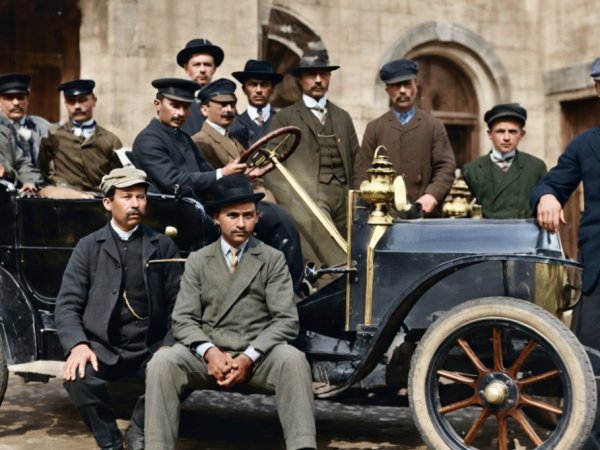
În 1910, the automobile was still a rarity on the streets of Bucharest, and the sound of its engine attracted the attention of passersby just as much as today's most spectacular supercars do. At a time when transportation was dominated by horse-drawn carriages and traffic regulations were only beginning to take shape, Romania's capital became the place where the country's first driving school was established. The initiative belonged to the Romanian Automobile Club, led by Leonida Leon, and marked a milestone in the development of road transport and the professional training of those who wished to drive automobiles.
Bucharest, the city where the history of driving schools in Romania began
At the beginning of the 20th century, the automobile was a symbol of technological progress and modernity. The number of cars was still small, but they were increasingly being used by wealthy individuals, state institutions, and various public services. Their appearance made it necessary to establish clear traffic regulations and to train those who would be behind the wheel.
In this context, the Romanian Automobile Club (ACR), under the leadership of Leonida Leon, decided to establish Romania's first driving school at the beginning of 1910. Bucharest thus became the place where the foundations of organized road safety education were laid, at a time when only a few European countries had well-developed systems for training motorists.
The new institution was not intended merely to teach students how to drive an automobile, but also to train drivers capable of operating vehicles safely and respecting the traffic rules that were just beginning to emerge. For that era, it was an extremely modern initiative, demonstrating a strong concern for road safety and for the development of motoring in Romania.
The driving test existed before the driving school
A lesser-known fact is that Romania's first official driving test took place before the establishment of the country's first driving school. In 1908, by order of the Prefect of the Bucharest Police, the first official examination was organized for those wishing to drive automobiles on public roads.
Unlike today's complex examinations, the assessment was extremely simple. Candidates had to pass only one test, known as the "speed with unexpected braking" test. Examiners observed how the driver controlled the automobile and reacted when required to brake suddenly.
This single test was considered sufficient to prove that the future driver could control the vehicle under difficult conditions. If the candidate passed the examination, they received a driving certificate, the document that legally entitled them to drive on public roads.
The fact that the driving test was introduced before the creation of a specialized driving school shows that the authorities quickly understood the need to regulate road traffic, even though the number of automobiles was still very small.
How the first driving school operated
After the school was established in 1910, the Romanian Automobile Club organized a well-structured training system for that period. The courses combined theoretical instruction with practical training, providing students with all the knowledge required to operate an automobile.
Theoretical classes took place in the morning and focused on understanding how an automobile functioned, learning traffic regulations, and acquiring essential technical knowledge. The afternoons were reserved for practical lessons, during which students learned how to start, maneuver, and control the automobiles made available by the school.
The entire program lasted two months, a period considered sufficient to acquire the necessary knowledge. At the end of the first training session, 12 students successfully graduated, becoming among the first drivers trained through an organized system in Romania.
Compared to today's standards, the duration of the courses may seem short, but it should be remembered that traffic was incomparably simpler. Roads were almost free of automobiles, and the main challenges came from sharing the streets with horse-drawn carriages, pedestrians, and animals roaming freely throughout the capital.
Gheorghe Simion, Romania's first driving instructor
The success of the first driving school was also due to the man responsible for training the future motorists. Gheorghe Simion is regarded as Romania's first driving instructor.
He was responsible for both the theoretical and practical training, carrying out the difficult task of teaching students how to operate automobiles that were far more complicated than modern vehicles. Starting the engine, changing gears, and controlling the brakes required solid technical knowledge and constant attention.
The instructor's experience was essential because automobiles at the beginning of the 20th century lacked modern safety systems. Every mistake could have serious consequences, and students had to quickly develop the reflexes necessary for safe driving.
Who could become a student
Enrollment in the first driving school required candidates to meet several clear conditions, some of which are surprisingly similar to those that still exist today.
Applicants had to be at least 18 years old and pay the enrollment fee. They also had to prove that they were in good health, since driving an automobile required physical effort and constant attention.
Another interesting requirement was the presentation of a certificate of good conduct. The authorities believed that a driver should not only be technically competent but also be a responsible person with an appropriate moral reputation.
These criteria reflected the concern to select drivers who would inspire confidence and contribute to the development of safe road traffic from the very first years of Romanian motoring.
The first road traffic regulations
The establishment of the driving school was accompanied by the introduction of Romania's first specialized decree regulating road traffic. It laid down clear rules both for the conduct of driving examinations and for granting driving privileges.
According to the decree, a student could take the driving test a maximum of four times within a year. The examination could not be held under just any circumstances, but only in the presence of an official representative of the Romanian Automobile Club and a traffic police officer, giving the procedure official status and ensuring the fairness of the evaluation.
This system represented one of the first institutional mechanisms for assessing drivers' skills in Romania and demonstrated that the authorities were already seeking to standardize driver training.
Another interesting detail concerns the automobiles used during the examinations. These belonged to the state and could easily be identified by the special inscription "Driving School", serving as the predecessor of today's learner vehicles.
From the Romanian Automobile Club to the Royal Romanian Automobile Club
The activities of the Romanian Automobile Club continued to expand in the following years, and its importance in promoting motoring steadily increased.
In 1914, as a tribute to Romania's Royal Family, the organization changed its name to the Royal Romanian Automobile Club. The new title reflected the prestige the institution had gained and its close ties with the Royal House.
For 33 years, members of the Royal Family served as presidents of the club, helping strengthen the image of Romanian motoring and expand the organization's activities. During this period, the club supported the organization of motor racing competitions, promoted road safety, and contributed to the development of infrastructure dedicated to motorists.
The legacy left by the Romanian Automobile Club and, later, by the Royal Romanian Automobile Club is exceptionally important. The first driving school established in Bucharest in 1910 was not only the beginning of a new profession but also the first step toward Romania's modern driver training system.
From the simple examination based on a single test to today's comprehensive training programs, the evolution of driving schools reflects the profound transformation of Romanian society and its adaptation to technological progress. Bucharest therefore remains the place where the history of road safety education in Romania officially began—a fascinating chapter in the history of the capital and of Romanian motoring.
We also recommend: