8 Lost Inns of Bucharest and the Buildings That Replaced Them
By Eddie Țone
- Articles
- 17 AUG 26
Old Bucharest hides in plain sight. Just pay attention. Beneath the dome of the CEC Palace, beneath the columns of the National Museum of Romanian History, or beneath the marble of the National Bank lie, layer upon layer, the foundations of a merchant city that smelled of wet wood, coffee, leather, wine, and goods brought along the dusty roads of the Balkans. Today’s hurried passer-by walks past palaces, bank headquarters, and solemn façades. Only the archaeologist sees the walls underneath. And the historian probably sees the demolition bill as well.
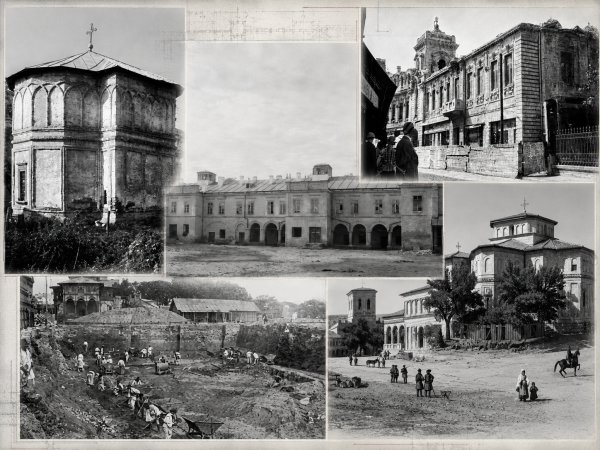
In Bucharest, an urban inn meant rooms for rent, shops, cellars, storerooms, and a courtyard protected by solid gates. Under the same roof, merchants found lodging for themselves and shelter for their goods—an extremely efficient combination at a time when travelling a trade route came bundled with mud, robbers, and a capricious administration. The Bucharest Municipality Museum estimates that the city once had around 145 inns. A handful of well-known buildings have survived from that commercial universe: Manuc’s Inn, the Linden Tree Inn, Gabroveni Inn, Solacolu Inn, and Elias Patria Inn (rarely mentioned, although it is the only 19th-century inn still inhabited), alongside many names buried beneath the modern city.
The eight places below tell the story of a spectacular transformation. Royal and monastic inns gave way to banks, museums, hotels, and public squares. Bucharest changed its clothes, but the plots retained the memory of the old cut.
Șerban Vodă Inn, the Merchants’ Fortress over Which the National Bank Was Built
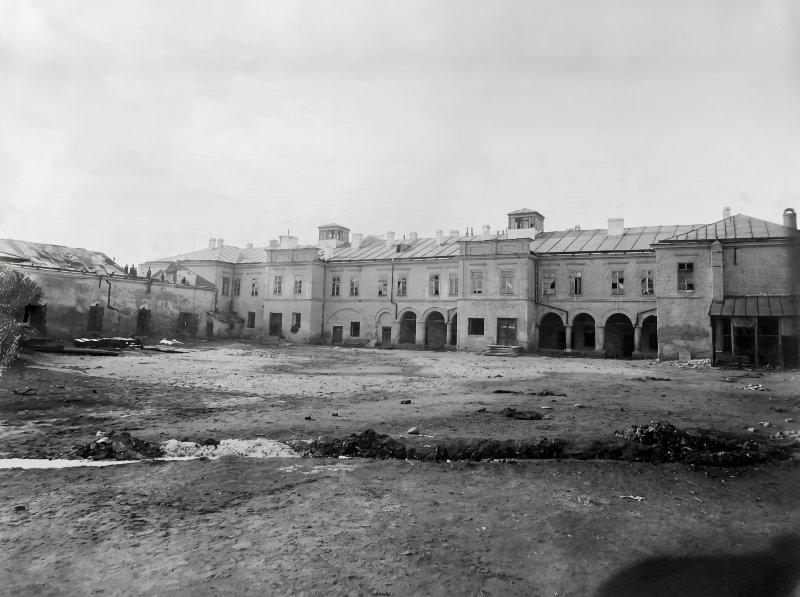 Șerban Vodă Inn / Image restored using artificial intelligence, preserving the original details.
The Old Palace of the National Bank dominates Lipscani Street with the calm air of an institution that knows the value of every centimetre of stone. Beneath it once stood Șerban Vodă Inn, one of the largest and most important inns of premodern Bucharest.
Șerban Cantacuzino built it between 1683 and 1685 and dedicated it to Cotroceni Monastery. The inn looked like a commercial fortress, with strong walls, gates, an inner courtyard, shops, and storage areas for merchandise. Security mattered enormously. A merchant might put up with a straw-stuffed mattress and a rather approximate dinner; losing his bales of cloth, however, called for an entirely different philosophy of life.
Its location near Lipscani and its reputation as a safe place attracted merchants and money changers, the forerunners of modern bankers. The change in the plot’s function seems almost programmatic. Money had been circulating through the inn’s courtyard long before the National Bank installed its vaults here.
The National Bank of Romania purchased the property in November 1881 for 800,000 lei. The Old Palace was built between 1884 and 1890 to designs by the French architects Cassien Bernard and Albert Galleron, with construction overseen by architects Nicolae Cerchez and Constantin Băicoianu. The inn disappeared, and one of the great buildings of Bucharest’s financial district rose in its place. Merchants with iron-bound chests were replaced by clerks with ledgers, and later by electronic systems. Concern for money has remained perfectly constant.
Constantin Vodă Inn, from Brâncoveanu’s Ambition to the National Museum of Romanian History
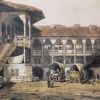
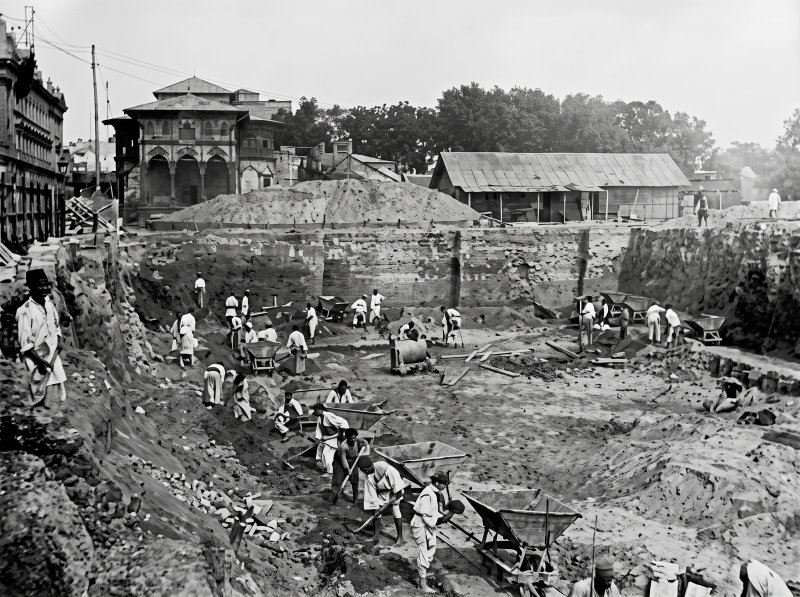 Image from the demolition of Constantin Vodă Inn / Image recreated using artificial intelligence, while largely preserving the original details.
Across from the CEC Palace stands the massive building of the National Museum of Romanian History, formerly the Postal Palace. The plot had previously been occupied by Constantin Vodă Inn, built by Constantin Brâncoveanu between 1692 and 1694.
The inn followed the model of Șerban Cantacuzino’s great establishment and became the second largest in the city. It had a broad courtyard, high walls, thick iron-clad oak gates, and commercial premises arranged around the enclosure. In 1848, the plan drawn up by Rudolf Arthur Borroczyn recorded 35 shops on the ground floor and 25 rooms upstairs. Business was thriving, although the building was ageing with a perseverance worthy of the local administration.
The Great Fire of 1847 hastened its decline. Demolition continued over several years, and by 1861 the site was already hosting an agricultural exhibition. Constantin Brâncoveanu Square followed, with shows, café-concerts, circuses, and makeshift stalls. Grigore Manolescu and Aristizza Romanescu performed at the popular Alcazar Theatre, while sources also list I.L. Caragiale among its performers. A former royal plot had become a little Wallachian Las Vegas, with more bragă and rather less neon.
The Postal Palace was built between 1894 and 1899 according to plans by architect Alexandru Săvulescu, inspired by the Geneva post office building. Today, it houses the National Museum of Romanian History. The succession remains splendidly characteristic of Bucharest: royal inn, circus fairground, administrative palace, museum.
Saint John the Great Inn, the Lost Complex Beneath the CEC Palace
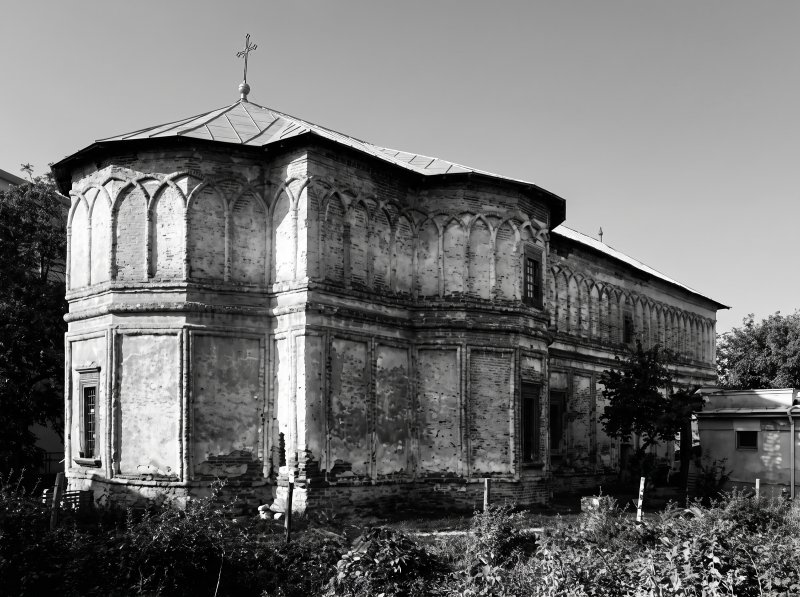 The Church of Saint John the Great Monastery, a complex that also housed the inn of the same name / Image recreated using artificial intelligence, while largely preserving the original details.
The CEC Palace sits on Calea Victoriei with all the confidence of a French pastry that has found the right display case. Before the glass-and-metal dome, the plot was home to a complex consisting of a church, monastery, cemetery, and Saint John the Great Inn.
The establishment’s origins go back to the 16th century, and Constantin Brâncoveanu rebuilt the complex in 1702–1703. The inn belonged to the family of monastic establishments that funded their religious activity through rent from shops and rooms. Commerce and faith shared the same courtyard, each with its own ledgers and its own way of reckoning debts.
Having fallen into an advanced state of decay, the complex was demolished in 1875. The first purpose-built headquarters of the House of Deposits and Consignments was erected on the site, but it quickly became too small for the growing institution. Construction of the present building began in 1897, and it was inaugurated in 1900. The plans were drawn up by French architect Paul Gottereau, while architect Ion Socolescu supervised their execution.
Beneath one of Bucharest’s most photographed domes, therefore, lies the memory of a cemetery, a church, and an inn. The city practises such superimpositions with an almost brazen naturalness.
Damaris Inn, Transformed into the Hotel de France and Ultimately AFI Central Tower
The plot at 15 Calea Victoriei probably offers the most spectacular lesson in urban geology in central Bucharest. Romania’s National Archaeological Record places Damaris Inn here, with the Hotel de France built over it in 1881.
The hotel, later known as the Grand Hôtel de France, Grand Hotel Lafayette, and Hotel Victoria, became one of Calea Victoriei’s elegant landmarks. It survived the 1940 earthquake and then the 1977 quake, when part of the building collapsed. Demolition followed in 1979. The site remained empty for a time, before the 1990s brought the Bancorex headquarters, later known as Bucharest Financial Plaza.
The property was purchased by AFI Europe in 2024 and, in 2026, is undergoing a major transformation. The podium of the former Bancorex building is being partially demolished, while the tower is being retained and incorporated into the new AFI Central Tower project, conceived as a mixed-use development of offices and retail spaces.
The chain of changes was slow but spectacular: inn, French hotel, socialist-era hotel, post-communist bank headquarters, and then a modern office centre. Each era built its own definition of prestige here, with results that invite admiration at times and a raised eyebrow at others.
Kretzulescu Inn, the Clock-Tower Building That Hid the Church
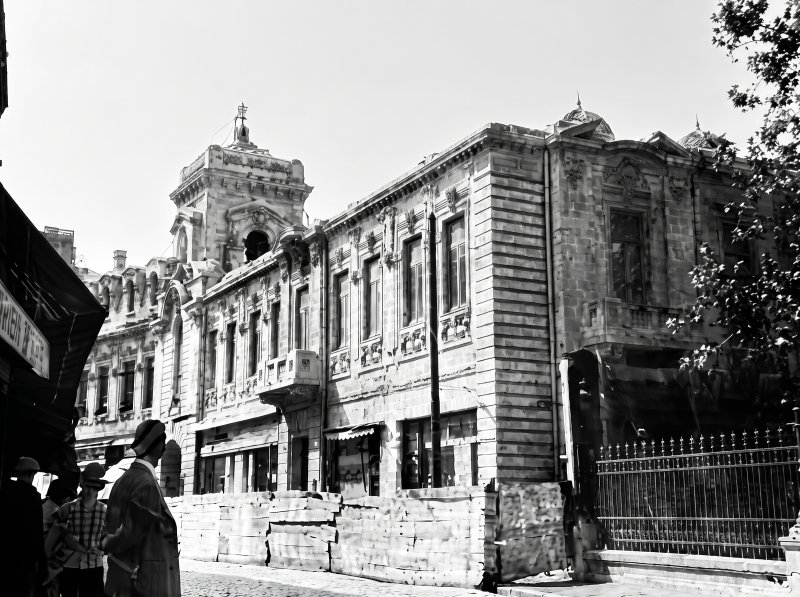 Kretzulescu building, before demolition / / Image restored using artificial intelligence, preserving the original details.
Today, Kretzulescu Church is clearly visible from Revolution Square. Until 1938, the view was blocked by the buildings of the monastery-inn, among which stood out a two-storey structure with a clock tower. The timepiece operated at the municipality’s discretion and, judging by accounts from the period, the municipality’s discretion went through lengthy periods of reflection.
The history of the complex begins with Iordache Kretzulescu and Safta, the daughter of Constantin Brâncoveanu. The masonry church, monastic cells, and vaults facing the street were consecrated in 1722, while the commercial complex developed over the following decades. The shops on Calea Victoriei benefited from their proximity to the Royal Palace and the fashionable centre of the city, which raised both their prestige and their rents. Bucharest had already discovered the fundamental rule of real estate: location costs money.
The clock-tower building was demolished in 1938 as part of the redevelopment and opening up of the southern side of the Royal Palace. The former complex had covered a broad footprint, and its site can now be read in several urban fragments: the open space around the church, the southern area of the former Royal Palace, and the Kretzulescu Building (pictured), designed by G.M. Cantacuzino, with arcades and retail premises on the ground floor.
The result gave the church visibility while erasing much of the old enclosure. Aesthetic gain and historical loss sit here on the same bench, probably avoiding conversation.
Saint George the New Inn, Consumed by Fire and Turned into a Public Garden
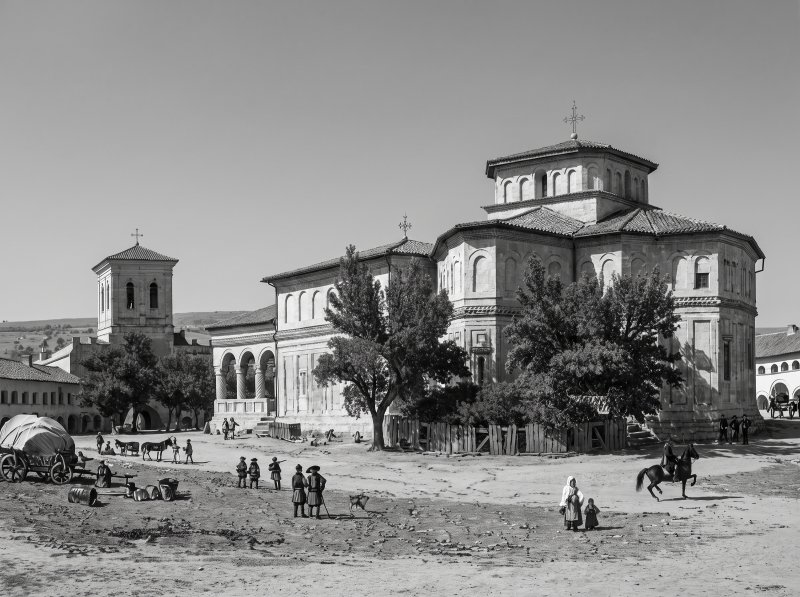 The Saint George Church and Inn complex / Image recreated using artificial intelligence, while largely preserving the original details.
The Saint George area marks one of the capital’s symbolic centres. The church, the statue of Constantin Brâncoveanu, and the Kilometre Zero monument occupy a space once tightly enclosed within a large monastic and commercial complex.
The establishment has ancient origins, and Constantin Brâncoveanu gave it the monumental form known from descriptions and depictions. The prince built the new church, extended the monastic cells, and created a spacious inn, along with residences for the patriarch and the monastery’s abbot. The church was consecrated on 29 June 1707 in the presence of senior church dignitaries, while high-ranking participants received purses of gold coins and commemorative gold medals. Solemn launches had budgets in the Brâncoveanu era too.
The fire of 1847 struck the inn hard. Many people had sought shelter within its solid walls, and Anton Pann captured the disaster in a bitter quatrain about the hope of safety the building had offered. The following year, the authorities ordered the remaining walls demolished. The municipality then laid out a public garden around the church.
Today, the site of the former inn is largely occupied by the square and the green space surrounding Saint George the New Church. Kilometre Zero symbolically reinforces the idea of a centre. National-road distances are measured from here, from the very place where merchants once measured their profits, their goods, and their patience.
Zlătari Inn—Two Hundred Rooms, Parisian Fashion, and a Church Left Standing Alone
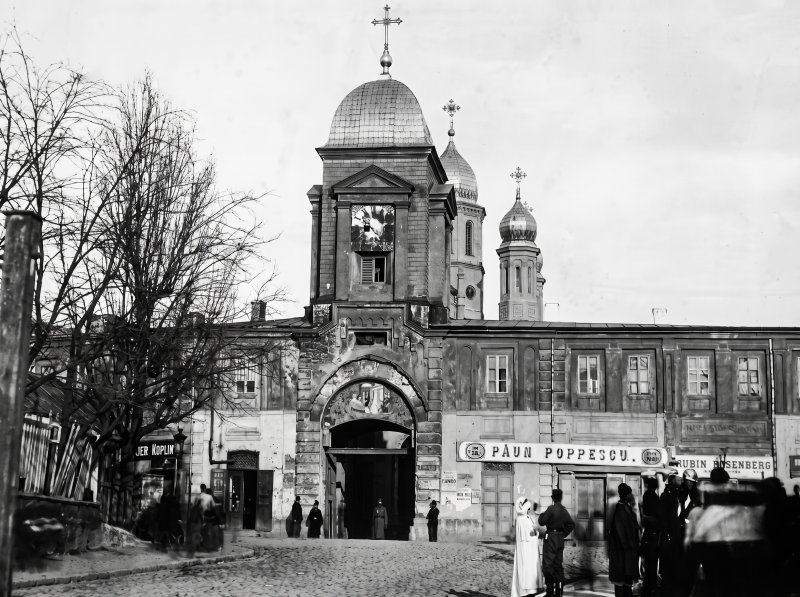 Zlătari Inn / Image restored using artificial intelligence, preserving the original details.
On Calea Victoriei, near today’s National Museum of Romanian History, Zlătari Church now looks slightly awkward amid the buildings that have grown around it. In the 19th century, the situation looked entirely different. The church stood in the middle of a huge inn, with a ground floor, an upper storey, shops, and nearly 200 rooms. A small commercial city in the centre of the city, because Bucharest has always appreciated organisation that generated rent.
The inn developed around the old Zlătari Monastery, mentioned in documents as early as the 17th century. Its name came from the zlătari, craftsmen who worked gold and silver—people with a rather more elegant trade than today’s traffic on Calea Victoriei might suggest. After the church was rebuilt between 1850 and 1852, the surrounding commercial buildings were extended, and their rental income supported the religious complex.
The inn’s rooms and shops were frequented by craftsmen, merchants, publicans, traders in goods from Lipscani, and female tenants described in period documents as “free women,” an administrative phrase elastic enough to let the imagination wander off on its own. The ground floor even housed a hair salon whose owner, newly arrived from Paris, promised haircuts in the latest French fashion. Paris reached Bucharest gradually, strand by strand.
A photograph taken by Franz Duschek in 1871 preserves the image of the inn built around the church, with sober façades and a long row of windows. In 1903, the inn buildings were demolished to widen Calea Victoriei. Zlătari Church remained in place, like a stubborn landlord who watched every tenant leave. Today, between the CEC Palace, Lipscani, and the former Postal Palace, it is the last visible landmark of a commercial complex that once occupied a sizeable chunk of central Bucharest.
Ivanciu Gherasi Inn, Replaced by the Athénée Palace
At the corner of Episcopiei Street and Calea Victoriei stands the InterContinental Athénée Palace, a hotel associated with diplomats, journalists, receptions, political intrigue, and spy stories. A century before it opened, the site was occupied by Ivanciu Gherasi Inn.
The sources preserve fewer details about the inn than about the hotel that replaced it, but its location is confirmed by Constantin C. Giurescu and by historical research into the building. Work on the Athénée Palace began in 1912 to a design by French architect Théophile Bradeau, and the hotel opened in 1914. It had 149 rooms and ten suites decorated in the Louis XIV style.
In 1937, Duiliu Marcu remodelled the hotel and gave it the Art Deco expression for which it later became known. The building survived the 1944 bombings, the extension of the 1960s, the 1989 Revolution, and several renovations. Since 2023, it has operated under the InterContinental brand.
The transformation preserves a delightful continuity. The inn was replaced by another place of accommodation, although the stables and merchants’ courtyard gave way to gilded salons and an English bar. Hospitality climbed a few rungs up the social ladder and began wearing a dinner jacket.
The Modern City Sits Down to Dine with the Old Inns
The eight sites show how Bucharest modernised through replacement. The inns lost ground to hotels, banks, and public institutions, while the old commercial courtyards were absorbed into new plots. The fire of 1847, earthquakes, decay, and urban-development ambitions accelerated the process.
Traces continue to emerge in documents, plans, and archaeological excavations. They change the way the city centre can be read. The National Bank Palace becomes the top floor of a history that began with money changers and merchants, the CEC Palace covers a monastic complex, and the National Museum of Romanian History stands directly over the ruins of a Brâncoveanu-era inn. Present-day Bucharest appears solid and final; beneath the pavement, however, its older version still keeps the key to the gate.
You may also like: 15 Beautiful Places in Bucharest That No Longer Exist Today