10 Lesser-Known Facts About the Romanian Athenaeum
By Eddie Țone
- Articles
- 05 AUG 26
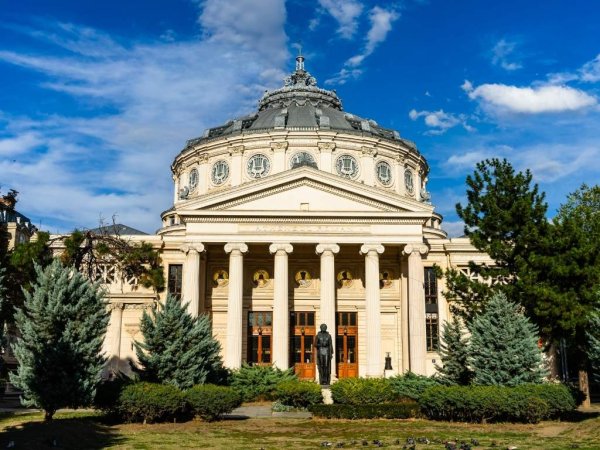
The Romanian Athenaeum delights everyone in central Bucharest, exuding the quiet confidence of a building that knows perfectly well it is the star of the city. Its dome, iconic columns, and front garden have long since become part of the capital’s official scenery, alongside pigeons, traffic jams, and the eternal question of where to park. Behind this familiar image, however, lies a surprisingly eventful biography involving an abandoned riding arena, a national lottery, a building inaugurated while work was still in progress, a fresco altered by political order, and an organ purchased through a collective effort.
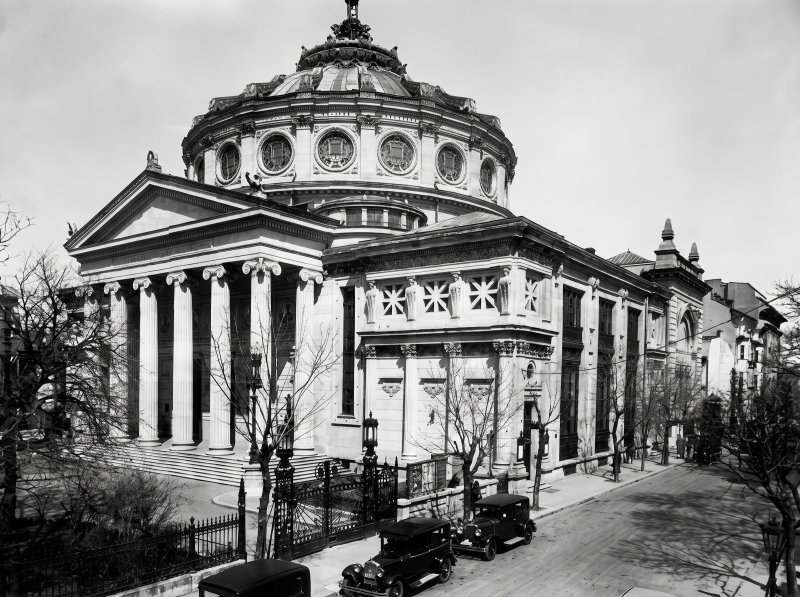
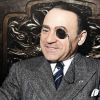
Photo: The Romanian Athenaeum, 1931 / / Image restored and colorized using artificial intelligence, preserving the original details.
The Athenaeum Palace grew out of the ambitions of the Romanian Athenaeum Society, a cultural organization founded in 1865 and associated above all with the scholar and diplomat Constantin Esarcu. The aim went beyond erecting an elegant hall. Bucharest was gaining a venue for lectures, exhibitions, debates, and concerts, at a time when public culture was organized with great solemnity—and with budgets that caused palpitations even then. The building’s story also demonstrates that major national symbols sometimes emerge from very practical circumstances. The year 1888 marks the “birth” of the Romanian Athenaeum, but let us explore 10 facts about it that may be less widely known:
1. The Athenaeum’s circular shape came from a riding school
The famous rotunda originated in an equestrian project. On the site of the former Bishopric Garden stood foundations prepared for a riding school belonging to the Romanian Equestrian Society. In 1886, the Romanian Athenaeum Society purchased the land, the bricks in the foundations, and the remaining construction materials, and French architect Albert Galeron adapted the new cultural palace to the circular base that had already been laid.
The solution proved splendidly suited to a lecture and concert hall. The circle visually brings the audience closer to the stage, supports an amphitheater-style arrangement, and gives the building the silhouette that any Bucharest resident can recognize from a distance today. In a delightful twist of urban planning, a project intended for horses eventually came to host Beethoven, Enescu, and Ravel—or at least their music. Bucharest has long handled such changes of purpose with remarkable nonchalance.
The official history of the George Enescu Philharmonic confirms that the riding school’s foundations were used, while documents presented by Historia magazine mention the purchase agreement signed on June 21, 1886.
2. “Give one leu for the Athenaeum” advertised a lottery
Today, the famous phrase sounds like an avant-la-lettre fundraising campaign. The actual mechanism was somewhat more spectacular. The Romanian Athenaeum Society organized a national lottery and offered 500,000 tickets for sale, each priced at one leu. The press supported the campaign, and the slogan achieved what every successful advertisement hopes to do: it remained in the collective memory long after the product it promoted had disappeared.
The draw took place on May 22, 1886, in Cișmigiu Garden. The grand prize was worth 75,000 lei, and the lottery ticket bore the signatures of Nicolae Kretzulescu and Constantin Esarcu. Romanians were therefore buying a chance to win a prize while simultaneously helping to build the palace. Crowdfunding with a raffle, frock coats, and plenty of patriotic rhetoric.
Donations and other sources of funding supplemented the lottery proceeds.
3. The public entered the Athenaeum while the building was still under construction
The foundation stone was laid on October 26, 1886. Some 16 months later, on February 14/26, 1888, the palace welcomed the public for its inauguration ceremony. The dual date reflects the calendars in use at the time: February 14 in the Old Style corresponded to February 26 in the New Style.
The pace seems dizzying even for an era of major construction projects managed with thick ledgers and elegant handwriting. The explanation lies in the work’s phased nature. Construction of the main structure and auditorium continued until 1889, while a new expansion phase took place between 1893 and 1897. The inauguration therefore marked the building’s entry into public life, even as the craftsmen and architects still had several substantial chapters left to complete.
4. The first major event was… a lecture
At the opening, the conductor’s baton gave way to the lecturer. Writer and archaeologist Alexandru Odobescu spoke about “The Romanian Athenaeum and Buildings with Circular Domes,” a title perfectly suited to an evening when the audience probably gazed at the dome with the same curiosity now reserved for a technological premiere.
The choice was directly connected to the mission of the Romanian Athenaeum Society. The institution had grown out of a series of public lectures, and as early as January 1865, Constantin Esarcu had delivered a talk on the animal kingdom before an audience of approximately 500 people. The Athenaeum thus began as a place where knowledge was made available to the general public. Concerts soon took on a central role, especially after the orchestra of the Romanian Philharmonic Society took up residence there in 1889, but Odobescu’s speech officially opened the house.
5. The foyer is located beneath the concert hall because of a land constraint
In Europe’s great concert venues, the foyer generally extends in front of the auditorium, allowing guests to ease gradually into the evening’s atmosphere and inspect one another’s outfits under excellent lighting conditions. At the Athenaeum, the circular foyer lies directly beneath the Great Hall.
The explanation involves land ownership. The area now occupied by the garden belonged to another owner, while the Romanian Athenaeum Society had only a limited space at its disposal. Galeron stacked the two main volumes: the foyer’s rotunda on the ground floor and the concert hall above it. This constraint produced one of Bucharest’s most memorable interior sequences. Visitors ascend from the foyer toward the music along curved staircases, in a carefully choreographed architectural ceremony.
6. The monumental staircases were created by Carol Storck
The four spiral staircases, made of Carrara marble, bear the signature of sculptor Carol Storck. A member of the renowned Storck family of artists, Carol studied in Florence and Philadelphia and taught sculpture at the School of Fine Arts in Bucharest. At the Athenaeum, his role went beyond adding ornament to an already conceived building. The staircases shape the movement of the audience and turn the journey to the hall into a small performance in its own right.
The foyer holds another material surprise. Part of the marble-like decoration was produced from artificial marble at the workshop of brothers Pietro and Giovanni Axerio, Italian craftsmen who had settled in Romania. The era appreciated opulent effects and had thoroughly mastered the art of imitation. Any visitor convinced that they are surrounded exclusively by rare blocks of stone receives, somewhat belatedly, a lesson in Belle Époque decorative technology.
7. The fresco waited half a century
The idea of a painted history encircling the hall had existed since 1888. At the inauguration, Alexandru Odobescu spoke of an “enchantment of scenes from national history,” and for many years the frieze bore an inscription reserving the space for the future fresco. In 1901, painter Ștefan Popescu presented a proposal estimated to cost at least 80,000 lei, a sum considered too high. Discussions, committees, and decades of blank wall followed—a bureaucratic combination that Bucharest would go on to perfect.
Costin Petrescu’s project was approved on May 27, 1933, with a ceiling of three million lei and a requirement that he use the al fresco technique, applying pigments to fresh plaster. The actual work was completed in April 1937, and the ensemble was ceremonially unveiled on May 26, 1938. The catalogue published by the painter in 1938 and Elena Cercel’s study in the academic journal NOEMA support 1938 as the correct year, although 1939 appears in several later accounts.
The fresco stretches for approximately 75 meters, stands three meters high, and comprises 25 episodes. The scenes flow into one another, from Trajan to the reign of Carol II, like a historical film projected around the audience long before panoramic screens existed.
8. Carol II and Prince Michael were erased from the final scene
The last episode originally showed Carol II descending the steps of a building alongside his son, Grand Voivode Michael, surrounded by a modern society. Following the king’s abdication in September 1940 and the change of political regime, Costin Petrescu was forced to redo the scene. The portraits of the two royals gave way to a flag-waving crowd celebrating the creation of Greater Romania.
One clarification is worth preserving, because legend has merged two neighboring episodes. The four young women in regional costumes—personifications of Romania, Transylvania, Bukovina, and Bessarabia—already appeared in Scene XXIV, dedicated to King Ferdinand and Queen Marie. The original description published by Costin Petrescu confirms their placement there. They survived the alteration, while Carol II was replaced in Scene XXV by the popular group carrying flags. Politics thus intervened directly in the plaster, with the cold efficiency of an editorial office changing the photograph on its front page.
9. The red velvet concealed the fresco and, paradoxically, protected it
In February 1948, the Athenaeum hosted the congress that unified the Romanian Communist Party with the Social Democratic Party, creating the Romanian Workers’ Party. The depictions of the monarchy surrounding the hall clashed sharply with the meeting’s ideological setting. The authorities covered the fresco with a red velvet curtain.
The painting remained hidden until 1966, when the drapery was removed. The act of censorship also had a protective effect. The fabric spared the ensemble from Socialist Realist repainting or outright destruction. For nearly two decades, the velvet intended to conceal it served as an unintended shield. History occasionally has a dry and expensive sense of humor.
10. The organ arrived at the Athenaeum through a campaign initiated by George Enescu
The Great Hall received its concert organ in 1939, following another public fundraising drive. George Enescu supported the effort to raise the necessary funds, and the instrument was built by the prestigious E. F. Walcker & Co. company of Ludwigsburg, associated with organ builder Oscar Walcker. It was inaugurated on April 22, 1939, with a concert performed by organist Franz Schütz, director of the Viennese institution now known as the University of Music and Performing Arts.
The story creates a pleasing symmetry. The public lottery helped raise the palace, and several decades later Enescu’s campaign gave it one of its most commanding voices. The same simple and surprisingly contemporary idea connects the two moments: the public can fund the culture it wishes to have.
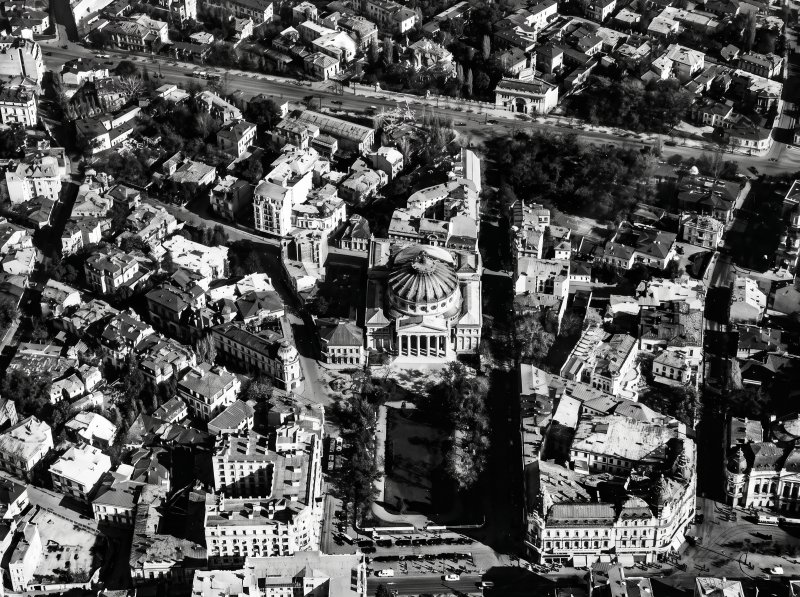
Photo: View from a plane, 1920.
The Romanian Athenaeum therefore remains the result of a series of intelligent adaptations. The foundations of a riding arena became a symphonic hall, a cramped plot produced a spectacular foyer, a lottery turned one leu into a national slogan, and the velvet of censorship ended up protecting the fresco. Seen from the square, the building appears perfectly settled and almost inevitable. Its biography, however, tells the story of a structure achieved through improvisation, perseverance, and an impressive amount of cultural stubbornness.
You may also like: Filarmonica George Enescu in Bucharest, a century and a half of history through excellence and music at the highest level