Filarmonica George Enescu in Bucharest, a century and a half of history through excellence and music at the highest level
- Articles
- 04 DEC 25
The George Enescu Philharmonic represents today the most prestigious musical institution in Romania, a true cultural authority that has shaped, over more than 150 years, the artistic identity of the country. Founded in April 1868 under the name Romanian Philharmonic Society, the institution was born from the vision of Eduard Wachmann, a musician dedicated to the mission of transforming Bucharest into a modern musical center. Wachmann sought from the very beginning to create a permanent symphony orchestra, capable of popularizing classical music and offering the Romanian public access to valuable repertoires.
The origins of an emblematic institution
The first concert of the new orchestra took place on December 15, 1868, under the baton of its founder, marking the beginning of a tradition that would develop impressively in the following decades. The city of Bucharest, going through a period of profound transformations, found in Wachmann’s initiative a catalyst for forming a modern cultural life, and the orchestra’s success did not take long to appear.
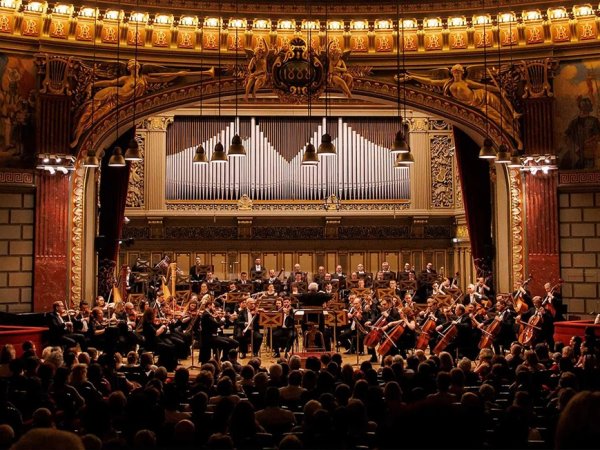
One of the defining moments of the Philharmonic’s history was the inauguration of the Romanian Athenaeum, on March 5, 1889. The monument building, constructed through collective efforts and later becoming a national symbol, became the permanent headquarters of the orchestra. From then until today, the concerts of the Philharmonic have resounded uninterruptedly in this magnificent hall, turned into a sanctuary of the art of sound.
After Eduard Wachmann, who led the Philharmonic until 1907, the baton passed to important conductors. First Dimitrie Dinicu, an important personality in Romanian musical life, and then, starting in 1920, George Georgescu, a disciple of the legendary Arthur Nikisch. Under his baton, the institution would enter a new era of excellence.
International ascension under George Georgescu
George Georgescu transformed the Philharmonic into an artistic organism of European scope. In his two mandates (1920–1944 and 1954–1964), he modernized the repertoire, imposed new standards of interpretation, and integrated the orchestra into the international musical circuit.
He envisioned an orchestra connected to the major currents of the time, and this ideal materialized through the invitations addressed to celebrities of the interwar musical world: Jacques Thibaud, Pablo Casals, Igor Stravinsky, Maurice Ravel, Alfred Cortot, Enrico Mainardi, Richard Strauss, or Yehudi Menuhin. Moreover, Herbert von Karajan, one of the greatest conductors of the century, stepped on the stage of the Athenaeum in the years dominated by Georgescu.
Besides the memorable concerts, the conductor remained in history through the initiation of reference discographic recordings, among which the complete Beethoven symphonies, considered at the time a rare performance in Eastern Europe. The recordings contributed substantially to the international recognition of the orchestra, becoming reference points for future generations.
After the Second World War, during the period when George Georgescu returned to the leadership, the George Enescu Philharmonic expanded its activity. The Academic Choir was founded, various chamber ensembles were created, from reduced orchestral formations to piano trios, and a group of instrumental and vocal soloists of great value was gathered.
The institution’s presence at the first editions of the George Enescu International Festival, an event inaugurated in 1958, strengthened the orchestra’s reputation as an essential partner in the greatest Romanian cultural events.
During this same period, starting from 1955, the Philharmonic received the name of the great composer George Enescu, shortly after his passing. The change symbolized the desire to honor the artistic legacy of the most important Romanian musician and to link the institution’s identity inextricably to his monumental figure.
Continuity, transformations, and new artistic directions
In the years that followed, the leadership of the Philharmonic passed through the hands of personalities such as Mircea Basarab, Dumitru Capoianu, Ion Voicu, or Mihai Brediceanu, each of them contributing to the repertorial and organizational evolution of the institution. Although living in a restrictive political context, the Philharmonic managed to maintain its artistic standards, confirming its position as a pillar of Romanian culture.
The year 1989 brought a new opening. With the fall of the communist regime, the institution entered a stage of reconstruction and revitalization. Pianist Dan Grigore took over leadership in 1990, followed, between 1991 and 2009, by conductor Cristian Mandeal, under whose baton the orchestra rediscovered the brilliance of its great early eras. Mandeal developed a refined interpretative style, anchored in tradition but adapted to the demands of the contemporary public.
From 2010 to 2022, the Philharmonic was led by Andrei Dimitriu, a period during which the institution continued to modernize and expand its international activity. Tours in Europe, Asia, and the Far East became constant, and the discography was enriched with dozens of recordings. The complete symphonic works of George Enescu and the complete symphonies of Johannes Brahms are only two of the major projects that strengthened the orchestra’s prestige.
In parallel, the Philharmonic continued to discover and promote young Romanian artists who imposed themselves on international stages: Ioana Cristina Goicea, Daniel Ciobanu, Gabriel Bebeșelea, Andrei Ioniță, Vlad Stănculeasa, Mihai Ritivoiu, Valentin Șerban, and many others. The institution thus became a true incubator of talent.
The Philharmonic today: tradition, excellence, and global openness
In April 2022, the leadership of the Philharmonic was taken over by cellist Marin Cazacu, one of the most appreciated Romanian musicians of recent decades, university professor and member of the orchestra. Under his direction, the symphonic season has experienced a remarkable development, both through repertorial diversity and through the level of invited artists.
In recent years, world-class artists have stepped onto the stage of the Romanian Athenaeum: Mikhail Pletnev, Charles Dutoit, Vadim Repin, Thomas and Michael Sanderling, Lawrence Foster, Leonard Slatkin, Vasily Petrenko, Andreas Haefliger, Sayaka Shoji, Hrachuhi Bassenz, Julian Rachlin, or Renaud Capuçon. This impressive list confirms the Philharmonic’s openness to top-level international collaborations.
The repertoire approached is broader and more ambitious than ever, combining works from the universal heritage with Romanian creations and contemporary scores. The Philharmonic thus maintains its role as a path-breaker at the intersection between tradition and innovation.
Today, the institution presents approximately 300 concerts annually — symphonic, chamber, and educational — and continues to be a link between artists and public. The Romanian Athenaeum remains the center of a vibrant musical life, and the Philharmonic is the beacon guiding it.
A symbolic institution of Romanian culture
For more than a century and a half, the George Enescu Philharmonic has offered the Romanian and international public the joy of classical music as a universal language of communication and understanding. It is an institution in which tradition intertwines with innovation, and value is cultivated with dedication.
In a world in continuous change, the Philharmonic remains a constant of excellence, a space where the art of sounds succeeds in uniting generations, inspiring, and transforming. From its founding in 1868 until today, the George Enescu Philharmonic continues to represent not only a cultural landmark, but also a form of resistance through beauty, discipline, and harmony — an institution that gives meaning to the notion of a living heritage and that transforms Bucharest into a bright point on the musical map of the world.
We also recommend: The Romanian Opera in Bucharest, Built by Minister Octavian Goga, Inaugurated by the Great George Enescu