10 Art Deco Buildings in Bucharest and Their Impressive History
By Eddie Țone
- Articles
- 19 APR 26
Interwar Bucharest remains, to this day, one of the most fascinating "showcases" of European modernism—a city where the architectural avant-garde completely redesigned the urban profile. The Art Deco style, with its rigorous geometric lines, "ocean liner" windows, and stylized decorative details, gave Bucharest an aura of cosmopolitanism and dynamism, transforming it into a metropolis of refined contrasts. From grand boulevards to hidden alleys in old neighborhoods, these ten emblematic buildings are living testimonies to an era that celebrated speed, progress, and absolute aesthetics.
/ Images restored and colorized with artificial intelligence, while preserving the original details intact.
1. The Telephone Palace (Palatul Telefoanelor)
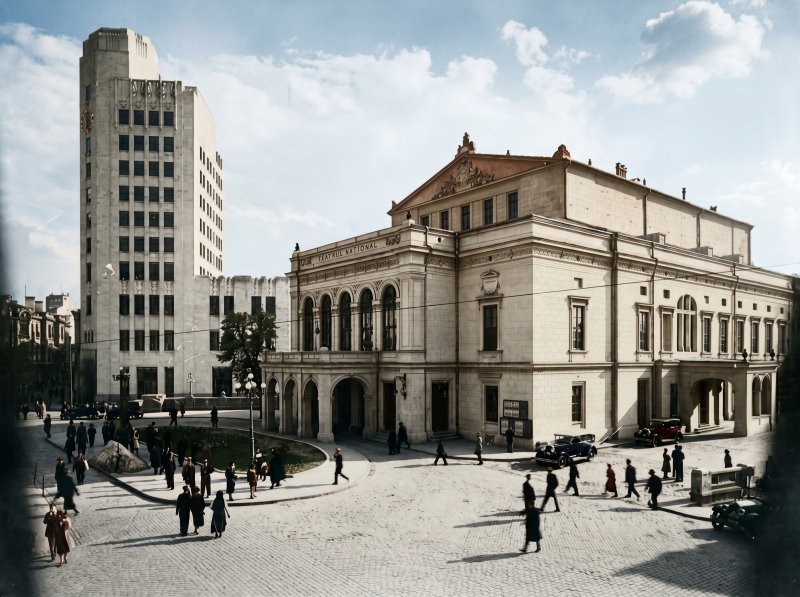
The Telephone Palace naturally takes first place, being the building that brought a Manhattan air to Calea Victoriei—translated into Romanian with an American accent and a dose of local wonder. Erected between 1929 and 1934 based on plans associated with architects Louis S. Weeks, Edmond van Saanen Algi, and Walter Froy, the structure appeared at a time when Bucharest wanted to seem grand, fast, and perfectly synchronized with the 20th century. It is the only local example of the New York style with a ziggurat silhouette, which sparked heated protests at the time. In short: the city dreamed of modernity, then got scared when modernity actually knocked on the door.
Its importance goes beyond the spectacle of the facade. The Palace served as the headquarters for the capital's telephone infrastructure and remained the tallest building in Bucharest until 1970 (when the Intercontinental Hotel was built), a clear sign that the telephone and urban pride went hand in hand back then. In 2024, the building was reopened by Orange Romania, an episode showing that an Art Deco monument can live in a register other than that of dusty nostalgia. When you look at it, you see the ambition of a capital that wanted to converse directly with the future—ideally from an office with an elevator, a telephone exchange, and immense confidence in progress.
2. The ARO Block and ARO Cinema (today Patria)
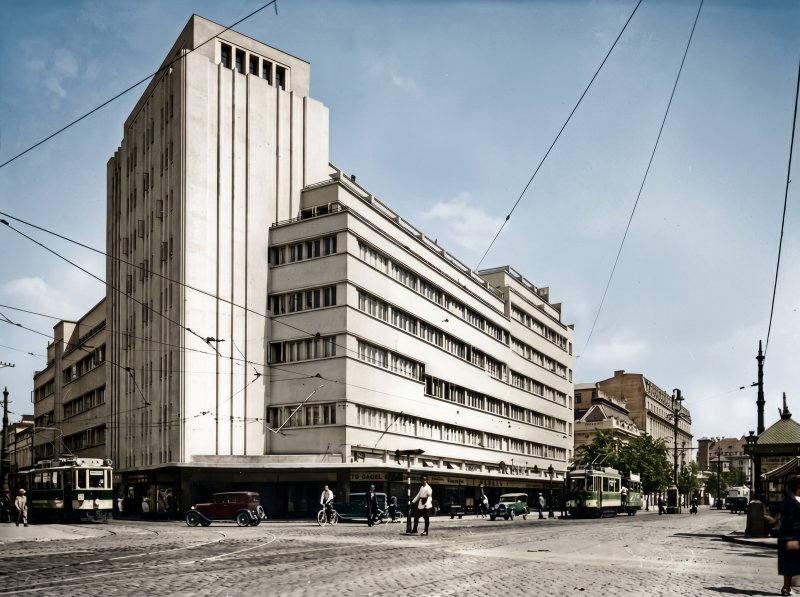
The ARO Block represents the moment the Magheru Boulevard decided it could play in Europe's major leagues. Horia Creangă (the grandson of writer Ion Creangă) designed the building in a formula that sits right on the edge between Modernism and Art Deco—a fertile interference zone where modern rigor gains elegance, nerve, and a thirst for spectacle.
The ARO Cinema hall, finished in 1934 and inaugurated in January 1935, was at that time the largest in Bucharest, boasting nearly 2,000 seats. A capital that builds such a temple for film says a lot about itself: it wanted speed, light, entertainment, and a good night out. The building's story continues through all the political shifts of the century. After the war, the ARO Cinema became Patria, a name that arrived with the new regime, which changed both the businesses and the symbolic decor of the city. However, the building maintained its strength as an urban landmark, and in 2026, public information emerged regarding its entry into consolidation after years of closure and waiting.
3. Hotel Ambasador
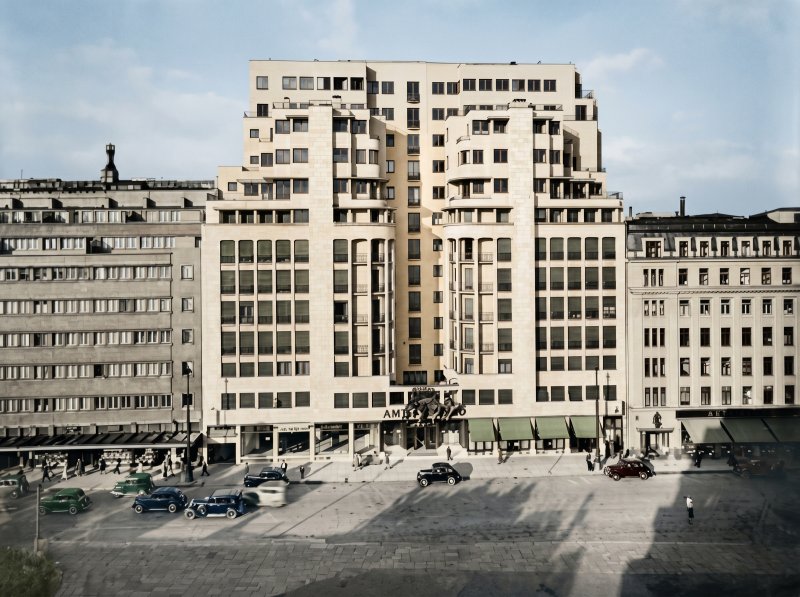
Hotel Ambasador possesses a slightly theatrical elegance, belonging to the interwar world that ordered champagne, danced until late, and made its entrance on Magheru as if onto a stage. It is among the representative hotels of the Bucharest Art Deco wave, designed by Arghir Culina and inaugurated on May 4, 1939. Its location, between the Ciclop Garage and the ARO area, makes it a centerpiece of an urban ensemble that permanently changed the face of the boulevard. In other words, this is where Bucharest put on its best suit and stepped out into the world.
Its history also tells the story of an era that associated luxury hotels with technical progress. The press of the time spoke of its 300 rooms and ultra-modern plumbing—a detail that might seem less romantic today, but in 1939 meant pure civilization. The vertical facade, the rhythm of the windows, and the massive composition give it the allure of a cruise ship anchored on the boulevard, ready to receive passengers with hats, suitcases, and plenty of plans for a long night in the city center.
4. The Adriatica Block
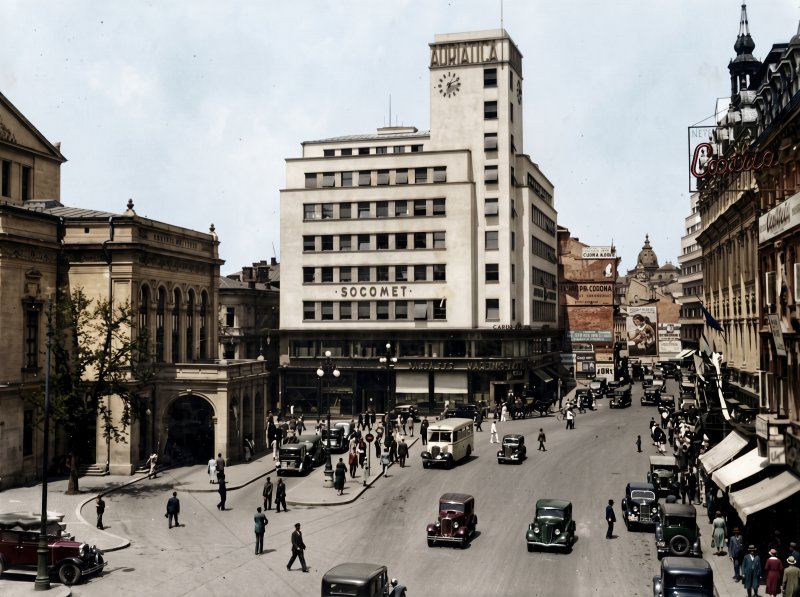
Located in the heart of the capital at the intersection of Regina Elisabeta Boulevard and Calea Victoriei, the Adriatica Block was built between 1933 and 1935, commissioned by the "Adriatica di Trieste" insurance company. The project was signed by architect Petre Antonescu, a central figure in Romanian architecture, who achieved a spectacular transition here from the Neo-Romanian style (which he established with buildings like the City Hall) toward Art Deco-inflected modernism.
The building was conceived as a mixed-use structure, offering modern commercial spaces on the ground floor and luxury offices and apartments on the upper floors, quickly becoming a symbol of interwar economic prosperity. Architecturally, the Adriatica Block imposes itself through its pyramidal volumetry and stepped-back tower—a typical element of the American "ziggurat" style adapted to the Bucharest context. The facade is dominated by a sober verticality, punctuated by geometric frames and balconies with rigorous lines, devoid of the heavy floral ornaments of the previous era. Over the decades, the edifice has survived major earthquakes and the 1944 bombings, remaining one of the most photographed buildings in University Square today.
5. The Ciclop Garage
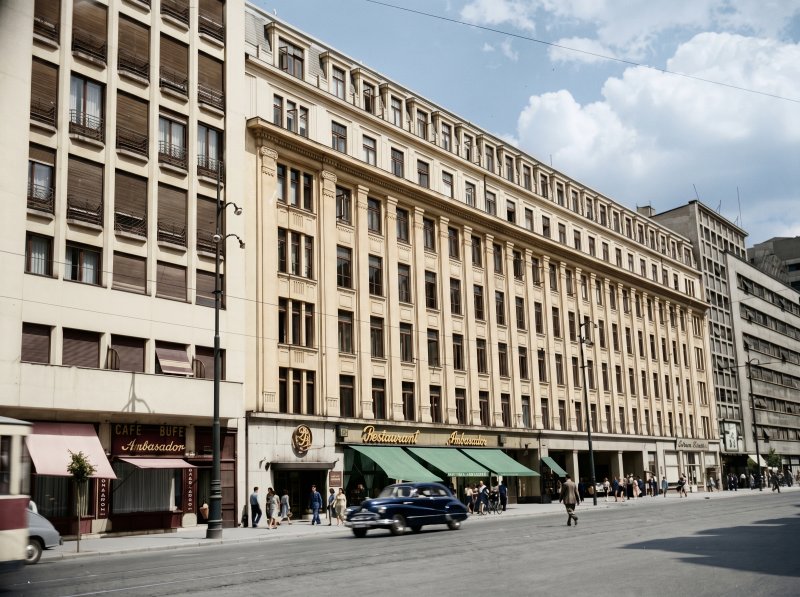
At first glance, the Ciclop Garage seems like one of those buildings you pass by too quickly, like any inhabitant of a city that has specialized in selective blindness. In reality, it represents one of the decisive pieces of interwar Bucharest. It is an important example of the eclectic Art Deco phase, alongside Franklin 5 and Hotel Ambasador, and subsequent history fixed it as a landmark of urban modernity. It appeared during the automobile explosion, a moment when the car became a status symbol and the city suddenly had to learn about parking, speed, and the new liturgy of gasoline.
Its technical story has a special brilliance. Recent sources present it as the first multi-story parking garage in Romania and even the first building in Europe with an anti-seismic system on rollers, constructed entirely of reinforced concrete. This makes it a small engineering manifesto and a declaration of interwar confidence in technology. Today it bears the marks of time and neglect, but therein lies its melancholic charm. Ciclop looks like a great urban mechanism that is still breathing, even if the surrounding city often prefers to admire its own ruins in passing, with its blinker on and its mind elsewhere.
6. Palace of the Bucharest Municipality Officials' Society (today ARCUB)
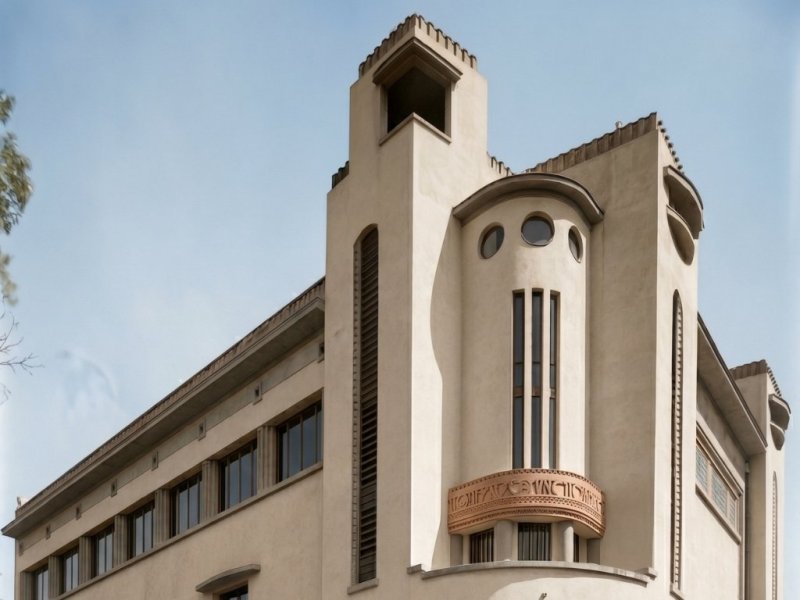
The building at 14 Batiștei Street has something of the ambition of a middle class that wanted to live well and be seen doing so. It is arguably the most relevant local sample of Art Deco with a dizzying program for the era: a 400 sqm festivities hall, a restaurant, a bar, a bowling alley, gyms, and even bath salons. It is an excellent summary of the 1930s in Bucharest: work, representation, leisure, and a bit of well-polished vanity, all under one roof.
Built between 1932 and 1934 according to the plans of Radu Culcer and Ioan C. Roșu, the palace has the energy of a city that took its fun seriously. After the war, the building entered another stage of life, being known as ARLUS and later becoming the headquarters of ARCUB. The shift toward culture suited it surprisingly well. A palace designed for sociability, spectacle, and public life now hosts events, exhibitions, and cultural projects, as if it kept its original instinct, just with different decor and different costumes. The building thus possesses a rare continuity of symbolic function: it remains a place where the city comes to meet itself.
7. Athénée Palace, in Art Deco Dress
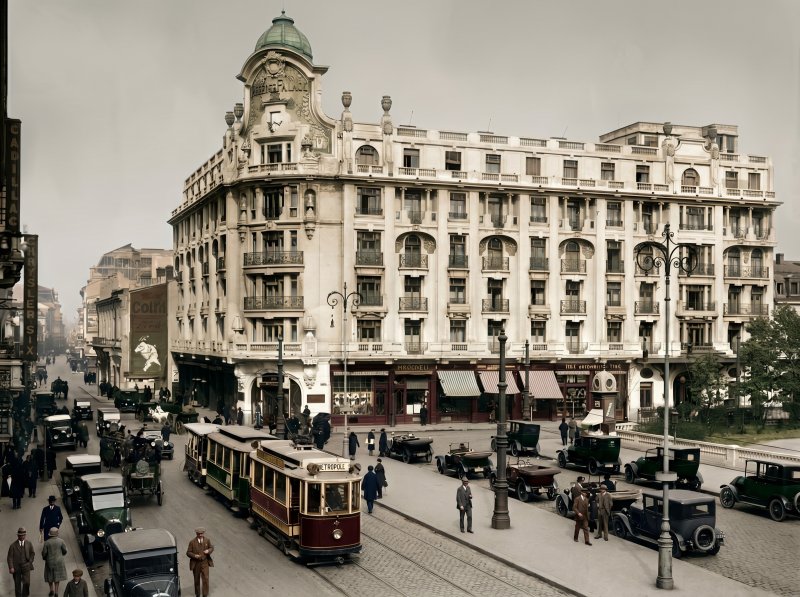
Athénée Palace already had a luxurious biography before Duiliu Marcu viewed it through an Art Deco filter. The hotel had been built before World War I, and between 1935 and 1937, it underwent a major remodeling that simplified its expression and brought it closer to the taste of the era. It was an intervention situated among his mature works, where the Art Deco style finds the right balance between comfort, prestige, and modernity. In other words, the hotel moved from adornment to refinement, and the transition suited it splendidly.
The history of Athénée Palace also has an almost novelistic side. The hotel witnessed diplomacy, intrigue, high society life, and all the conversations spoken in whispers but intended with gravity. Its Art Deco remodeling provided this world with a perfect backdrop: clear lines, tempered grandeur, and an elegance that suggested power without shouting it from the balcony. In an interwar Bucharest that wanted to seem like a top-tier European capital, Athénée Palace played the role with aristocratic calm and enough shine to fill the entire square.
8. Palace of the Central House of Social Insurance
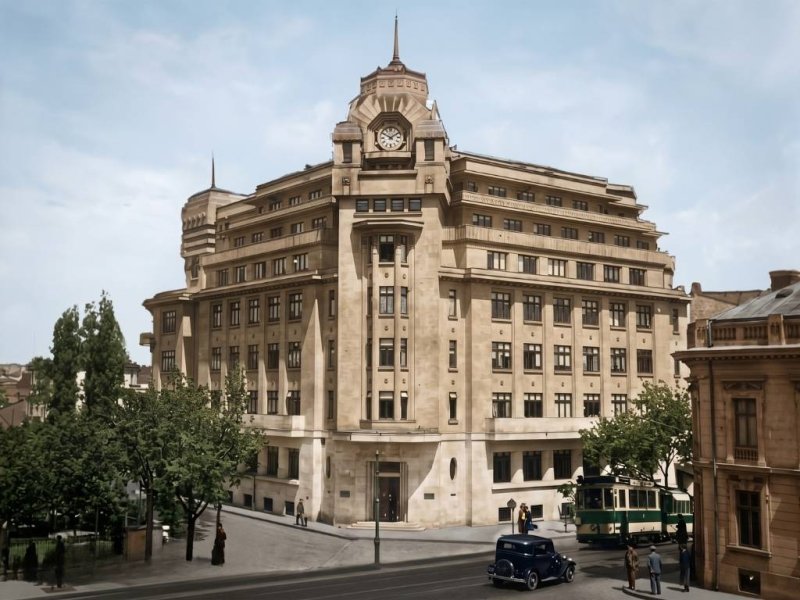
The Palace of the Central House of Social Insurance possesses an administrative presence that clearly states the interwar state had begun to understand the power of image. It is one of the grand public buildings that abandoned the Neo-Romanian style in favor of Art Deco variants, joining the family of compositions featuring towers, unifying frames, and vertical accents. Briefly, the bureaucracy was making its entrance in an elegant suit with broad shoulders and the attitude of a self-assured institution.
The subsequent story of the palace shows how often Bucharest buildings change their destiny, as if the city were permanently playing a remake of its own history. During the war, it was used by the Ministry of Defense; after 1944, it hosted the Ministry of Foreign Affairs; and the 1977 earthquake brought it serious damage. Even so, the building retains a cold and very convincing dignity—an edifice that reminds you that Art Deco served both the appetite for luxury, the desire for authority, and the grave theater of the modern state.
9. Hotel Union
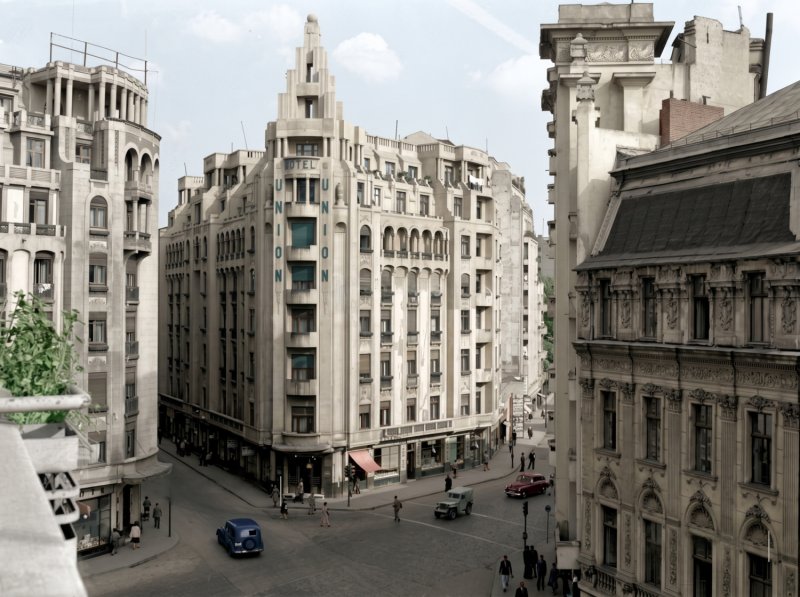
/ Foto: Agerpres
Built between 1931 and 1934, Hotel Union represents one of the purest expressions of the Streamline Moderne Art Deco style in Bucharest. The project was signed by architect Arghir Culina, a benchmark name who left his mark on numerous luxury hotels and buildings of the interwar period (such as Hotel Negoiu or Hotel Ambasador). The building was designed to reflect the cosmopolitan spirit of the era, strategically located at the intersection of Ion Câmpineanu and Decebal streets, right in the commercial and cultural "heart" of the capital at that time.
Its architecture is defined by the discrete elegance of curved lines, with the facade dominated by a spectacular rounded corner and long, horizontal balconies that mimic the decks of a luxury ocean liner—a central visual element of 1930s aesthetics. Although it passed through turbulent periods, including nationalization during the communist era and various renovations that partially altered its interior layout, Hotel Union has maintained its unmistakable exterior volumetry. Today, it remains a fundamental piece in Bucharest's modernist puzzle, recalling the period when local architecture was in direct dialogue with avant-garde trends from Paris or New York.
10. Marconi/Dacia Cinema
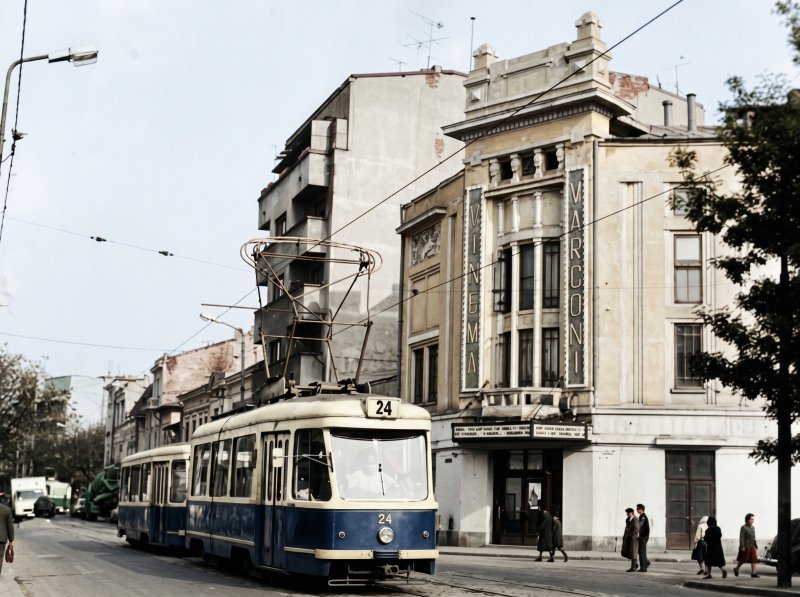
Built in 1930 on Calea Griviței, the cinema was originally known as Cinema Marconi, an ambitious project signed by architect Constantin Cananău. The building immediately stood out as a landmark of Bucharest modernism, blending the functionality of a performance space with avant-garde aesthetics. Its facade is one of the most spectacular in the city, decorated with stylized geometric Art Deco bas-reliefs that frame the entrance and windows, giving the property a unique visual identity in the industrial and commercial landscape of the Grivița area.
During the communist period, the cinema was renamed—first as Cinema Popov, then (from 1963) Cinema Dacia—continuing to function as a popular cultural center for neighborhood residents for decades. Unfortunately, after 1990, the building entered an aggressive process of degradation, being abandoned to the elements and vandalism. Although it is currently in an advanced state of ruin, its architectural skeleton and the remains of its exterior decorations remain a painful but fascinating testimony to interwar elegance. Cinema Marconi is considered one of the most important architectural "victims" still waiting for a chance at restoration. The good news is that a restoration plan for this emblematic Art Deco building was recently announced.
The ten monuments presented demonstrate that Bucharest’s Art Deco heritage is more than just a historical stage; it is the backbone of its modern identity. Although many of these architectural gems bear the mark of time today, they continue to define the spirit of the Capital through elegance and symmetry. Protecting and valuing them represents, in essence, an act of respect toward the period when Bucharest learned to look toward the future with courage and style.
You may also like: The Telephone Palace in Bucharest: From Little Paris to the New New York