What were the chivuțe of old Bucharest. When they appeared, what role they had, how much they earned, and when and why they disappeared
By Eddie Țone
- Articles
- 17 MAR 26
Old Bucharest, the one from before concrete and glass flattened everything into uniform boredom, was a city of distinctive sounds, a kind of street symphony where every trade had its own identifying call. Among the sellers of bragă, the yogurt vendors carrying shoulder poles, and the shoeshiners with their polished boxes, there stood out lively, colorful female figures holding a whitewashing brush and a bucket of lime.
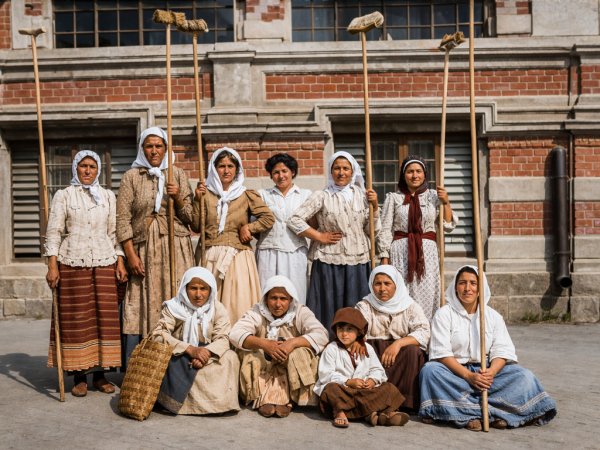
These were the chivuțe, the emblematic figures of urban cleanliness, Roma women who, for more than a century, held a near-monopoly over cleaning and whitewashing Bucharest homes. They formed a distinct caste, an unwritten but remarkably well-organized guild that turned the grime of winter into the blinding white of spring. Their image, with long skirts, vividly colored headscarves, and unstoppable verbal energy, remained etched in the city’s memory as a symbol of the periodic renewal of Romanian homes.
The roots of a seasonal trade and the identity of the name
The emergence of the chivuțe in Bucharest is closely tied to the city’s urban development in the 19th century. Their name, which today sounds like an exotic archaism, has a very practical explanation. The term derives from the given name “Paraschiva,” extremely common among Roma communities at the time. Since many of the women practicing this trade bore this name, Bucharest residents began calling them generically “Chiva” or “Chivuța.” Over time, the diminutive evolved into a common noun defining the entire professional category of itinerant whitewashers.
Historically, their presence became notable after the mid-19th century, alongside the settlement of Roma communities and the growing demand for maintenance services in a city that was beginning to adopt European standards of living. The chivuțe belonged to a social layer that quickly understood that hygiene was a valuable commodity. They occupied a niche ignored by male painters, who considered such work beneath their professional dignity: simple whitewashing, ceiling cleaning, and floor scrubbing.
The organization of a street-corner guild
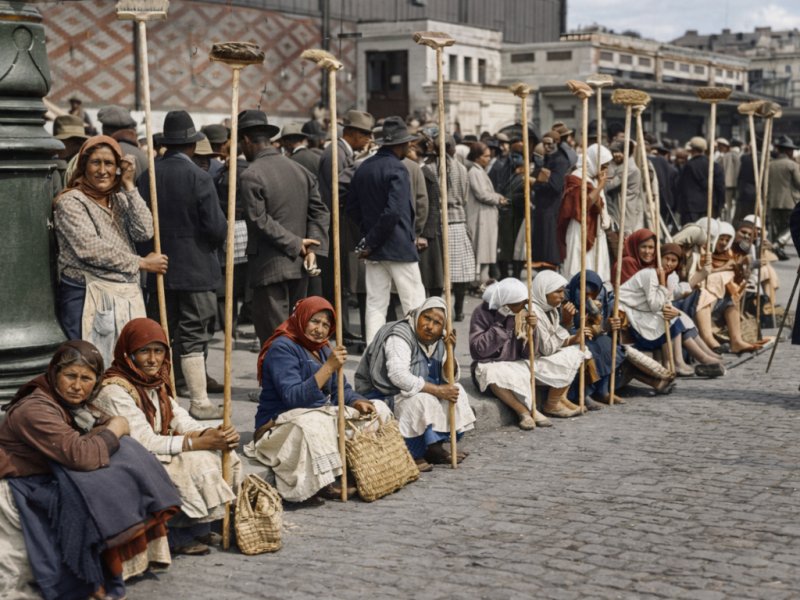
Chivuțe waiting for the clients, in 1929. Photo: Nicolae Ionescu
Despite appearances of chaos and noise, the chivuțe had a highly structured system based on territory and seniority. They gathered in well-established spots, called “customs” or “stations,” where housewives would come to hire them. The most famous meeting points were in Piața Amzei, at Sfântul Gheorghe, in Obor, or at Bariera Vergului. There, they formed compact groups, sitting on their lime crates and waiting for clients.
Hierarchy was dictated by experience and, quite frankly, by who had the loudest voice. The oldest women, true matriarchs of the brush, had priority when choosing clients who appeared wealthier. There were unwritten rules about respecting territorial boundaries; a chivuță from Amzei would rarely venture to “steal” clients from Rahova without risking a spectacular scandal, seasoned with curses and threats delivered at astonishing speed. Their tools were few but sacred: a horsehair brush, a metal bucket, a rough root brush for scrubbing floors, and sometimes a piece of pumice stone for stubborn stains.
The work ritual and the technique of perfect white
A chivuță’s work truly began with the first rays of spring sunlight. When housewives smelled the damp earth, they stepped outside to look for a “whitewasher.” Once hired, the chivuță entered the house like a whirlwind. Her role was complex: she moved furniture, covered fragile items with newspapers, and prepared the lime solution. The lime was slaked on the spot in a spectacle of bubbling and steam, sometimes mixed with a bit of laundry blue to achieve that faint bluish-white tone that suggested absolute freshness.
Their technique was rudimentary yet highly effective. The chivuță handled the brush with agility, covering an entire wall in minutes without streaks. Then came the hardest part: washing the floors.
At the time, houses had pine or oak wooden floors that had to be scrubbed with lye and a root brush until the wood became almost white. This work, done on their knees for hours, proved their remarkable physical endurance. Beyond whitewashing, they also served as confidantes, bringing news from other neighborhoods and fresh gossip, turning cleaning day into a lively social event.
Income and the economic status of these brush-wielding “entrepreneurs”
The economics of this trade were based on direct negotiation and rough estimation. The price depended on the number of rooms, the condition of the walls, and, most of all, each party’s persuasive abilities. A chivuță could earn in a single intense working day the equivalent of a minor clerk’s weekly salary, though the work was strictly seasonal. Peak periods occurred around Easter and Saint Demetrius’ Day, when all of Bucharest needed to shine.
During the rest of the year, income dropped sharply, and they shifted to other domestic work or small-scale street trading. Still, successful chivuțe held a special status within their communities. They wore gold necklaces as a sign of prosperity and dressed in expensive fabrics on holidays.
Their earnings were managed with strict discipline, often destined for their daughters’ dowries or for purchasing land on the city’s outskirts. In essence, they were among the city’s first independent working women, relying solely on their labor and their ability to sell their services.
The chivuțe in literature and art: celebrities of the slums
Their charm and colorful language fascinated writers and artists of the time. Ion Luca Caragiale captured their type brilliantly in his sketches, highlighting their verbal energy and ability to dominate any conversation through sheer volume and repetition. In the revue theater of the 1930s, the chivuță character was indispensable, often portrayed by famous actors parodying their signature call: “Whitewash, madam, whitewash!”
A real figure, preserved in urban legend, was Chiva from Dealul Spirii, said to have whitewashed a ten-room house in just two days, alone, without apprentices. Painters such as Nicolae Grigorescu and Ștefan Luchian were drawn to the vivid colors of their clothing and the contrast between whitewashed walls and their olive-toned skin. They were seen as part of the Balkan picturesque, giving the city an authenticity that no administrative reform could erase.
The decline and disappearance of the chivuțe
The end of this guild began to take shape after World War II, alongside radical changes in lifestyle and technology. The emergence of washable paints, modern rollers, and later professional cleaning companies made the chivuțe’s services seem outdated and inefficient. Modern paint no longer required yearly lime refreshment, and the new apartment blocks, with their limited space and standardized finishes, left no room for the noisy ritual of traditional whitewashing.
The communist regime also played a decisive role in their disappearance. Policies of forced employment and the banning of unauthorized street trade pushed the chivuțe into factory jobs or state sanitation work. The craft, passed down for generations from mother to daughter, gradually vanished.
The last authentic chivuțe could still be seen in Bucharest’s markets until the late 1970s and early 1980s, though by then they were little more than nostalgic silhouettes of a long-faded world.
The memory of the chivuțe
Their disappearance left Bucharest quieter and, paradoxically, more gray. They belonged to a time when cleaning a house was a ritual event, a purification of living space accompanied by stories and noise. Today, people use phone apps to find cleaning help, but the spirit of direct negotiation and work done with overwhelming vitality remains a fond memory among older Bucharest residents. The chivuțe were, in their own way, guardians of public hygiene, turning a basic necessity into a form of street spectacle.
Today, the only traces of their existence can be found in yellowed magazine pages or in black-and-white photographs by Costică Acsinte, where their proud gaze reminds us of a time when whiteness was achieved with sweat, a brush, and a great deal of passion.
Photo: restauration and colorization with A.I.
You may also like: Vanished Trades in Bucharest: How Much Did a Shoeshiner or a Carriage Driver Earn?