The Morning of May 1st. What Bucharest Looked Like When Labor Day Was Mandatory
- Articles
- 30 APR 26
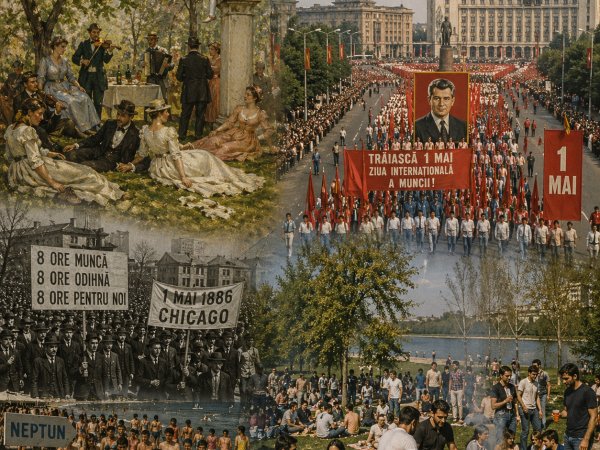
On May 1, 1886, around 90,000 people took to the streets of Chicago. It wasn't a parade — it was a strike. They were demanding a reduction of the working day from ten or sixteen hours to eight, and the mood was angry rather than festive. The days that followed brought deaths, arrests, and a trial that entered American history as one of the greatest judicial farces of the century. From the whole episode, Europe remembered one thing: the date.
The irony is that the Americans themselves rejected it. Fearing its association with socialist ideas, the US moved its labor day to September, where it remains today. Europe pressed on, and the Soviet Union turned May 1st into a state spectacle — with parades, slogans, and podiums lined with party leaders. The model was exported immediately across the entire Eastern Bloc.
Before it reached Romania, May 1st had meant something else entirely. It was called Armindeni — a celebration of early summer, with circle dances, wine, and afternoons spent outdoors. The painter Theodor Aman captured it in a canvas from around 1880: his family in a garden, musicians playing in the background, women in wide summer dresses, men at ease, a child perched on a column pedestal. No banners, no podium. The communists emptied the holiday of all that and replaced it with columns of workers.
The Lists
Around mid-April, the same ritual would begin in the administrative offices of factories and institutes across Bucharest. Section heads drew up lists, posted them or passed them along verbally, and everyone understood this wasn't an invitation. The only accepted excuse was serious illness — with a doctor's note — or a death in the family. Otherwise, you showed up.
You woke before dawn. You went to wherever the column was forming, received your assigned banner or portrait, and waited. Rehearsals had already taken place weeks earlier. Every institution knew its position in the procession, its pace, its chants.
The City on Parade Day
Bucharest on May 1st looked unlike any other day of the year. First came the workers from the capital's industrial enterprises, then researchers from scientific institutes, agricultural workers from the Ilfov district, youth representatives, and top athletes. Every category had its place in the column, every column had its place on the boulevard.
The route descended through the city center toward the podium where Ceaușescu stood to salute. Everything was choreographed, rehearsed, inspected. The square we know today as Charles de Gaulle was then called Aviatorilor — and before that it had been Stalin Square, when the Soviet dictator's statue stood at the entrance to Herăstrău Park. The names of places changed with the political wind. The people stayed.
What Happened After the Parade
The morning belonged to the party. The afternoon belonged to the people.
Bucharest's parks — Herăstrău, Tineretului, Cișmigiu — filled up the moment the march was over. Someone lit a grill, someone else brought a bottle. Within a few hours, Labor Day had become something else entirely. That's the real continuity of May 1st in Romania — not the ideology, but the barbecue that came after.
Young people, meanwhile, did whatever they could to skip the parade altogether. The preferred destination was the Black Sea coast — Neptun above all. The paradox was that precisely there, in Ceaușescu's own summer resort, the authorities allowed a deliberate pressure valve. Trains to the seaside left dangerously overcrowded, nobody bought a ticket, and nobody seemed surprised. It was days of music and drinking, with money saved up in advance not for accommodation but for alcohol.
Nostalgia, With an Asterisk
There are Romanians who say they miss May 1st from the communist years. It's not hard to understand why — not because the regime was kind, but because memories are never really about the regime. They're about the age you were then, about the family you sat with on the grass, about the fact that today's worries didn't exist yet. The historian Liviu Zgârciu put it plainly: that nostalgia is personal, not political.
The anthropologist Vintilă Mihăilescu said the same thing differently. Communism tried to fill the holiday with real meaning and only managed to drain it of what it had before. What remained was a day with hundreds of thousands of people in the street, most of whom would have rather been somewhere else.
May 1st, 2026
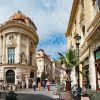
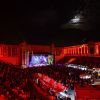
Magheru Boulevard is the same. Herăstrău is the same. On May 1st, 2026, Bucharest has concerts, urban festivals, theater at Bulandra and the National Theatre, tours of the Palace of Parliament — a program that everyone chooses for themselves, without lists drawn up in administrative offices and without portraits assigned a month in advance.
Aman's Armindeni — people on the grass, music in the background, a May afternoon with no agenda — never entirely disappeared. It survived underneath the parade, and came back to the surface the moment the parade was over.