Vanished Trades in Bucharest: How Much Did a Shoeshiner or a Carriage Driver Earn?
By Eddie Țone
- Articles
- 12 FEB 26
If you walk down Calea Victoriei today, or deliberately get lost in the twisty little streets around Mântuleasa, your senses get hit with a very modern blend of honking, phone pings, and that unmistakable smell of sun-baked asphalt mixed with exhaust. The city hums at a high frequency, the frequency of permanent urgency, where everything has to happen now, immediately, instantly.
But if you could turn the clock back, peel away the layers of modernity like an urban onion, you would find a completely different Bucharest. A city whose pace was set by horses’ hooves, the cries of street vendors, and the trembling light of gas lamps.
That vanished Bucharest ran on an army of people who are invisible today, vivid characters who made up the city’s nervous system. They were the capital’s living infrastructure, and their disappearance marks the shift from a tactile, artisanal, human world to one that is automated and efficient, yet perhaps a little lonelier and more high-strung. Let’s take a walk through this gallery of urban ghosts and meet the people who kept Bucharest moving before there were apps for everything.
The Lamplighter, Keeper of the Light
At dusk, when the sun dropped beyond the Dâmbovița and shadows began to stretch menacingly across the cobblestones, he appeared. The lamplighter. You could spot him by his measured stride, the long ladder on his shoulder, the pole in his hand. His job mattered for public safety and public morale, because he drew the line between civilization and total darkness.
In mid-19th-century Bucharest, public lighting, introduced in 1857, relied on “aerial gas” and kerosene lamps, and required daily hands-on work. The lamplighter would arrive, set the ladder against the post, climb up with the bored agility of a seasoned acrobat, clean the smoke-darkened glass, check the wick, and light the flame. In the morning, he reversed the routine.
His service cost the municipality a substantial amount, but for the ordinary resident the lamplighter delivered something priceless: safety. Lit streets discouraged thieves and allowed social life to continue after sunset.
A lamplighter’s pay was roughly on par with a skilled municipal worker. The cost of the service was folded into local taxes, paid by property owners for “the lighting of streets and public squares.” In other words, you paid for light and the lamplighter came as part of the package.
When the city was electrified, the lamplighter’s quiet romance was replaced by the blunt efficiency of a central switch. Today, light sensors do his work, and the city has lost that small ritual of gradual illumination, street by street, as evening settled in.
The Carriage Driver, the Taxi Man in a Top Hat and a Spring-Suspended Carriage
Long before yellow Logans and ridesharing apps defined urban transport, the carriage driver ruled the streets, or more accurately the cobblestones. Carriage drivers formed a caste of their own. The most sought-after and expensive were the “muscali,” often members of the Skoptsy sect, Russian eunuchs who practiced self-castration for religious reasons. They were known for their calm manners, magnificent horses, and elegant carriages fitted with velvet seats.
You’d find them waiting outside the National Theatre, at Capșa, or by the railway station. Haggling over the fare was mandatory sport and a kind of conversational performance. A ride from the station to the center could cost as much as a generous meal at a good restaurant, but you got more than transport: a tour guide, a confidant, and sometimes a steady supply of fresh gossip from high society. The luxury drivers wore long velvet coats, wide sashes, and top hats, looking impeccably refined.
Official fares were published periodically in the Monitorul Comunal. For short rides around the center, the charge reached about one leu; for longer distances, toward the city’s outskirts, it could climb to a few lei. A laborer earned roughly 3–5 lei a day, so a carriage ride was a serious expense, mostly reserved for people with some money or travelers in a hurry.
They faded away gradually after the First World War, pushed off the road by the arrival of the automobile. Cars were faster and cheaper. They won the battle, but Bucharest lost the steady rhythm of hooves and that slow elegance of a promenade along the Șosea, when the goal was to be seen, not to arrive quickly.
The Water Carrier (Sacagiu), a Mobile Spring for the Neighborhood
In a city perched along the banks of a murky and often unsanitary river like the Dâmbovița, drinking water was a luxury commodity. Before the water network was properly organized, the water carrier was a lifeline. You could hear him coming from far off, his cart loaded with big barrels, shouting, “Waaater! Good water!”
Water carriers brought water from well-known city wells or from cleaner springs on the outskirts. Their service was vital and ran on familiarity. People stuck with the same carrier, and he knew his customers. The price varied with distance and quantity, but a bucket cost only a few coins. It sounded small, but paid daily it became a substantial “subscription,” one that usually fell on women and children, the ones handling household chores. The value was obvious: he delivered the vital liquid to your gate, saving you the exhausting job of hauling heavy water over long distances.
The trade disappeared with lead pipes and the tap. When the Water Works began pumping water straight into people’s homes, the water carrier became a useless relic. And yet, looking at supermarket shelves stacked with bottled water, you realize that, in a strange corporate twist, the water carrier has returned, only now the barrel is plastic and comes with a colorful label.
The Neighborhood Sheepskin Maker, Architect of Personal Warmth
Old Bucharest winters bit with a ferocity that climate change has since softened. In those days, the neighborhood sheepskin maker worked like an engineer of thermal survival. His workshop, usually a small ground-floor room, smelled of tanned leather, mothballs, and sheep’s wool.
Unlike the luxury furriers on Calea Victoriei selling mink and astrakhan to ladies peering through lorgnettes, the neighborhood craftsman worked for ordinary people. He made heavy sheepskin coats, vests, and thick hats meant to last ten winters, not to impress at the opera.
Prices depended on materials and complexity. In the interwar period, a solid sheepskin coat for a working man could cost the equivalent of several dozen lei, sometimes as much as a large Christmas pig. For modest-income families, these were major purchases, worn for years and patched up by the same craftsman.
The trade evaporated under the assault of mass-produced clothing, synthetic materials (nylon windbreakers, polyester), and malls. Along with the sheepskin maker, we lost the idea of a coat “for life,” replaced by the jacket you wear for a season and then abandon behind the wardrobe because the zipper gave up.
The Traveling Glazier, Savior of Shattered Windows
The traveling glazier’s call is etched into the old city’s soundscape: a long, nasal shout, “Glaaass! We do glaaass!” You’d see him slightly bent forward, carrying on his back a wooden rack like a makeshift backpack, packed with panes of glass in various sizes, balanced precariously, plus a box of putty.
The glazier offered an instant fix for domestic disasters. Kids kicked a ball, a window shattered, and the glazier would appear as if he had a radar for broken glass. The repair happened on the spot: he cut the pane with a diamond tool, set it in place with fresh putty, and the window looked new.
Payment was per pane installed, with different rates for larger sizes. In the interwar years, a typical repair fit comfortably within a middle-class household budget, somewhere around a few lei, so people called the glazier without much hesitation after every serious storm.
Modern double-glazing killed the traveling glazier. The complexity of contemporary windows, with inert gas between panes and complicated mechanisms, turned repair into an industrial process and removed the need for the street-roaming craftsman. Today, if you break a window, you call a company and wait two weeks. Back then, it was sorted before dinner.
The Cobblestone Mason, Artist of Granite Puzzles
If you look closely in the Old Town or on streets that escaped election-season resurfacing, you’ll see their work: cobblestones. Cobblestone masons were laborers with formidable strength and iron patience. They knelt for days, fitting each granite block into sand, tapping it with a hammer until it sat perfectly beside its neighbor.
They turned Bucharest mud into European boulevards. Their work meant durability. A properly laid stone roadway lasted for decades, unlike modern asphalt that gives up after the first serious rain. The costs were borne by the municipality, while the labor was brutal and poorly paid relative to the effort involved.
The trade disappeared because machines and speed took over. Asphalt goes down fast, it’s quiet, and it’s cheap. Cobblestones survived as a retro luxury or a pedestrian-zone aesthetic, but the craftsmen who could lay them by hand in elegant fan patterns have largely vanished, replaced by machinery.
The Telegraph Operator, the World Connected in Morse
In old post offices, the telegraph operator was a communications magician. In a world where letters took days or weeks, he could send a thought hundreds of kilometers away in minutes. The rhythmic clicking of the Morse device was the sound of absolute speed.
The first telegraph line in Wallachia was installed in 1854 between Bucharest and Giurgiu, for military and administrative use. It was followed by links to Vienna, Constantinople, and other capitals. Telegraph operators became highly respected civil servants. They mastered the code, worked with specialized equipment, and carried the responsibility of transmitting essential messages accurately. One extra comma or a wrong letter could change the meaning of an entire text.
A telegraph operator had to be educated, fast, and discreet. State secrets passed through his hands, along with birth announcements, death notices, and love declarations brutally compressed to save money. Telegrams were billed by the word, which encouraged a stripped-down telegraphic language, an ancient kind of Twitter where the essential had to fit in the fewest possible characters. In many European countries, a word could cost several tens of bani, and Romania aligned itself with these practices.
The telephone, then the fax, and finally the internet sent the telegraph to the museum. Today we send gigabytes of information for free, but we’ve lost the solemn weight a received telegram once carried. When the postman arrived with a telegram, time stopped. Now WhatsApp notifications are just background noise.
The Shoeshiner, the Psychologist at Shoe Level
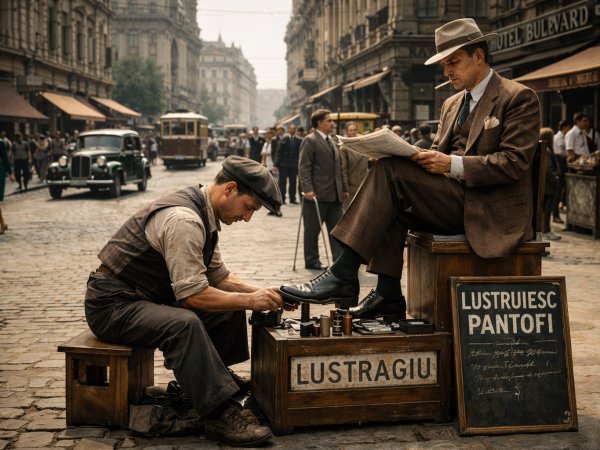
The shoeshiner was a real institution in central Bucharest. With his wooden box equipped with brushes, velvet cloths, and tinted creams, he stationed himself in heavy foot-traffic areas: Calea Victoriei, Lipscani, hotel entrances. For a self-respecting gentleman, dusty shoes were an unacceptable calling card.
In the interwar period, a shine cost a few lei or less, depending on where the shoeshiner worked and what kind of clientele passed by. Children and teenagers often did the job to earn extra income, and some paid for school out of this tiny business. For a handful of coins, the shoeshiner offered more than clean footwear: he gave you a pause. You sat down, lit a cigarette, and watched the world from a still point while he buffed your shoes to a mirror finish. The rhythmic snap of the cloth at the end, performed for sound effect, was the signature of work done properly.
Shoeshiners disappeared as fashion and daily rhythm changed. Sneakers do not get polished, and leather shoes show up less and less in everyday outfits. On top of that, the idea of sitting while someone works at your feet has become socially uncomfortable for many people.
The Street Bragă Seller, Summer’s Best Cooling System
“Coooold braaagă! Get your braaagă!” A shout that could trigger the salivary glands of any Bucharest resident on a July day with 35°C in the shade. The bragă seller, often of Turkish or Albanian origin, carried a large container on his back or in his hands, pouring the cloudy, sweet-tart, lightly fizzy drink into glasses.
Bragă, made from fermented millet or cornmeal, was enjoyed by rich and poor alike. It cost very little, just a few coins, which is where the phrase “as cheap as bragă” comes from. It was a quick hit of energy and a genuinely satisfying way to hydrate. The bragă seller brought liquid joy straight to the street.
Strict sanitary regulations and the invasion of Western carbonated drinks pushed these vendors out. Coca-Cola and Pepsi won the sugar war, and bragă became a nostalgic curiosity you can still find in a few isolated places, but it lost its former street-corner omnipresence.
The Neighborhood Watchmaker, Surgeon of Mechanical Time
The trade still exists here and there, but the old neighborhood watchmaker, the elderly man with a loupe stuck in his eye, bent over the inner organs of a Pobeda or an Orex, is heading toward extinction. His workshop was a sanctuary of quiet, filled with asynchronous tick-tocks and pendulums striking different hours.
You brought in a broken watch, he examined it with a doctor’s gravity, and told you to come back in a week. Repairs demanded patience, tiny parts, and a hand that never trembled. Prices varied by complexity. For a simple adjustment you paid little, but for a full cleaning or for replacing sensitive parts you handed over a few serious lei. Even then, repair was cheaper than buying a new watch, because quality mechanical pieces were major investments.
The quartz revolution, and then mobile phones, turned the mechanical watch from necessity into luxury accessory or collector’s item. Nobody repairs a 50-lei watch; they toss it and buy another. The patience required to take apart and clean hundreds of tiny gears does not match a consumption-driven economy.
With these trades, Bucharest lost more than a set of service providers. It inevitably gave up direct human interaction, negotiation, distinctive street sounds, and that unique texture of life lived at a slower pace. Maybe today we have comfort and speed, but we traded away the street’s poetry, and with it, a piece of the city’s soul.
You may also like: Tudor Arghezi and the 11 professions. What the great poet worked at before becoming a legend of Romanian literature