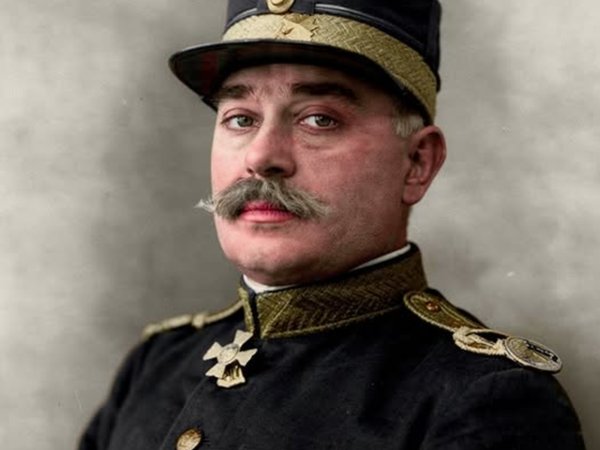
General Ioan Drăgălina, the hero of the Jiu Gorge, was shot one day after being appointed commander of the First Army in the First World War
- Articles
- 09 FEB 26
General Ioan Drăgălina remains one of the most powerful and dramatic figures of Romanian military history during the First World War. His destiny, brutally cut short just one day after he was appointed commander of the First Army, symbolizes the supreme sacrifice of the Romanian military elite at a critical moment for the existence of the state. His death, which occurred as a result of the wounds he suffered in the Jiu Gorge, stirred not only deep emotion, but also controversies that were to persist for decades.
The context of Romania’s entry into the war and the battles in the Jiu Gorge
In the autumn of 1916, Romania entered the First World War with the hope of achieving the national ideal of reunification. The initial enthusiasm was, however, quickly replaced by the harsh reality of confrontation with well-organized and technologically superior armies. The Jiu Gorge became one of the essential strategic points of the conflict, a natural gateway through which Austro-Hungarian and German troops attempted to penetrate the interior of the country.
Some of the most violent battles of the 1916 campaign took place here. The difficult terrain, unfavorable weather conditions, and constant pressure from the enemy turned the Jiu Valley into a true inferno for Romanian soldiers. Despite the courage they displayed, the Romanian First Army found itself in an extremely vulnerable position.
The Romanian First Army, numerically and technologically outmatched
At the beginning of the confrontations in the Jiu Gorge, the First Army was commanded by General Ion Culcer. Romanian forces were, however, clearly inferior in numerical strength and technology compared to the German and Austro-Hungarian troops. German General Erich von Falkenhayn, commander of the German Ninth Army, later described these battles as extremely costly for both sides.
Each position had to be taken by frontal assault, and advancement was achieved with considerable human sacrifice. Although the Romanians sometimes managed to capture prisoners and equipment, the price they paid was enormous. In the end, the constant pressure of the German forces led to the withdrawal of Romanian troops from the Carpathian passes.
The rise of Ioan Drăgălina and his appointment to the command of the First Army
Ioan Drăgălina had already distinguished himself in the battles of the summer of 1916, especially in the area of the Cerna Valley and at Orșova. His courage, discipline, and command ability established him as one of the most respected Romanian generals of the time. In this context, the General Headquarters decided to replace General Ion Culcer with Ioan Drăgălina at the command of the First Army.
His official appointment took place on October 11, 1916. On this occasion, General Drăgălina issued a daily order that became famous for its harshness and solemnity. He demanded that officers and soldiers defend the country’s land with their own lives, execute orders without hesitation, and not accept retreat as an option. The message reflected both the desperation of the situation and the determination of a commander who understood the enormous stakes of the moment.
The fatal day in the Jiu Gorge
The tragedy occurred the very next day after his appointment. On the morning of October 12, 1916, General Ioan Drăgălina set out on a reconnaissance mission in the front lines, accompanied by two officers and his driver. The group crossed the bridge near the Lainici Monastery, an extremely dangerous area that was partially under enemy control.
On their return, the general’s automobile was caught in a violent exchange of gunfire. Although the vehicle managed to cross the bridge at high speed, Drăgălina was struck by two bullets, one in the left arm and another in the shoulder blade area. The wounds were severe, and his medical condition deteriorated rapidly.
The road of suffering: hospitals, amputation, and lost hopes
The general was urgently transported to the medical post at Gura Sadu, where he received first aid. He was later moved to the hospital in Târgu Jiu, and then to Craiova. Doctors determined that amputation of the left arm was inevitable in order to save his life.
Nevertheless, by order of the General Headquarters, Ioan Drăgălina was placed on a special train and sent to the Military Hospital at the Royal Palace in Bucharest. During the transport, his wounds became severely infected. Although the amputation was eventually performed, the general’s weakened body could no longer withstand the ordeal.
On November 9, 1916, several weeks after being wounded, Ioan Drăgălina passed away. His death was perceived as an immense loss for the Romanian army and for the morale of the troops who were in full retreat.
The continuation of the fighting and the failure to defend the gorge
After the serious wounding of Drăgălina, command of the First Army was entrusted to General Nicolae Petală. In the Jiu Gorge, Romanian troops under the command of Colonel Ioan Atanasiu initially managed to repel the German offensive. Their resistance, however, was short-lived.
By the end of October 1916, approximately 60,000 soldiers and 30,000 cavalry horses of the German and Austro-Hungarian forces passed through the gorge, despite Romanian gunfire. The superiority of German artillery proved decisive, forcing the gradual withdrawal of Romanian troops.
Historical interpretations and the image of the hero
The politician Gogu Negulescu described, in his work The Sacrifice of the Romanians, published in New York in 1918, the heroic resistance of the Romanians in the Jiu Valley and the death of General Drăgălina as a symbol of national sacrifice. He emphasized the bloody battles and the determination with which Romanian troops attempted to stop the enemy advance through the Vulcan Pass.
In contrast, General Ion Culcer, the former commander of the First Army, offered a different perspective in his memoirs published in 1929. He claimed that Ioan Drăgălina did not actually have time to effectively command the First Army and that the attack plans had been established beforehand by him.
The controversy regarding the command of the First Army
Ion Culcer stated that on October 11, 1916, he handed over command to Drăgălina together with a clear plan of action, recommending the resumption of the offensive with the available troops. According to him, Drăgălina did nothing more than transmit the already established orders before departing for Târgu Jiu.
General Culcer recounted that the next day he received a telegram informing him of the serious wounding of his successor, which occurred as a result of an incident on the road in the Jiu Gorge, where Drăgălina had entered without knowing the exact situation at the front. Culcer was also the one who signed the order for the wounded general to be transported to the hospital at the Royal Palace.
The legacy of Ioan Drăgălina in collective memory
Despite the controversies, the image of Ioan Drăgălina has remained that of a courageous, competent officer, deeply respected by his subordinates. Even Ion Culcer acknowledged that Drăgălina was loved by the soldiers and appreciated for his military skill.
The fact that he died just one day after his appointment to the command of the First Army contributed to his mythologization as a hero of the Jiu Gorge. His tragic destiny reflects the drama of an army unprepared for modern warfare, yet driven by a profound sense of duty.
Ioan Drăgălina thus remains a symbol of sacrifice and devotion to the country, a general who paid with his life for his determination to be on the front line, alongside his soldiers, in one of the most difficult moments in the history of modern Romania.
We also recommend: General Ioan Emanoil Florescu, founder of the Romanian Army, has a street bearing his name in the center of Bucharest