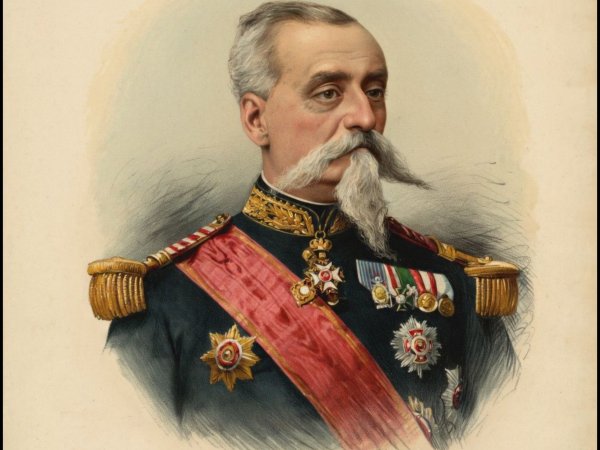
General Ioan Emanoil Florescu, founder of the Romanian Army, has a street bearing his name in the center of Bucharest
- Articles
- 29 JAN 26
The children of the aga Iordache Florescu — Dumitru, Costache, and Luxița — enthusiastically embraced the ideals of the 1848 Revolution, which was planned inside their family home in Bucharest. Luxița became the beloved and confidante of Nicolae Bălcescu, while her two brothers actively participated in the revolutionary movement. All three would later suffer exile after the revolution was suppressed, and Costache would endure many years of harsh imprisonment in Russia.
A family marked by revolution and exile
However, not all members of the Florescu family shared the same revolutionary zeal. One of them found himself in a particularly difficult position.
Although he shared the national aspirations of the revolutionaries, as a military officer he was bound to respect the oath of obedience sworn to the reigning ruler, Gheorghe Bibescu — who was also his father-in-law.
Origins and education of Ioan Emanoil Florescu
Ioan Emanoil Florescu was the cousin of Dumitru, Costache, and Luxița. His father, Manolache, was the brother of Iordache. Both Iordache and Manolache, sons of the Great Vornic Ioniță Florescu (1742–1801), had taken refuge in Transylvania after the failure of the revolutions led by Tudor Vladimirescu and the Philiki Hetairia in 1821.
Ioan Emanoil was born in 1819, shortly before this period of exile. After the family returned to Wallachia, he studied at the renowned Saint Sava School, an institution that cultivated Romanian national consciousness among many young boyars. At Saint Sava, Ioan Emanoil excelled in mathematics and sciences, but also developed a deep interest in literature. He even tried his talent as an actor in several Romanian and French plays and translated literary works from French into Romanian — a language he spoke perfectly from an early age.
The rebirth of the Wallachian army
The early years of Ioan Florescu’s life coincided with significant progress in the revival of the Wallachian army. Although the country had possessed military structures — the Small Host and the Great Host — since the foundation of the state in the 13th century, during the Phanariot era the army had been reduced to little more than the prince’s personal guard, composed largely of Greek, Serbian, and Albanian mercenaries.
Only after the end of the Phanariot period, especially during the era of the Organic Regulations under Kiseleff, was the idea of national armies in Wallachia and Moldavia translated into law. However, Article 5 of the Treaty of Adrianople (1829) strictly limited the army’s size and purpose: guarding borders, maintaining order, enforcing quarantine regulations, and preventing the spread of cholera from neighboring Ottoman provinces.
In other words, the Russian occupiers did not envision a modern fighting force for the Principalities, but rather a policing structure. Nevertheless, Romanians never abandoned the idea of rebuilding a true territorial army. Revolutionary leaders such as Tudor Vladimirescu and Nicolae Bălcescu looked to the legacy of Michael the Brave and became deeply committed to the necessity of a national army.
Early military career and studies abroad
In 1833, at only 14 years old, Ioan Florescu enthusiastically enlisted in the recently reestablished Wallachian army and received the officer rank of junker. Two years later, his grandmother Alexandrina — sister of Prince Alexandru Ghica — noticed him standing guard at the princely palace on a winter night. She invited him inside and introduced him to the daughter of the future ruler Gheorghe Bibescu, whom he would later marry.
At just 16 years old, Prince Ghica promoted him and sent him to study in Paris, despite Russian pressure to send Romanian officers to Saint Petersburg or Berlin. France was considered dangerously liberal. Florescu studied at the prestigious École Louis-le-Grand and then spent four years at the Saint-Cyr Military Academy. He later enlisted in the French army and was promoted to lieutenant in 1838, a rank he retained until returning to Bucharest in 1842.
Cultural interests and intellectual pursuits
By the time he returned to Wallachia, Ioan Florescu’s main interests were clearly defined: the army, literature, and education. In 1834, he produced a progressive theatrical play alongside colleagues, and in 1845 he became a member of the Romanian Literary Society.
In 1842, his grandmother Alexandrina Ghica gifted him a villa on Podul Mogoșoaiei (today’s Calea Victoriei), which he transformed into a center of cultural activity until 1850. He also translated French military treatises for young officers, demonstrating a strong commitment to professional military education.
Between loyalty and revolution
Although Florescu held progressive views on education and culture and was a determined nationalist, he rejected the radical social ideas of the 1848 revolutionaries — including those within his own family. His philosophy favored caution, gradual reform, and military discipline.
This mistrust was evident in a letter from Dumitru Brătianu to his brother Ion, warning him not to confide in Florescu because he was “not one of us.” In 1842, Gheorghe Bibescu ascended the throne, defeating both Florescu’s father and uncle. Ioan Florescu became his military adviser and accompanied him to Constantinople, returning with three cannons gifted by the Sultan — the symbolic beginning of Romanian artillery.
He married Bibescu’s daughter, Ecaterina, in 1844. By 1846 he was promoted to major, and in 1848 to colonel and governor of Wallachia’s penitentiaries.
The trauma of 1848
The 1848 Revolution placed Florescu in an impossible situation. While sympathetic to national ideals, he refused to break his oath to the ruler. He even requested that Russian General Duhamel punish officers who had violated their military oath. When the revolutionary government dethroned Bibescu, Florescu was dismissed from the army and crossed into Transylvania.
There, he made the controversial decision to join the Russian army under General Lüders, participating in the repression of the Hungarian Revolution. Though he later justified his actions by pointing out that Kossuth’s movement ignored Romanian rights in Transylvania, radicals viewed him as a collaborator with reactionary forces.
From Crimean War to national unification
After the Crimean War and Russia’s defeat, Florescu withdrew from Russian service. This shift allowed him to play a decisive role in the union of Wallachia and Moldavia. Initially supporting his father-in-law’s candidacy, he changed his stance after Alexandru Ioan Cuza was elected in Moldavia and convinced enough conservatives in Wallachia to support Cuza as well.
Thus, Cuza was elected ruler of both principalities — a political fait accompli that led to de facto unification. Contemporary newspapers and political figures, including Ion C. Brătianu, acknowledged Florescu’s decisive role.
Founder of the modern Romanian army
Promoted to general in 1860, Florescu entered the most productive period of his life. Between 1860 and 1866, he led the unification of the Wallachian and Moldavian armies into a single national force. Under Cuza’s full confidence, Florescu created the General Staff, unified military schools, reorganized ministries, established artillery, engineering, logistics, medical services, arsenals, and introduced standardized regulations and uniforms.
As General Rosetti later declared:
“There is not a single chapter of our military organization that does not bear Florescu’s imprint at its beginning.”
Preparing independence
During his later tenure as Minister of War under Prince Carol I, Florescu prepared Romania for the War of Independence (1877–1878). He introduced merit-based promotions, compulsory military service, annual maneuvers, and territorial forces. Despite fierce political attacks and lack of resources, he laid the structural foundation of the victorious Romanian army.
Although excluded from military command during the war itself, Florescu wept with joy upon victory, calling it “the most beautiful day of my life.”
Final years and legacy
After serving briefly twice as prime minister and later withdrawing from political life, Florescu devoted himself to cultural and educational activities. He remained active in the Romanian Athenaeum and the Society for the Education of the Romanian People. He received the French Legion of Honor as Grand Officer.
He died in France in 1893 at the age of 74. Two grand funerals were held — one in France, attended by the president and senior ministers, and another in Bucharest, with full military honors. His coffin, draped in the tricolor, was carried on a cannon carriage as soldiers and citizens paid their respects.
A complex figure of Romanian history
Ioan Emanoil Florescu was neither a revolutionary visionary nor a reactionary opponent of progress. He believed in moderation, discipline, education, and national unity.
His greatest achievement — the creation of the modern Romanian army — was organizational rather than political, yet fundamental to Romania’s independence.
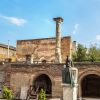
His bust stands today at the Military Museum, and his name remains engraved in Romania’s historical memory — including on a street in the center of Bucharest — as the man who built, almost from nothing, the army of a future independent nation.
We also recommend: Who was General Henri Mathias Berthelot and why a street in Bucharest bears his name