The house with armor, the history of one of the most unusual homes in Bucharest and the knight who watches over the city from above
- Articles
- 10 FEB 26
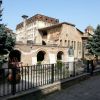
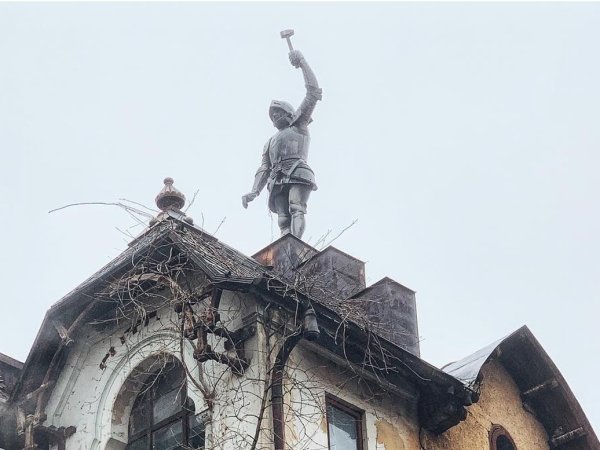
On Episcopul Radu Street, at number 29, in an area of Bucharest that still preserves the bohemian air of the interwar period, stands one of the most surprising houses in the city. It does not impress through monumental dimensions or opulence, but through a detail that defies the conventions of residential architecture: a knight made of iron, almost three and a half meters tall, perched on the roof, gazing over the city with a solemnity that is hard to ignore. It is the Alexandru Dimitriu House, known today as the “House with armor”, a dwelling that combines the refinement of Neo-Romanian architecture with the symbolic strength of metal and the pride of a guild that often remains invisible.
A corner of Bucharest where metal tells stories
The house is not just a building, but a statement. It tells the story of a man, of a craft, and of an era in which craftsmanship was considered art, and manual labor bore the imprint of the personality of the one who performed it. Behind the iron knight lies the destiny of the tinsmith-ornamentalist Alexandru Dimitriu, a name less familiar to the general public, yet essential for understanding Romania’s built heritage from the early 20th century.
Episcopul Radu Street is one of those discreet arteries of the Capital that do not appear on classic tourist routes, but which reward the attentive eye. The houses built here during the interwar period reflect the stylistic diversity of the time, from Neo-Romanian influences to Art Deco or eclectic echoes. In this urban context, the House with armor stands out not through an unusual volume, but through the symbol that crowns it.
The iron knight dominates the roof and functions as a sign of recognition. It is not a simple decoration, but a statue with deep symbolic meaning. Armed with a hammer, the character seems more like a defender of craftsmanship than a classic medieval warrior. His presence creates a bridge between past and present, between the raw strength of the material and the delicacy of ornamental detail.
Seen from street level, the house appears to conceal an unspoken story. The windows are often closed, the façade bears the marks of time, and the surrounding quiet contrasts with the powerful message conveyed by the iron silhouette above. It is the kind of building that forces you to slow your step and ask questions.
Alexandru Dimitriu, the craftsman who turned his house into a manifesto
Alexandru Dimitriu was born in 1871, in Iași, at a time when traditional crafts were passed down from generation to generation and apprenticeship was a form of education just as respected as academic studies. Trained as a tinsmith and ornamentalist, Dimitriu refined his craft in a vibrant European context, being influenced by the great workshops of Western Europe before the First World War.
The experience accumulated abroad offered him not only technical skills, but also an artistic vision of metal. For him, iron was not an inert material, but one that could be shaped, ennobled, and transformed into a visual language. Returning to Romania, Dimitriu became one of the most appreciated craftsmen of his time, collaborating on the creation of metal ornamentation for emblematic buildings.
The house he built for himself in Bucharest, around 1932–1933, is the most personal expression of this vision. Built in the Neo-Romanian style, the dwelling does not merely follow the architectural canons of the period, but complements them with decorative metal elements, made by the owner himself. Every detail speaks about respect for the craft and about the desire to leave a lasting mark.
Neo-Romanian architecture and the dialogue with metal
The Neo-Romanian style, dominant in Romania in the first half of the 20th century, was characterized by the reinterpretation of traditional elements, inspired by Brâncovenesc architecture and vernacular forms. Arcades, columns, richly decorated frames, and balanced proportions define this movement, which aimed to affirm a national identity through architecture.
The Alexandru Dimitriu House fits into this style, but takes it further by integrating metal as a central element of expression. The railings, ornaments, and, of course, the knight on the roof transform the dwelling into a rare example of synthesis between architecture and the art of metal. It is not about a simple decorative addition, but about a coherent fusion between structure and ornament.
Metal acquires here a symbolic dimension. It represents durability, strength, and precision, values that Dimitriu associated with his own guild. In an era in which architects and craftsmen collaborated closely, the House with armor becomes an example of how an artisan can claim his place in urban history.
The iron knight, symbol and guardian of the city
The element that definitively transforms the house into an urban landmark is the iron knight on the roof. With a height of approximately 3.5 meters, the statue impresses through its dimensions, but especially through its expressiveness. The armor, the posture, and the hammer held in hand point to the idea of protection and labor, rather than warfare.
The knight can be interpreted as an alter ego of the craftsman. He watches not only over the house, but also over the city, establishing a symbolic covenant between those who shape iron and the urban heritage. It is a form of affirming the dignity of manual labor, elevated to the rank of art and monument.
In a Bucharest where many historic buildings have lost essential details, the presence of this statue is all the more valuable. It recalls a period when ornament had meaning, and every element was conceived as part of a whole. The knight is not an isolated figure, but the peak of a narrative built from metal, stone, and memory.
From professional glory to neglect and decay
Although the House with armor is recognized today as a historical monument, its current condition reflects one of the major problems of Bucharest’s heritage: abandonment. After decades in which it witnessed the transformations of the city, the building has been in a state of disrepair for many years. Closed windows, deteriorated plaster, and the lack of coherent restoration contrast painfully with the symbolic strength of the construction.
This degradation does not erase the story of the house. On the contrary, it makes it even more visible. Every detail that remains intact speaks about the level of mastery achieved by Alexandru Dimitriu and about the importance of craftsmen in the construction of the modern city. The house continues to exist as a fragment of urban memory, even when it is not inhabited or properly valued.
Its status as a historical monument should offer protection, yet reality shows that official recognition is not always enough. The House with armor remains an eloquent example of the fragility of heritage, but also of the enormous potential that such buildings have if they are restored and reintegrated into the life of the city.
The legacy of Alexandru Dimitriu and the lesson of a manifesto-house
Beyond the story of an unusual dwelling, the House with armor is a lesson about professional identity and about the way an individual can leave a lasting imprint on the city. Alexandru Dimitriu did not limit himself to contributing anonymously to famous buildings such as the Romanian Athenaeum, the Patriarchal Palace, the North Railway Station, or the Palace of Culture in Iași. He chose to concentrate his vision in a personal space, transforming it into a manifesto of his guild.
The house tells a story about respect for detail, about pride in one’s craft, and about the dialogue between art and utility. In an era in which speed and standardization dominate urban construction, this dwelling reminds us of the importance of craftsmanship and individual expression.
The iron knight continues to watch over the city, even when hurried passersby no longer pay attention to him. He remains a symbol of endurance over time, of work done well, and of an authentic relationship between man, material, and urban space. The House with armor is not just an architectural curiosity, but a living page from the history of Bucharest, one that deserves to be rediscovered, protected, and told further.
We also recommend: Assan House, the palace in the heart of the Capital where the first Romanian to travel around the world lived