The most ill-famed place in last century’s Bucharest inspired the painter Ștefan Luchian. The history of the Yellow Inn
- Articles
- 11 FEB 26
In the history of Bucharest there are places that shone through elegance and splendor, but also spaces that remained in the collective memory because of their dark reputation. The Yellow Inn, located on the north-western edge of the old Capital, belongs to the second category. For more than a century, this inn was the witness of a colorful world, populated by tired merchants, cart drivers, porters, pickpockets and artists sensitive to the drama of peripheral life. Although it has physically disappeared, its story continues to fascinate, especially through its connection with the painter Ștefan Luchian, who transformed the sordid slum into a source of artistic inspiration.
The raising of the inn at the crossroads of commercial roads
The history of the Yellow Inn and of the Devil’s Slum, the neighborhood in which it stood, reflects a Bucharest of violent contrasts, where crushing poverty coexisted only a few streets away from the luxury and refinement of Calea Victoriei. In this harsh setting, life pulsed with a particular intensity, and the attentive eye of an artist knew how to capture the hidden beauty of a marginalized world.
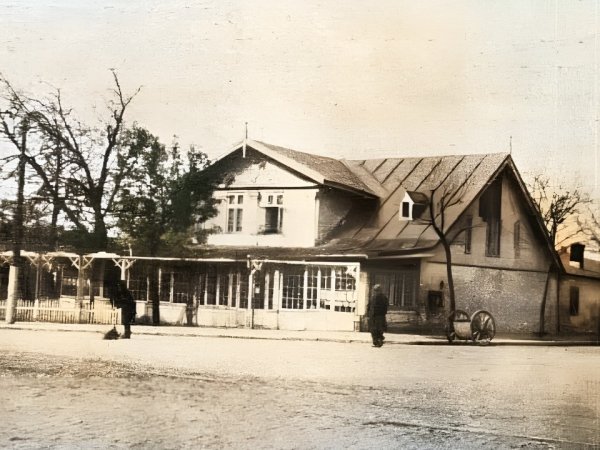
The Yellow Inn was built at the beginning of the 19th century by the steward Preda Săulescu, at a strategic point of the city, at the intersection of today’s Banu Manta Boulevard with Dr. Felix Street. At that time, the area was on the outskirts of Bucharest, but it had considerable commercial importance, because it connected with the Târgoviște road, one of the most traveled routes for the merchants who came to sell their goods in the Capital.
The positioning of the inn was, therefore, extremely advantageous. The traders arriving from Târgoviște, after exhausting days of travel and bargaining, found here shelter for the night. Payment was not always made in money; often, the host received part of the sold goods, thus consolidating the role of the inn as a vital point of transit and exchange. In a short time, the Yellow Inn became a landmark for those traveling between Bucharest and the old princely capital.
The building impressed through its solidity and size. It had one floor and a robust structure, and its name came from the yellow color of the façade, which made it easily recognizable from a distance. For that era, the construction was imposing, suggesting both the ambition of the owner and the economic potential of the place.
A complex and prosperous household
A document published in 1850 in the newspaper “Vestitorul Românesc” offers a detailed description of the inn. On the upper floor there were four rooms, two pantries and a kitchen, while on the ground floor there were five rooms and a spacious tavern. The latter was provided with a vaulted cellar, large enough to store 18 barrels of wine, a sign that the commercial activity was intense and well organized.
The courtyard of the inn was equally impressive. Here there functioned a stable capable of sheltering ten pairs of horses, an essential element for an inn located on a commercial road. There were two sheds with locked doors for carriages, a coal storage, a cabbage storage, an extended garden, hayfields and a vineyard of 13 pogons. In addition, a well-equipped wine cellar completed the household ensemble, suggesting a small self-sufficient economic universe.
After the death of Preda Săulescu, the inn passed through several hands, yet the details of the transactions are not fully known. Around the year 1870, the owner was a certain Cristea, and later the building came into the possession of the Saint Friday-Nouă Church. It is not known exactly how long the church administered the inn, but the beginning of the 20th century was to bring radical changes in the reputation of the place.
The Devil’s Slum, a space of the marginalized
With the passing of time, the area around the inn began to decay. The lack of public lighting and chronic poverty turned the place into an environment favorable to criminality. The Yellow Inn was located in the heart of an area known as the Devil’s Slum, considered one of the most dangerous in Bucharest.
This slum stretched between the Filantropia Hospital and today’s Banu Manta Boulevard, marking, at that time, the north-western limit of the city. Here had settled individuals considered dangerous, and the chronicles of the era describe the place in oppressive terms. In 1932, the publication “Ilustrațiunea Română” painted a shocking picture: an indiscreet misery without modesty, narrow and muddy streets, houses with windows covered with colored papers, peeling walls and a chaotic crowding of people, animals and garbage.
The population consisted of porters, cart drivers, day laborers, beggars, milkmaids, flower sellers, fortune tellers and washerwomen. The “Communal Monitor of the Bucharest City Hall” from 1890 recorded the presence of barefoot and uncombed women, of men marked by misery, and of children in rags or completely naked. The image was one of violent contrast compared to the elegance of Calea Victoriei, located only a few streets away.
Ștefan Luchian and the hidden beauty of the periphery
Paradoxically, this sordid space became a source of inspiration for artists. Among them was Ștefan Luchian, one of the most important Romanian painters. For two years, he lived right across from the Yellow Inn, attentively observing the life of the slum.
Luchian was not attracted by misery itself, but by the intense humanity that pulsed in this setting. The characters of the neighborhood, with their faces furrowed by toil and suffering, offered him a gallery of authentic figures. In his works, the artist captured not only the exterior appearance of the slum, but also its inner vibration.
Among the paintings inspired by this area is “Old Man Nicolae,” the portrait of an elderly cobza player whom Luchian considered a true living anthology of old and worldly songs. Also, the pastel “The Booth from Filantropia” and the watercolor “The Well on Clucerului Street” reflect the painter’s interest in the everyday details of a world ignored by the elites. Through these works, he immortalized the life of simple people, conferring upon them artistic dignity.
The decline and disappearance of the inn
As Bucharest modernized, the periphery was gradually integrated into the urban fabric. The Devil’s Slum slowly lost its notoriety, and living conditions began to improve. The Yellow Inn, however, did not keep up with the new times.
The building fell into ruin and, eventually, was demolished. In its place modern constructions appeared, completely changing the former landscape. Today, few elements still recall the existence of the inn and the tense atmosphere of the slum.
Nevertheless, the memory of the place has not been lost. Historical documents and the works of Ștefan Luchian keep alive the image of an era marked by strong contrasts. The Yellow Inn remains a symbol of a harsh but authentic Bucharest, in which merchants, pickpockets and artists coexisted in a fascinating mixture.
Its history demonstrates that even the darkest corners of the city can become sources of inspiration and reflection. Although it no longer exists physically, the Yellow Inn continues to live through art and through the pages of history, as a testimony of a disappeared, yet never forgotten world.
We also recommend: Ouatu’s Pit and the forgotten history of the slum on the edge of Grivița neighborhood