16 Famous Dishes from Old Bucharest, Now Forgotten
By Eddie Țone
- Articles
- 10 FEB 26
You sit down at a table in some obscure restaurant, tucked away in the heart of the city, maybe on a cobbled street that promises a detour into Little Paris, and you open the menu. The paper is thick, the fonts are calligraphic, and your expectations rise in direct proportion to the prices. You flip the first page and find burgers. The second offers carbonara. The third insists on pizza and, perhaps, a stray pork neck surrounded by frozen fries. A mild sadness settles in. It’s the melancholy of the gourmand realizing that globalization tastes like industrial ketchup.
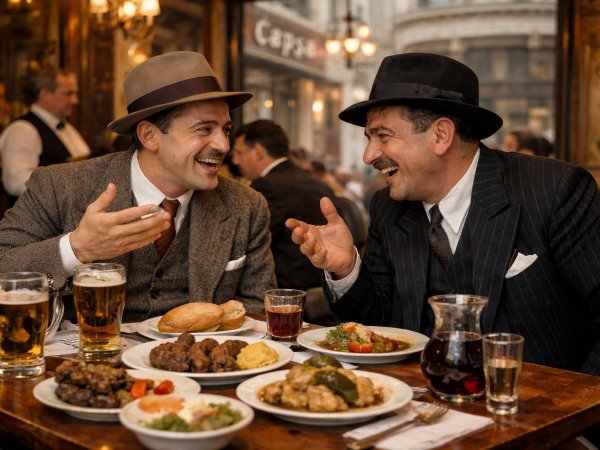
Bucharest once had a bold, far more textured culinary identity. The lunches of our grandparents, or even our parents, included anatomical parts we now consider, at best, pet food. Restaurant menus from the interwar years, and even from the rosy phase of communism up to around 1980, overflowed with dishes that required hours of cooking and a stomach free of prejudice. Those old Bucharest dishes faded slowly, chased away by fear of cholesterol and the modern preference for bland chicken breast.
And yet they still lurk in the shadows of the local food scene, waiting to be rediscovered by someone willing to leave their preconceptions at the door.
Texture over looks, or where the organs went
If you leaf through a 1930s cookbook, you’ll notice a fascinating obsession with everything inside the animal. Old-school Bucharest wasted nothing, and the chefs at Capșa or Enache turned necessity into art. Today, the gelatinous or creamy textures of offal are treated with suspicion, though they once represented the height of refinement.
Tuslama is probably the dethroned queen of enriched soups. Unlike tripe soup, which survived the democratic transition, tuslama became a memory. It’s a dense, unctuous dish made from tripe and beef feet, simmered until collagen turns the liquid into a sticky, delicious gel, often served with horseradish. It was the breakfast of revelers heading home from the lăutari at sunrise. Its disappearance has everything to do with prep time and appearance, which openly defies the “Instagrammable” standards of the twenty-first century.
Breaded brain and tongue with olives complete this portrait of soft textures. Brain, served hot beneath a golden breadcrumb crust, delivers a flavor experience the French still cherish, though modern Romanian restaurants have largely abandoned it. Its texture resembles a cloud of butter. Tongue, on the other hand, demands slow cooking and a complex sauce, often with wine and olives, to cut through the richness.
You can still find these dishes today only in places that openly assume the mission of recovering urban culinary history, such as ZEXE or, surprisingly, in a few neighborhood canteens that refused to update their recipe books after 1980. The conclusion is simple: we gave up complex flavors because we lost the patience to cook them and the courage to chew them.
Post-party potroace soup
Potroace soup belongs to the classic Bucharest ritual of long, drawn-out parties. Made from the humbler parts of poultry, with well-boiled bones, vinegar, vegetables, and sometimes a bit of rice, its declared purpose was to get you back on your feet after a night of excess.
In the interwar years, potroace appeared in many restaurants. Later, neighborhood taverns served it in the morning as a remedy for regulars. Today, tripe soup has taken over, and potroace has slipped into the forgotten corner of the menu.
You’ll still encounter it in a handful of traditional restaurants, often listed as a weekend or holiday dish. Sometimes it shows up at weddings and baptisms with a more conservative air, where the head chef still honors grandmotherly recipes.
The decline of river fish and the mystery of plachie
It’s a small tragedy that a city so close to the Danube has almost completely forgotten how to cook carp or catfish. Fish plachie, with rings of caramelized onions and a tomato sauce reduced in the oven until it becomes something like a savory jam, vanished under the assault of Norwegian salmon fillets. Convenience won. River fish have bones, and modern diners seem to have lost the patience to deal with them, preferring uniform, sterile textures.
Plachie was the trial by fire for a respectable boardinghouse cook or an ambitious restaurant chef. It had to be balanced, neither too greasy nor too acidic. Today, if you want an authentic plachie, you have to venture into the less explored parts of the city or seek out fish restaurants that still honor local catches. It’s an effort worth making for fish lovers, because no grilled sea bream can match the complexity of a Romanian carp prepared by the old rules.
Small birds and lost refinement
There’s a category of meat that has almost entirely vanished from everyday urban life: small birds. In Cezar Petrescu’s novels and in memoirs of the era, characters frequently order pigeon cooked in a cauldron or quail roasted in the oven.
These weren’t seen as extravagant indulgences but as a flavorful alternative to boring chicken. Pigeon meat is dark, densely fibrous, with a slightly ferrous, gamey taste. Quail offers a delicacy no farm chicken, however organic the label, can rival. Their disappearance comes down to logistics and profitability. A pigeon yields little meat and requires meticulous handling. In an age obsessed with efficiency, no one wants to spend twenty minutes cleaning tiny bones for three bites of divine flesh.
Still, if you want to understand how a well-off civil servant’s family ate on a Sunday after church, you have to seek out these dishes. They appear sporadically on the menus of game restaurants or in places trying to revive the atmosphere of old boyar estates.
Honest working-class food turned curiosity
Not all vanished dishes belonged to the elite. Some fed generations of workers, students, and rushed clerks, and their disappearance leaves a gap in Romanian comfort cuisine. Enter baked beef, grilled kidneys, and the controversial breaded luncheon meat.
Baked beef was a staple of any respectable cafeteria. A serious chunk of beef, slowly cooked in a thick tomato and wine sauce, invariably served with mashed potatoes or macaroni. It defined comfort food before Americans packaged the term for us. In the 1990s, it was replaced by quick grilled steaks, often with the texture of a rubber sole. Kidneys, properly prepared on the grill or in a wine sauce, demanded flawless cleaning to eliminate unpleasant odors. Many cooks failed to master this, and kidneys were exiled from menus.
Breaded luncheon meat divides opinion. For some, it’s an abomination born of scarcity. For others, it’s Proust’s madeleine, fried in oil. A thick slice of luncheon meat, dipped in egg and breadcrumbs, became the poor man’s schnitzel. It may seem dated, but a good-quality luncheon meat prepared this way has a certain charm. You’ll still find it in self-service spots in Bucharest markets, Obor for instance, where time has been kinder to old habits. It proves that good taste doesn’t always depend on expensive ingredients.
Boiled fish with vegetables
Boiled fish served with vegetables, lemon slices, and sometimes a discreet garlic sauce was a quiet star in restaurants along the Dâmbovița and in places serving freshwater fish. The fish often came from nearby rivers, and the dish had an almost dietetic air, perfect for clerks who wanted to appear moderate at lunch.
In today’s Bucharest, fish tends to arrive fried, griddled, or dressed up in Mediterranean styles. Boiled fish feels too well-behaved for modern menus. Still, a few urban fish houses preserve the tradition, especially when they have access to good carp or catfish.
If you ask directly for it, a waiter might sometimes suggest an improvised version, particularly in places that still keep large pots simmering, not just theatrical griddles in front of customers.
Spring lamb stew
Lamb stew with green onions or leeks, bound with a reddish sauce and finished with wine, once had a vibrant life in Bucharest. In spring, especially around Easter, city restaurants competed with home kitchens. Menus filled with stew, offal loaf, roasts, and seasonal soups.
In the age of short menus, lamb stew lives mostly at home. Restaurants prefer oven-roasted lamb, easy to plate elegantly. Stew feels harder to sell to a public that associates thick sauces with cafeterias.
Still, around Easter, a few old restaurants and neighborhood spots add stew to the daily menu. You’ll also find it at holiday fairs, where cooks allow themselves to resurrect forgotten recipes.
Desserts that demand patience
If main courses changed, desserts were practically wiped out. Modern display cases are ruled by mousse cakes, cheesecake, and tiramisu. Hot, plated desserts assembled to order have nearly vanished.
Apples in pajamas and floating islands are prime casualties. Apples, peeled, sliced, and fried in fluffy batter, then dusted with vanilla sugar, offered a perfect contrast between fruit acidity and sweet crust. Floating islands, with clouds of meringue drifting in a sea of vanilla sauce, were the ultimate test of a homemaker or pastry chef. If the sauce split or the meringue turned rubbery, disaster followed.
These desserts disappeared because they don’t keep. They can’t sit in a refrigerated case for three days. They require freshness and a kitchen that cooks to order. You can still hunt them down in places like Hanu’ lui Manuc or Caru’ cu Bere, which carry a moral obligation to keep historical recipes alive. Ordering one delivers a serving of warm nostalgia, far superior to any thawed pastry.
Joffre cakes, Capșa’s mini stars
Joffre cakes, inevitably associated with Casa Capșa, are nearly legendary. Two dense chocolate layers with a rich ganache in between, inspired by French fashion. The cake was dedicated to a French marshal, and the story quickly captured Bucharest’s audience, ever attuned to Parisian echoes.
In the interwar period, Joffre cakes were part of the urban seduction toolkit. A date at Capșa with coffee and an elegant pastry said plenty about your status and aspirations.
Today, authentic Joffre cakes exist in very few places. Capșa remains the main reference, with a handful of old pastry shops attempting similar recipes. Many imitations stray far from the original texture, veering either toward overly fluffy sponge or excessively sweet cream.
Boema, the most bohemian cake
Boema, the cake with cocoa sponge, airy cream, and glossy glaze, carries a name that points straight to artists and crowded cafés. It was hugely popular in the latter half of the last century, in both central and neighborhood pastry shops.
The structure was simple but delicately balanced. The sponge had to be light, the cream generous, the glaze thin yet intensely cocoa-forward. Boema was the safe dessert choice for those wanting something elegant without Capșa prices.
In today’s Bucharest, Boema survives mainly in the memories of those who grew up in the eighties and nineties. A few traditional pastry shops still keep it in their cases, especially in areas with loyal customers attached to old recipes. Alongside them, modern reinterpretations appear in artisanal bakeries using more refined ingredients.
So next time you go out, commit a small act of rebellion. Ignore the pizza. Skip the pasta. Ask the waiter, with a conspiratorial smile, whether they happen to have breaded brain or a hidden pot of tuslama in the kitchen. You might get a puzzled look, but if you’re lucky enough to find the right place, you’ll discover that Bucharest’s history tastes far better than its standardized present.
When was the last time you ate something that would genuinely frighten a modern food influencer?
You may also like: Where to eat well in Bucharest: from traditional restaurants to international cuisines