Gheorghe Țițeica, the greatest mathematician in the history of Romania, has a street named after him in Bucharest
- Articles
- 10 FEB 26
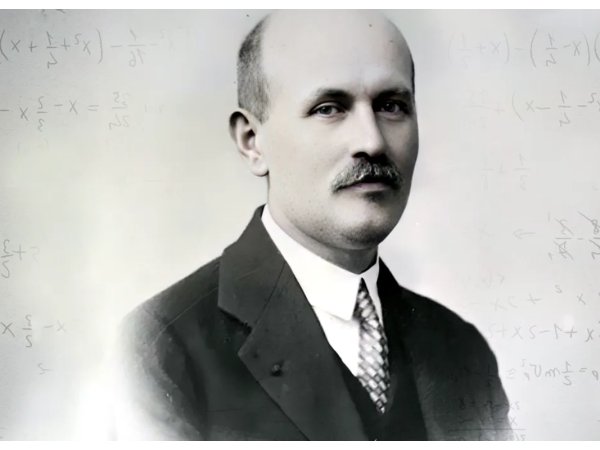
In the cultural and scientific landscape of Romania, few names have the resonance and prestige of Gheorghe Țițeica. Considered by numerous specialists to be the greatest Romanian mathematician of all time, Țițeica was a personality who went beyond the academic boundaries of his era and established the Romanian school of mathematics on the international stage. Today, his name is preserved not only in scientific treatises and university textbooks, but also in the urban space of the capital city, through a street that bears his name, a symbolic gesture of recognition of an exceptional intellectual legacy. The life and work of Gheorghe Țițeica represent an example of rigor, passion for knowledge, and devotion to education. From a child born into a modest family in Turnu Severin to a scholar respected in the great university centers of Europe, his path is a lesson about the power of intelligence and constant work.
Childhood and the first signs of an exceptional mind
Gheorghe Țițeica was born on October 4, 1873, in Turnu Severin, into a family without academic traditions. His father worked as a postal clerk, and his mother, Ana Țițeica, took care of the household. The environment in which he grew up did not offer particular intellectual privileges, yet young Gheorghe demonstrated from his earliest years an extraordinary intelligence.
A curious and extremely disciplined child, Țițeica was drawn to mathematics from primary school. The order, logic, and elegance of mathematical proofs fascinated him, and this passion would define his entire life. Teachers quickly noticed his ability to understand abstract concepts far beyond his age level.
He attended the “Traian” High School in Turnu Severin, one of the most prestigious educational institutions in the area. Here he distinguished himself as an outstanding student in all subjects, but mathematics remained the field in which he truly excelled. His remarkable results earned him the recognition of his teachers and allowed him to obtain a scholarship, opening the path toward university studies.
University education and encounters with the great teachers of Romanian mathematics
In 1892, Gheorghe Țițeica became a student at the Faculty of Sciences of the University of Bucharest. It was a period when Romania was building its intellectual elites, and the university gathered first-rank professors. Under the guidance of personalities such as Spiru Haret and Nicolae Coculescu, Țițeica came into contact with high-level mathematics and the rigor of authentic scientific research.
Even during his student years, he demonstrated remarkable intellectual maturity. He published scientific papers that attracted the attention of specialists and was quickly regarded as one of the most promising young mathematicians of his generation. His capacity for synthesis, originality of ideas, and rigor of proofs clearly distinguished him from his peers.
After graduating from the university, his academic performances earned him a scholarship to study in France, one of the great capitals of world mathematics at the end of the nineteenth century. This stage would prove decisive for his formation as a scholar.
Years of study in Paris and the influence of the French school
Upon arriving in Paris, Gheorghe Țițeica was admitted to the prestigious École Normale Supérieure, a true laboratory of modern mathematical ideas. Here he had the opportunity to work and interact with some of the greatest mathematicians of the time, including Henri Poincaré and Élie Cartan.
The influence of the French school would be deeply felt in his later works. In Paris, Țițeica deepened his studies in differential geometry, a field that was then experiencing a spectacular expansion. He began to develop original ideas, formulate new concepts, and seek subtle connections between geometry and mathematical analysis.
This period was not only one of accumulation of knowledge, but also of intellectual maturation. Contact with European academic elites confirmed his value and gave him the confidence needed to build his own research direction.
Return to Romania and academic career
In 1899, after completing his studies in France, Gheorghe Țițeica returned to Romania. He was appointed professor at the University of Bucharest, where he began teaching advanced mathematics. His main teaching interests were differential geometry and differential and integral calculus.
Țițeica quickly distinguished himself as an exceptional professor. His courses were known for the clarity of exposition, rigor of demonstrations, and depth of the ideas presented. Students respected him not only for his erudition, but also for the passion with which he taught, managing to convey the beauty of mathematics.
At a time when Romanian higher education was still in formation, Gheorghe Țițeica contributed decisively to raising the academic level and aligning it with European standards.
Differential geometry and fundamental contributions
The field that definitively established Gheorghe Țițeica was differential geometry. This subfield of mathematics studies geometric forms and structures using analytical and differential methods, with profound applications both in pure mathematics and in physics.
Țițeica focused on the study of surfaces and curves, managing to formulate original results that attracted the attention of the international scientific community. His best-known contribution is related to the so-called “Țițeica surfaces,” a special class of surfaces defined by particular relations between curvature coefficients.
The discovery of these surfaces represented a major innovation, opening new research directions in differential geometry. To this day, they continue to be studied and cited in specialized literature, confirming the lasting relevance of his ideas.
Scientific works and international recognition
Throughout his career, Gheorghe Țițeica published over 400 scientific papers, many of them appearing in prestigious international journals. Among the most important are “Sur les surfaces réglées” (1907), in which he analyzed surfaces generated by the movement of a straight line along a curve, and “Analytical geometry of surfaces” (1910), a reference work in the field.
International recognition soon followed. Țițeica was invited to numerous mathematical congresses and conferences, where he presented his research. He became a member of the Academy of Sciences in Paris and corresponded with renowned mathematicians from around the world.
Through his activity, he contributed decisively to promoting the Romanian school of mathematics internationally, proving that Romania could produce scholars of world-class stature.
Professor, mentor, and reformer of mathematical education
Beyond his research activity, Gheorghe Țițeica was deeply devoted to education. He wrote textbooks and didactic works intended for pupils and students, among them “Elements of differential geometry,” which were used for decades in Romanian schools and universities.
His teaching methods were appreciated for the balance between rigor and accessibility. He trained entire generations of mathematicians, many of his former students later becoming, in turn, prestigious professors and researchers. In this way, Țițeica laid the foundations of a genuine Romanian school of mathematics.
The Romanian Academy and the promotion of science
His involvement in academic life was not limited to the university. Gheorghe Țițeica was a founding member of the Romanian Academy and played an active role in the development of research institutions. He supported the creation of sections dedicated to mathematics and exact sciences, contributing to the consolidation of the Academy’s prestige.
He was a fervent promoter of mathematics, considering it essential for the development of logical thinking and for the technological progress of society. He delivered public lectures and participated in initiatives aimed at popularizing science among the general public.
Distinctions, legacy, and the memory of Gheorghe Țițeica
For his contributions, Gheorghe Țițeica received numerous distinctions. He was elected a member of the Romanian Academy in 1913 and received the State Prize for Mathematics, along with international recognitions that confirmed his status as a leading scholar.
Gheorghe Țițeica passed away on February 5, 1939, leaving behind an impressive body of work and a lasting academic legacy. Today, his name is borne by streets, awards, and competitions for young mathematicians, and his works continue to be studied and cited.
Gheorghe Țițeica Street in Bucharest is not merely an urban landmark, but a symbol of respect for intellectual excellence. Through his life and work, Gheorghe Țițeica remains a source of inspiration for all those who believe in the power of knowledge and the value of education.
We also recommend: Who Was Șerban Țițeica, the Brilliant Scientist Who Founded the Romanian School of Quantum Physics