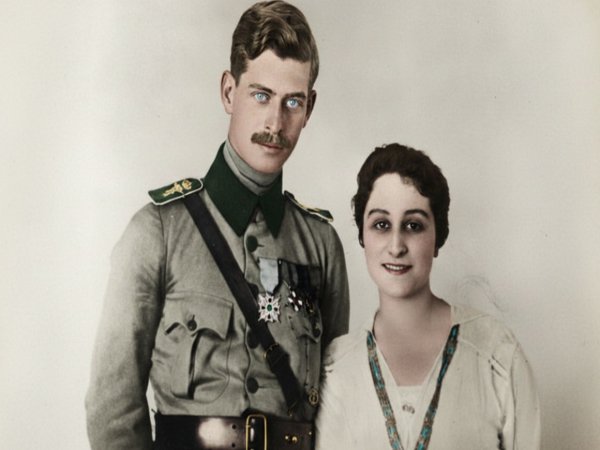
Zizi Lambrino, the first love of King Carol II. For her, he gave up the throne of Romania twice, shot himself in the leg and threatened to take his own life
- Articles
- 10 FEB 26
The history of Romania’s Royal House is marked by controversial loves, dramatic decisions, and scandals that went far beyond the boundaries of private life. None of these stories, however, was as passionate, as disturbing, and as full of political consequences as the relationship between Prince Carol, the future King Carol II, and Zizi Lambrino, his first great love. A relationship that endangered the succession to the throne, provoked governmental crises, and exposed the fragility of a young heir caught between duty and passion.
The meeting that changed the destiny of a crown heir
For Zizi Lambrino, Carol defied conventions, ignored his parents’ orders, challenged the Royal House, and went as far as extreme gestures: he renounced the throne twice, intentionally shot himself in the leg, and threatened to take his own life. Their story is not only one of love, but also a dramatic episode in Romania’s history, in which personal feelings collided directly with reasons of state.
In the summer of 1913, Europe was in a state of growing political tension, and Romania was no stranger to the turmoil of the time. In this context, at a party organized by the influential conservative politician Alexandru Marghiloman, Prince Carol, the son of King Ferdinand and heir to the Romanian throne, met the young Ioana Maria Lambrino.
Carol was only 20 years old, impulsive, restless, and eager for freedom. Zizi Lambrino, as Ioana Maria was known, immediately caught the young prince’s attention. Paul D. Quinlan notes in the volume “The Playboy King, Carol II of Romania” that she would become one of the three women who played a fundamental role in Carol’s life. Born in 1898, in the town of Roman, Zizi came from a family of aristocrats with Greek Phanariot origins and Jewish roots.
Described by contemporaries as brunette, short, plump, dark-complexioned, and extremely sharp-witted, Zizi possessed a charm that went beyond appearances. The education she received at a boarding school in France had turned her into a cultivated young woman, passionate about music and literature, capable of sustaining refined conversations and impressing a young prince searching for intense emotions.
A love ignored, but impossible to control
The relationship between Carol and Zizi began as a flirt, regarded with a certain indulgence by the Royal House. No one suspected, at first, that this bond would grow into a full-blown scandal. As I. G. Duca would later note in “Political Memoirs”, no one imagined that the story would go so far as marriage, especially in such a complicated moment for the country.
As feelings deepened, Carol became increasingly determined to follow his heart, completely ignoring the strict rules governing the life of a crown heir. Differences in social status, the lack of royal approval, and the tense political context only heightened the drama of the relationship.
For Carol, Zizi had become not just a lover, but a form of rebellion against the constraints imposed by his rank. Nicknamed “Zizi,” “Zucky,” or “Baby,” the young Moldavian woman occupied a central place in the prince’s life, who seemed ready to sacrifice everything for her.
The flight to Odessa and the secret marriage
The peak of this love was reached in 1918, when Carol made a radical decision. Advice, prohibitions, and pressure from the Royal House no longer mattered. Together with Zizi, the prince fled to Odessa, determined to marry her regardless of the consequences.
Crossing the border was carried out under circumstances worthy of an adventure novel. Carol disguised himself in civilian clothes and was helped by a lieutenant from his regiment. In Russia, the two were married in a religious ceremony by an Orthodox priest, who is said to have been paid the considerable sum of 50,000 lei to officiate the wedding.
The act was followed by an unprecedented gesture of defiance. Carol announced the marriage to his family through a short and blunt telegram: “I have taken Zizi Lambrino as my wife. May I return with her, or shall I take the road to France?” The message struck the Royal House and the political class like a thunderbolt.
King Ferdinand’s reaction and the political crisis
The news of the secret marriage triggered a major crisis. King Ferdinand, deeply shaken, ordered that a colonel be sent to bring Carol back home, even by force if necessary. In a telegram sent on September 6, 1918, the sovereign emphasized the gravity of the situation and the danger of a definitive rupture between the prince, his family, and the country.
Brought back to Romania against his will, Carol refused to give up the marriage. When he threatened to abdicate the throne in favor of his new wife, the scandal took on national proportions. The government became directly involved, and debates grew heated.
Alexandru Marghiloman, then head of the government, demanded Carol’s permanent removal from the line of succession, proposing that Prince Nicolae be proclaimed heir and given a strict education to prevent such situations in the future. In contrast, Ion I. C. Brătianu defended Carol, arguing that the prince was too young and could still be brought back to reason.
Pressure, punishment, and the annulment of the marriage
King Ferdinand decided to punish his son, sentencing him to 75 days of arrest at Horaița Monastery. Queen Marie, far more uncompromising, demanded that Carol renounce Zizi, stating that it would have been more honorable for him to die than to betray his country.
Brătianu was tasked with holding direct discussions with the prince, explaining that he would not be able to reign if he persisted in the marriage and that abdication would be equivalent to desertion. In the end, Carol gave in to the pressure and, on November 11, 1918, signed the document accepting the annulment of the Odessa marriage.
The High Court of Cassation confirmed the annulment on January 8, 1919. Immediately after this episode, Carol was sent to the front in Hungary, from where he sent yet another letter of abdication, which the Royal House chose to ignore.
Extreme gestures and the final separation
In an attempt to make him forget Zizi, the king arranged a journey around the world for his son. Desperate, Carol resorted to dramatic gestures: he intentionally shot himself in the leg and threatened suicide, hoping to soften his family’s stance.
Meanwhile, Zizi Lambrino gave birth on January 20, 1920, to a boy, Mircea, Carol’s son. This event led the prince to temporarily reconsider his decision to abdicate. The Royal House reacted swiftly, staging a supposedly accidental meeting with a former love of Carol’s. The prince fell into the trap and, for a time, distanced himself from Zizi.
Hurt, Zizi sent the newspaper “Epoca” a copy of a love letter in which Carol acknowledged his son. The gesture infuriated the prince and led to the definitive rupture. The Royal House offered Zizi an annual allowance of 110,000 francs, in exchange for her disappearance from Carol’s life and the renunciation of any claims.
The final years of Zizi Lambrino
Settled in a villa in Cannes, on the French Riviera, Zizi led a discreet life. Shortly after the separation, Carol’s marriage was arranged with Princess Helen of Greece. In 1940, Zizi sued Carol, seeking recognition of her son, but without success.
After the establishment of the communist regime in Romania, the financial agreement was annulled, and the annual allowance ceased. Zizi Lambrino died on March 11, 1953, in Neuilly, just one week before Carol II’s death. Her story remains one of the most dramatic and disturbing love affairs in Romania’s history, a powerful illustration of the eternal conflict between heart and crown.
We also recommend: The forbidden love between King Carol II and Elena Lupescu. “Duduia” won him over with a simple candy