Bucharest’s expats of the past. What ethnic communities lived in the capital and how they stood out among locals
By Raluca Ogaru
- Articles
- 29 APR 26
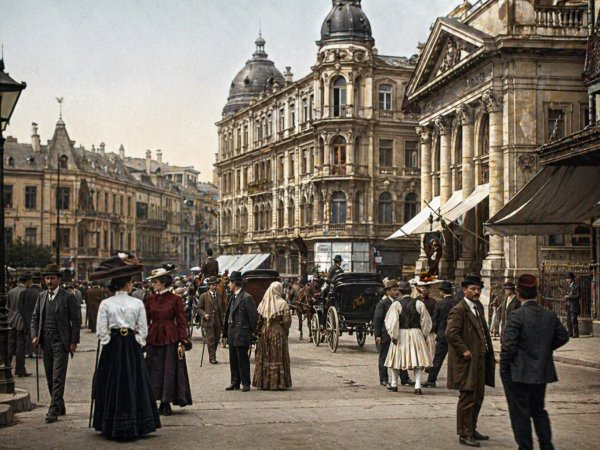
Long before it was described as a city of expats, Bucharest was a multiethnic capital. Over the centuries, Romanians, Greeks, Armenians, Jews, Germans, Hungarians, Bulgarians, Italians, Russians, Albanians, Turks, Tatars and many other communities lived here, influencing the city’s trade, architecture, gastronomy, education and cultural life.
According to material published by Bucureștii Vechi și Noi, the history of the capital cannot be fully understood without these communities. Bucharest was not only the political center of Romanians, but also a meeting point between the Balkans, Central Europe, the Orient and the West.
Bucharest, a city open to merchants, refugees and craftsmen
The first important waves of foreigners came to Bucharest for commercial, religious or political reasons. Merchants from Brașov, Constantinople, Lviv or Ragusa arrived here for trade, and some stayed, helping form stable communities.
After the Ottoman conquest of Bulgaria and much of the Balkan Peninsula, many refugees came to the Romanian principalities. Bulgarians, Greeks, Albanians, Armenians, Jews and others from the Balkan world settled in towns, on estates or in the capital, bringing with them trades, customs, languages and commercial networks.
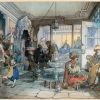
Bucharest needed these people. Rulers and boyars relied on merchants, gardeners, coachmen, innkeepers, pharmacists and craftsmen, and later, in the 19th century, on photographers, musicians, printers, doctors, teachers and engineers. The modernization of the city cannot be separated from the contribution of these communities.
Greeks, Armenians, Jews and Bulgarians, visible communities in the city
During the Phanariot era, Greek influence became very strong. Clerics, teachers, merchants and people connected to the Phanariot administration came to Bucharest. The Greek language was present in education, culture and the upper circles of society.
Armenians were one of the city’s old communities, known especially for trade. Over time, they built their own church, library, museum and institutions, showing that their presence was not only economic, but also cultural.
Jews played a major role in trade, credit, agencies, manufacturing and services. During the interwar period, the Jewish community was one of the most important in Bucharest, with synagogues, temples, schools, hospitals, charities, newspapers and sports clubs.
Bulgarians, Russians, Albanians and other Orthodox communities integrated more easily into local society, but many also preserved their own places of worship, schools or community structures.
Germans, Hungarians and Italians helped shape modern Bucharest
After 1848, Bucharest attracted more Germans, Austrians, French, Belgians, Swiss, Italians and Hungarians. Many were craftsmen, skilled workers, teachers, artists, doctors, pharmacists or merchants.
Germans were especially present in industry, trade, banking and technical professions. Their community had an Evangelical church, schools, cultural associations and sports clubs. Hungarians were numerous in construction, industry and services, while Italians became known especially as stonecutters and builders, many arriving during major infrastructure works in the second half of the 19th century.
These communities contributed directly to turning Bucharest into a modern capital. They were involved in raising buildings, developing urban services, commerce, education, medicine and cultural life.
Interwar Bucharest, a city with minority institutions
During the interwar period, Bucharest’s multicultural character was visible throughout the city. There were denominational schools, Greek, Bulgarian, Jewish and Catholic high schools, German institutions, French associations, newspapers in foreign languages, sports clubs and many places of worship.
In 1912, Bucharest had more than 341,000 residents. The data cited by Bucureștii Vechi și Noi indicates over 39,000 Jews, over 28,000 Hungarians, more than 7,000 Turks, over 3,000 Germans, as well as Bulgarians, Russians and other nationalities.
By 1930, the capital had reached more than 631,000 residents. The city was developing rapidly, and minorities were active in its economy, culture and urban life. Jews were strongly involved in commerce, credit and manufacturing, Germans in industry and skilled services, Hungarians in construction and urban labor, and Armenians in trade.
War and communism radically changed the city’s structure
World War II and the installation of the communist regime profoundly changed multiethnic Bucharest. Some communities were affected by deportations, expulsions, nationalizations and forced migration.
Romanian citizens of German origin were deported to the Soviet Union in 1945, and many never returned. Jews began emigrating in large numbers in the following decades. After 1948, denominational schools were nationalized, and community institutions gradually lost their role.
Under communism, the old urban elites became increasingly less visible. The city grew quickly, but it lost an important part of the social and cultural diversity that had defined it in previous centuries.
From the old “expats” to today’s international communities
After 1990, Bucharest entered a new stage. The historic German and Jewish communities became much smaller, while the Hungarian community also declined numerically. At the same time, the city began attracting new groups: Western citizens, businesspeople, foreign students, doctors, entrepreneurs, Asian workers and Muslim communities from the Middle East, Turkey, Iran, Afghanistan and other regions.
Today’s Bucharest continues, in a new form, an older tradition: that of a city where people coming from elsewhere change the local rhythm. The difference is that, in the past, these people were called merchants, craftsmen, refugees, foreign subjects or minorities. Today, we call them expats.
READ ALSO:
7 essential things every expat should know before moving to Bucharest
Understanding the Tax System in Romania: What Locals and Expats Need to Know
Seen this way, Bucharest did not become multicultural only in the age of globalization. It has been a city of intersections since the medieval period, and traces of those communities can still be seen today in churches, cemeteries, neighborhoods, buildings, street names and urban stories.