Cafés, carriages and promenades: what the atmosphere of Bucharest Belle Époque was like
- Articles
- 30 APR 26
The period known as the “Belle Époque” represented for Bucharest one of the most effervescent and elegant stages in its history. Spanning roughly from the end of the 19th century to the beginning of the First World War, this era was marked by accelerated modernization, strong Western influences, and a vibrant social life. The capital of Romania was often compared to major European cities, and the nickname “Little Paris” was not accidental at all. In those years, the atmosphere of the city was defined by harmonious contrasts: traditional and modern, Oriental and Western, aristocracy and a rising bourgeoisie. Elegant cafés, carriages crossing wide boulevards, and fashionable promenades shaped an urban landscape full of refinement and dynamism.
The charm of Bucharest cafés
Cafés were the heart of social life in Belle Époque Bucharest. These spaces were not just places where coffee was consumed, but true centers of debate, culture, and socialization. Intellectuals, politicians, artists, and businessmen met here to discuss ideas, comment on the events of the day, or simply to be seen.
Among the most well-known were the establishments located on Calea Victoriei, the city’s main artery, where elegance and modernity met. The interior décor was inspired by Western styles, with refined furniture, large mirrors, and warm lighting. The atmosphere was completed by soft music and the smell of freshly brewed coffee.
Cafés were also places where newspapers were read, where political alliances were made and unmade, and where cultural trends were launched. For many Bucharest residents, a day was not complete without a stop at the café, either in the morning or in the evening.
The carriages and the elegance of urban travel
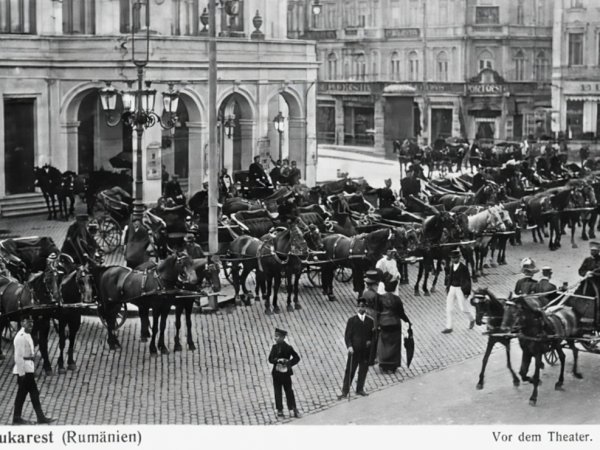
A defining element of the urban landscape of that period was represented by carriages. These were the main means of transport for the elites, but also a symbol of social status. On the wide boulevards of the city, carriages moved at an elegant pace, contributing to the sophisticated image of the capital.
On Șoseaua Kiseleff or in the central area, carriages were omnipresent, whether they transported wealthy families or were rented for leisure rides. Coachmen, dressed in specific uniforms, skillfully guided the horses, and the vehicles were often carefully decorated.
For the more modest social classes, there were simpler transport options, but even these retained a certain charm. Travel was not just a necessity, but also an experience in itself, an opportunity to see and to be seen.
The promenades – the social ritual of the era
Promenades represented one of the most important social rituals of Belle Époque Bucharest. People went out for walks not only for relaxation, but also to socialize and to display their elegance.
One of the favorite places for such walks was Cișmigiu Garden, where the shaded alleys and the lake offered an ideal setting for meetings and conversations. Also, Șoseaua Kiseleff had become a true boulevard of fashion, where ladies and gentlemen displayed their sophisticated outfits.
Promenades had an unwritten code: elegance was mandatory, and behavior had to be impeccable. It was a way of participating in the social life of the city, of making an impression, and of observing the trends of the moment.
The western influences and the transformation of the city
During this period, Bucharest underwent a profound transformation under the influence of Western models, especially French ones. Architecture, fashion, gastronomy, and social customs were strongly influenced by Parisian culture.
Imposing buildings were constructed in eclectic or neoclassical style, and the boulevards were modernized. Public lighting, transport, and urban infrastructure were improved, contributing to the creation of the image of a modern European city.
This openness toward the West was supported by the political and cultural elites, who saw modernization as a way for Romania to assert itself on the international stage. Bucharest thus became a cosmopolitan space, in which local traditions coexisted with foreign influences.
The high society life and social events
High society life was extremely active in Belle Époque Bucharest. Balls, receptions, and soirées were frequent events, organized by aristocratic families or important institutions. These occasions were perfect for socializing, for establishing relationships, and for asserting social status.
Theatres and concert halls attracted large audiences, and performances were true cultural events. The public came not only for the show, but also to take part in the elegant and sophisticated atmosphere.
Fashion played an essential role in high society life. Elaborate dresses, impeccable suits, and refined accessories were indispensable elements for any public appearance. Elegance had become a form of expression and a criterion of social appreciation.
The contrast between luxury and everyday life
Although the image of the Belle Époque is often associated with luxury and refinement, reality was more complex. Behind the elegant façades there were also less developed areas, where living conditions were modest.
Bucharest was a city of contrasts, in which wealth and poverty coexisted. While the elites enjoyed comfort and entertainment, a significant part of the population lived in difficult conditions. However, the dynamism of the city offered opportunities for social ascent to those who were ambitious.
These contrasts did not diminish the general charm of the era, but rather added a realistic dimension, reflecting the complexity of a society in full transformation.
The legacy of the belle époque in today’s bucharest
The legacy of the Belle Époque period is still visible in contemporary Bucharest. Many of the buildings constructed then have survived and continue to define the urban landscape. The wide boulevards, parks, and certain social habits preserve the memory of that era.
The spirit of cafés, the pleasure of promenades, and the appreciation for elegance are elements that, in one form or another, can still be found today. Although the city has changed considerably, there are still places and moments that evoke the atmosphere of the past.
Belle Époque Bucharest remains a source of fascination and inspiration, a period in which the city shone through elegance, dynamism, and openness to the world. Through cafés, carriages, and promenades, that era left a lasting imprint on the identity of the capital, transforming it into a unique space where the past continues to dialogue with the present.
We also recommend: 10 things about Belle Époque Bucharest you didn’t know until now