The flower market in Bucharest, the Roma “boldeni” and trade in the 19th century. How it evolved from street vendors to today’s wholesale market
- Articles
- 30 APR 26
The flower market in Bucharest represents one of the most vivid and picturesque commercial traditions of the Capital, a unique world where past and present intertwine in a fascinating way. From the street vendors of the 19th century to the continuous bustle of the modern wholesale market, this universe has been decisively shaped by the Roma community known as the “boldeni,” recognized for their trading spirit and for their essential role in the development of the flower trade. Over time, the market has not been just a place for transactions, but also a social space, a meeting point, and a mirror of urban transformations. Its evolution reflects the changes that Bucharest has gone through, from a traditional town to a modern metropolis.
The origins of the flower trade and the tradition of the boldeni
The history of the flower market in Bucharest begins in the 19th century, during a period when the city was shaping its urban and economic identity. In those years, the flower trade was dominated by the Roma “boldeni,” a category of itinerant traders who built a solid reputation in this field.
The flower sellers, mostly of Roma ethnicity, were emblematic figures of old Bucharest. Often dressed in simple but brightly colored clothes, they walked the city streets with baskets full of fresh flowers. They sold them one by one, directly to passersby, turning each bouquet into a small story. This form of itinerant trade was not only a source of income, but also a tradition passed down from generation to generation.
The boldeni usually came from the outskirts of the city, where they lived, and started their activity early in the morning. They were known for their negotiation skills and for their ability to build stable relationships with producers and customers. Thus, they managed to dominate the flower trade for a long period, laying the foundations of an organized market.
Saint Anton market and the first commercial centers
One of the most important landmarks of the flower trade in Bucharest was the area of Saint Anton, located in the heart of the Old Town. Here, as early as the 19th century, flower sellers gathered at dawn to procure their goods and prepare them for sale.
This market quickly became a nucleus of the flower trade, a place where prices were set, negotiations took place, and commercial relationships were built. The atmosphere was vibrant, marked by bustle, the smell of fresh flowers, and lively discussions. For many Bucharest residents, the market was a familiar place where they could find flowers for any occasion.
The area around Unirii Square and the adjacent streets also hosted this activity for a long time. The tradition of the flower trade was well rooted as early as the reign of Alexandru Ioan Cuza, when the boldeni constantly came into the city to sell their goods.
These spaces were not organized in the modern sense of markets, but functioned rather as spontaneous meeting places between sellers and buyers. Nevertheless, they laid the foundations for the later development of a structured market.
The transformations during the interwar period and the consolidation of trade
The interwar period brought important changes in the way the flower trade was organized. Bucharest was becoming an increasingly modern city, and the demand for floral products was constantly growing, against the backdrop of the development of social and cultural life.
Flower sellers continued to play a central role, but their activity began to be better organized. Saint Anton Market remained an essential point, but other areas also appeared where the flower trade intensified. Relationships between producers and traders became more stable, and supply was carried out in a more systematic way.
During this period, flowers became increasingly present in the daily life of Bucharest residents, being associated with social events, celebrations, and gestures of courtesy. The flower trade began to acquire a more complex dimension, going beyond the status of a marginal activity.
The 1960s and the emergence of the modern flower market
A turning point in the evolution of the flower market in Bucharest took place in the 1960s, when, near Unirii Square, an area dedicated almost exclusively to the flower trade appeared. Here, producers came with thousands of varieties—roses, tuberoses, tulips, or carnations—and sold them to Roma traders.
This area quickly gained the name “flower market” and became an emblematic place for Bucharest trade. Negotiations were intense, often noisy, and traders bargained passionately to obtain the best prices. The expression “like at the tent door” perfectly described the atmosphere of these transactions.
After purchasing the flowers, young flower sellers were sent to the city center, especially in busy areas, where they sold the flowers one by one. The image of these girls, with their arms full of flowers, became iconic for Bucharest of that period.
The move toward Rahova and the emergence of George Coșbuc market
With the urban systematizations of the communist period, many of the old commercial areas were reorganized or relocated. The flower trade was no exception, and the activity gradually moved toward the Rahova area.
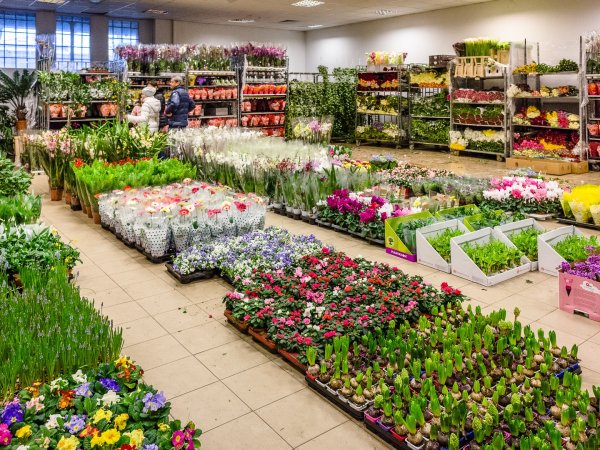
Today, the main wholesale flower market in Bucharest is located on Calea Rahovei, near George Coșbuc Square. This place is known as a market that never sleeps, being active non-stop. Traders, producers, and buyers meet here at any hour, in a continuous flow of activity.
George Coșbuc Market has become the nerve center of the flower trade in the Capital, the place from which most small flower shops supply themselves. Here, the tradition of negotiation and direct relationships between traders is preserved, even if the context is a modern one.
The cultural importance and the atmosphere of the market
The flower market in Bucharest is not just an economic space, but also a cultural one. Its atmosphere is often described as picturesque, full of color and energy. The smell of fresh flowers, the voices of traders, and the diversity of products create a unique experience.
One of the peak moments of activity is the period before March 1 and March 8, when the demand for flowers increases spectacularly. On these days, the market becomes extremely crowded, and the pace of transactions intensifies considerably.
Near the market, an important symbolic element was inaugurated in 2019—the “Dacian from the Flower Market.” This sculpture marks the identity of the place and contributes to strengthening its image in the urban landscape.
A living tradition between past and present
The flower market in Bucharest remains, to this day, a living tradition, an example of continuity and adaptation. From the flower sellers who sold on the streets to the modern wholesale complex, its evolution reflects the economic and social transformations of the city.
The role of the Roma “boldeni” in this story is essential, as they are the ones who built and maintained this tradition across generations. Their entrepreneurial spirit and ability to adapt have contributed to the survival and development of the market.
Today, the market is a place where past and present coexist. Modern methods of trade blend with old customs, and the atmosphere retains something of its former charm. In a constantly changing city, the flower market remains a stable landmark, an important part of Bucharest’s identity.
Through its dynamics, through the people who animate it, and through the history it carries, the flower market in Bucharest continues to be more than just a place of transactions: it is a living story about tradition, adaptation, and a passion for beauty.
We also recommend: Obor Market in Bucharest, the history of the old "Outside Fair": from cattle market to place of execution