How May 1st was celebrated during Nicolae Ceaușescu’s era. The holiday dates back to 1890
By Raluca Ogaru
- Articles
- 29 APR 26
Today, May 1st is mostly associated with relaxation and the start of the warm season, but during Romania’s communist period it had a very different meaning. Although Labor Day originated from workers’ movements in the United States, the communist regime reinterpreted the holiday and turned it into a tool of propaganda.
In Romania, May 1st was first marked in 1890, during the reign of King Carol I. Later, under communism, it became a national holiday and one of the most important public events organized by the state.
Mandatory parades and weeks of rehearsals
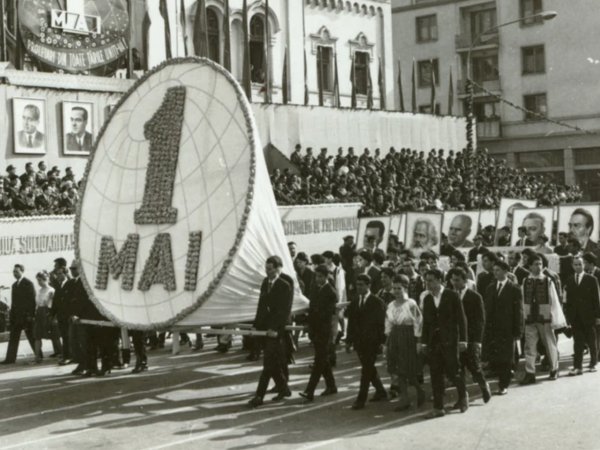
During the regime led by Nicolae Ceaușescu, preparations for May 1st began weeks in advance. Participation in parades was not optional—workers, students, and pupils were mobilized and organized into groups that rehearsed synchronized movements and choreographies.
Rehearsals lasted for weeks, with every detail carefully planned. Thousands of banners with slogans were produced, routes were established, and the parades were coordinated to project an image of order and unity.
The streets of major cities became stages for large-scale demonstrations, with thousands of participants dressed in festive attire. Schoolchildren, including members of the Pioneer and “Falcons of the Motherland” organizations, were also part of these events, chanting messages in support of the party and its leadership.
Propaganda and the image of the communist regime
May 1st parades were designed as public displays of the regime’s achievements. These events took place on major boulevards or in stadiums, and every speech and symbol was strictly controlled.
The country’s leadership, including Elena Ceaușescu, attended these demonstrations and was greeted with expressions of loyalty and admiration. The atmosphere was highly formal, with each moment carefully staged to reinforce the image of the Romanian Communist Party.
Labor Day thus became more than a celebration—it was a political instrument, where mass participation played a key role in delivering the intended message.
From parades to picnics: how May 1st changed after 1989
After the Romanian Revolution, the meaning of May 1st changed completely. Official parades and state-organized demonstrations disappeared, and people were no longer required to take part in collective events.
In the years that followed, Labor Day became a time for relaxation and socializing. Celebrations moved outdoors, and Romanians began to associate the day with picnics, barbecues, and short holidays.
This shift became especially visible in large cities and tourist areas, where May 1st now marks the informal start of the summer season.
How May 1st is celebrated today
Today, May 1st is a mix of tradition and entertainment. While in the past the focus was on organized demonstrations, now the emphasis is on personal choice.
What May 1st looks like today:
- short getaways to the seaside or the mountains
- outdoor barbecues with friends and family
- urban festivals and food events
- concerts and open-air parties
For many Romanians, this day has become synonymous with relaxation and social life. The tradition of grilling outdoors—present even during the communist era—is one of the few elements that has remained.
Key differences between past and present
For a quick overview, the differences are clear:
During communism:
- mandatory participation in parades
- state-organized events
- political and propaganda-driven messaging
- strict rehearsals and coordination
After 1989:
- voluntary participation
- private or commercial events
- focus on leisure and entertainment
- freedom of choice
READ ALSO:
A holiday that has completely changed its meaning
The evolution of May 1st reflects the major transformations Romanian society has undergone. From a strictly controlled, propaganda-driven day to an occasion for relaxation and socializing, the holiday has adapted to new realities.
Today, May 1st represents free time, events, and the beginning of the warm season, while its past remains an important reference point for understanding Romania’s recent history.