Romulus and Remus, the orphan twins who founded Rome, each have a street in Sector 3 of Bucharest
- Articles
- 27 APR 26
Few stories from ancient history have managed to cross the centuries with the same symbolic force as the legend of Romulus and Remus, the twin brothers considered the mythical founders of Rome. It is one of the best-known legends in the world, a story about destiny, survival, power, betrayal, and divine intervention, which became a fundamental part of the identity of Roman civilization.
The two streets from Bucharest that bear their names
The legend of the two abandoned children, saved by a she-wolf and later becoming the leaders of a new world, fascinated entire generations and continues to inspire even today. Their story belongs not only to mythology, but also to the European collective memory, being one of the strongest symbols of the birth of a civilization.
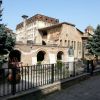
Surprisingly, this legend also has a small presence in Bucharest. In Sector 3, near Calea Călărași, there are two streets that bear the names of the two brothers: Romulus Street and Remus Street. It is a discreet but important way through which the Capital keeps alive one of the most famous stories of Antiquity.
The betrayal that changed the destiny of two children
The story begins a long time ago, in the ancient city of Alba Longa, an important center of Latium, considered the symbolic ancestor of Rome. There, power was conquered through betrayal and cruelty.
The legitimate king was Numitor, but his brother, Amulius, blinded by ambition and the desire for power, removed him from the throne. He was not satisfied only with the usurpation of the reign, but wanted to eliminate any possible threat to his new authority.
Thus, Amulius made an extreme and cruel decision: he ordered the death of his nephews, the twins Romulus and Remus, the sons of Numitor’s daughter. The two children represented a possible continuation of the legitimate line of succession, and for the usurper this was unacceptable.
The order was simple and terrible: the twins had to be thrown into the Tiber River, in order to disappear without a trace. It was a certain death sentence, and Amulius believed that in this way he was permanently securing his power. But destiny had other plans.
The basket on the Tiber and the miraculous rescue
Those tasked with carrying out the king’s order did not have the courage to kill the children. Instead of throwing them directly into the water, they placed them in a basket and let it float on the waters of the Tiber, letting fate decide.
The river did not swallow them, but on the contrary, carried them safely. The gentle current took the basket to the riverbank, where one of the best-known episodes in all Roman mythology was about to take place.
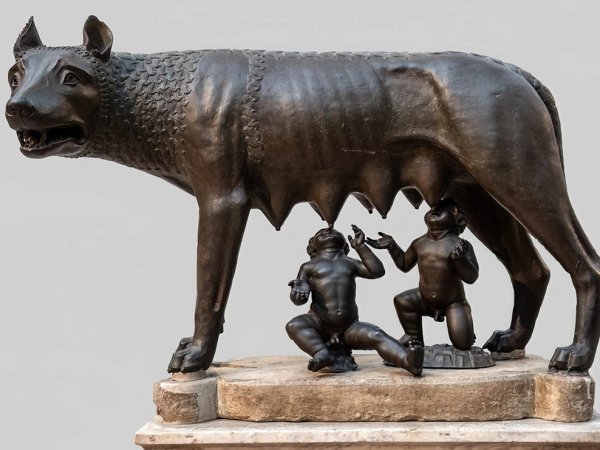
There, a she-wolf was attracted by the crying of the children. Instead of attacking them, the animal protected them and fed them with her own milk, as if they were her own cubs. The image of the she-wolf nursing Romulus and Remus became one of the strongest symbols of Rome and is known all over the world.
Under the protection of this unexpected guardian, the twins survived and grew strong. For the Romans, this episode was not only a miracle, but a clear proof that the gods had a special plan for the two children.
Their survival was seen as a divine sign, and the intervention of nature confirmed the fact that their destiny was an exceptional one.
The truth about their royal origin
As they grew, Romulus and Remus became strong, brave, and respected young men. However, they did not know the whole story of their birth nor their true descent.
At one point, the truth came to light. The two found out that they were not ordinary children, but the grandsons of the rightful king, Numitor, and that they had been sentenced to death by their own uncle, Amulius, the one who had usurped the throne.
This revelation completely changed their lives. Fueled by the desire for justice and the need to avenge their family, the brothers decided to confront the tyrant.
With intelligence, courage, and determination, Romulus and Remus managed to defeat Amulius. The usurper was removed, and their grandfather, Numitor, was restored to the throne that rightfully belonged to him. This victory represented not only a personal revenge, but also the restoration of legitimate order. The two brothers had fulfilled their first great mission.
The dream of a new city
After the past had been repaired, Romulus and Remus turned their attention toward the future. They did not want only to correct an injustice, but to build something that would remain through the ages.
Thus, the idea of founding a new city was born. The brothers chose a place situated on the seven hills near the Tiber River, a strategic and symbolic space, suitable for the raising of a great city.
At first, the dream was shared. The two imagined together a new capital, a place that would reflect the power, courage, and new beginning of their family.
But ambition and pride quickly began to transform cooperation into rivalry. The main problem was an apparently simple one: who had the right to rule and what name the new city would bear. This dispute was going to change history forever.
The sign of the gods and the tragedy between brothers
Unable to reach an agreement, Romulus and Remus decided to leave the choice in the hands of the gods. In ancient Roman belief, divine will was essential, and heavenly signs could decide the destiny of people and kingdoms.
The two watched the sky, waiting for a clear sign. Eagles, considered divine symbols and messengers of the gods, were to provide the answer.
Legend says that Romulus saw more eagles than his brother and interpreted this as proof that he was the leader chosen by the gods. Convinced that he had the divine right to found the city, he declared himself the leader.
Remus did not accept the verdict, and the dispute became more and more violent. The fraternal rivalry turned into a tragic confrontation, ending with the death of Remus.
Romulus killed his brother and remained the sole founder of the new city. The city received his name: Rome. Thus, one of the greatest civilizations in the world was born from a story in which glory and tragedy went together.
A legend about power, destiny, and divine intervention
The story of Romulus and Remus is much more than a simple legend about the beginnings of Rome. It reflects the fundamental values of the Roman world: belief in destiny, the importance of power, the role of divine will, and the idea of sacrifice necessary for greatness.
The Romans saw in this story proof that their city had been chosen by the gods and that the founding of Rome was not a simple historical accident, but the result of a superior will. The she-wolf, the Tiber River, the heavenly signs, and the final victory were part of a cosmic plan.
The legend also conveys a harsh lesson about ambition. The desire for power can build empires, but it can also destroy blood ties. Romulus becomes a hero and founder, but also the brother who chose glory instead of brotherhood.
This complexity makes the story remain alive even today. It is not only mythology, but also a reflection on human nature, on the price of success, and on the way civilizations build their own myths of origin.
From abandonment and survival to ambition and triumph, the legend of the founding of Rome remains one of the most powerful stories of Antiquity.
Romulus and Remus Streets in Sector 3 of Bucharest
Few Bucharest residents know that the names of the two legendary brothers can also be found today in the Capital, in Sector 3, in the area near Calea Călărași. Romulus Street and Remus Street are located close to each other, in an old neighborhood of the city, where many streets bear names inspired by history, mythology, or important personalities.
These streets discreetly preserve the memory of the mythical founders of Rome and represent a symbolic connection between Bucharest and the great stories of European civilization. For passersby, they may seem like simple urban names, but behind them lies one of the best-known legends in the world.
Near Calea Călărași, in an area full of Bucharest history, Romulus Street and Remus Street remind us that the myths of Antiquity continue to live even in the present, even in apparently ordinary details of everyday life. Bucharest thus preserves, on its own map, a small part of the eternal legend of Rome.
We also recommend: