Depoul Victoria, 155 years of history. How the first tram depot in Bucharest appeared
- Articles
- 30 APR 26
Victoria Depot represents one of the most valuable testimonies of the development of public transport in Bucharest and, at the same time, a symbol of the city’s modernization. With a history that spans more than a century and a half, this place has been a witness to major transformations, both in terms of urban infrastructure and the evolution of Romanian society. Built in a period when the capital was beginning to adopt Western elements, the depot played an essential role in the introduction and development of tram transport, decisively contributing to changing the way Bucharest residents moved around the city.
The beginnings of bonaparte depot and the appearance of the tram in bucharest
Over time, Victoria Depot was not just a simple technical space intended for vehicle maintenance, but also a place full of memory, affected by dramatic historical events and, at the same time, a point of attraction for urban transport enthusiasts. Its story begins in the second half of the 19th century and continues to the present, being an example of continuity and adaptation.
Built approximately 155 years ago, Victoria Depot was initially known as Bonaparte Depot. At the time of its appearance, Bucharest was going through a period of accelerated modernization, and the introduction of horse-drawn trams represented an important step towards aligning with the standards of major European capitals.
Bonaparte Depot was the first tram depot in Bucharest and, at the same time, the first in the Old Kingdom of Romania. This highlights its historical importance, being the starting point of organized public transport in the capital. Horse-drawn trams required dedicated spaces for shelter, maintenance, and organization, and the depot was built specifically to meet these needs.
At that time, the tram was an absolute novelty for the city’s residents. Its appearance radically changed the dynamics of travel, offering a faster and more efficient alternative compared to traditional means. Bonaparte Depot thus became a vital center of urban mobility, contributing to the development of the transport network and to increasing the accessibility of different areas of the city.
The historical halls and the transformations at the end of the 19th century
At the end of the 19th century, the depot was expanded and modernized, with the construction of the halls that are today considered a historical monument. These structures were initially dedicated to horse-drawn trams and reflect the architectural style specific to the era, combining functionality with subtle aesthetic elements.
The halls did not have only a practical role, but over time they became symbols of technological evolution. As public transport modernized, they were adapted to accommodate electric trams, marking the transition from animal traction to electric traction. This transformation represented a crucial moment in the development of urban transport, and the depot was at the center of this change.
In addition, the halls were witnesses to the transformation of the city as a whole. Bucharest grew rapidly, and the tram network expanded considerably. The depot continued to play an essential role in supporting this expansion, being a support point for the maintenance and operation of vehicles.
The depot in the face of history: fires, wars, and bombings
Throughout its existence, Victoria Depot went through numerous difficult moments, being affected by historical events that changed the course of the country. Fires, frequent in that period, tested the resistance of the constructions and infrastructure, requiring repeated interventions and reconstructions.
One of the most dramatic episodes was represented by the bombings of 1944, during the Second World War. Bucharest was the target of devastating air attacks, and the depot was not spared. The halls suffered significant damage, but managed to survive, being subsequently repaired and put back into operation.
These moments demonstrated not only the fragility of urban infrastructure in the face of conflicts, but also the city’s capacity for recovery. Victoria Depot continued to operate even after these events, becoming a symbol of resilience and continuity.
The evolution of transport and the role of the depot in the 20th century
The 20th century brought major changes in terms of public transport in Bucharest. Electric trams became the norm, and the network expanded to cover more and more neighborhoods. Victoria Depot was constantly adapted to meet new technological and operational requirements.
During this period, the depot became one of the most important maintenance points for trams in the capital. Here, repairs, inspections, and maintenance operations were carried out, ensuring the optimal functioning of vehicles. The specialized staff working in the depot contributed significantly to maintaining an efficient and safe transport system.
In addition to its technical role, the depot was also a place where generations of workers and specialists were trained. The experience accumulated here was passed down over time, contributing to the development of a solid tradition in the field of public transport.
The restoration and the rediscovery of heritage
In recent years, the historical importance of Victoria Depot has been increasingly recognized, and restoration efforts have brought back to life an important part of Bucharest’s urban heritage. The historical halls were rehabilitated, preserving the original architectural elements while also integrating modern solutions.
A special moment took place in 2024, when, after restoration, the last two Romanian historical trolleybuses from the STB heritage were temporarily exhibited inside the depot. The event attracted hundreds of visitors, from children to adults, all eager to discover a part of the history of public transport.
This initiative demonstrated that the depot can also have a cultural role, not just a technical one. Its transformation into a space open to the public contributed to increasing interest in the city’s history and in the evolution of urban mobility.
The vintage tram parades and the fascination of the public
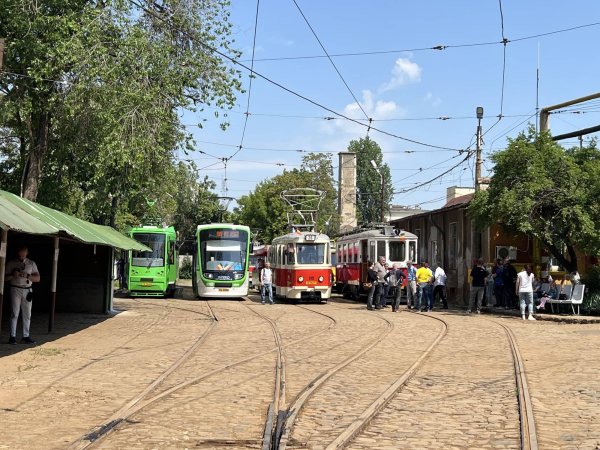
Over the years, Victoria Depot has hosted numerous vintage tram parades, events that attracted an impressive number of participants. These parades have become true urban spectacles, offering the public the opportunity to see and experience vehicles from different historical periods.
The interest in these events shows how strong the connection is between Bucharest residents and public transport. Trams are not perceived only as means of transport, but also as elements of urban identity, an integral part of collective memory.
Victoria Depot plays a central role in organizing these parades, being the place where vehicles are stored, restored, and prepared to be presented to the public. Thus, the depot becomes a living space, where the past and the present meet.
A symbol of continuity and modernization
Today, Victoria Depot is more than just a tram depot. It is a symbol of continuity, adaptation, and evolution of the city of Bucharest. From horse-drawn trams to modern vehicles, this place has witnessed all stages of the development of public transport.
Its importance is not limited to the past, but extends into the present, being an active part of the transport network. At the same time, its historical value transforms it into a reference point for those interested in urban heritage.
Looking to the future, Victoria Depot has the potential to become a multifunctional space, combining the technical role with the cultural and educational one. By preserving and valuing it, Bucharest can maintain an important part of its identity, while also offering future generations a lesson about evolution, resilience, and modernization.
We also recommend: Băneasa Train Station, a historic place: King Carol I’s last journey, King Ferdinand’s entrance into Bucharest on the day of the Great Union