What "Mahala" Truly Meant in Old Bucharest and the Spirit of the Term
By Raluca Ogaru
- Articles
- 31 MAR 26
Today's Bucharest, with its wide boulevards, modern glass buildings, and incessant hustle and disregard, seems to have largely forgotten its roots. However, beneath the asphalt and beyond the renovated facades, the memory of a steadier, more picturesque, yet more chaotic Bucharest still pulses: the Bucharest of the mahalas. Today, the term mahala has come to carry pejorative connotations, being associated with a lack of education, gossip, or the periphery. Yet, its original meaning and authentic spirit were entirely different. A mahala was not just a geographical area, but a state of mind, a form of social organization, and a way of life that defined the Capital for centuries.
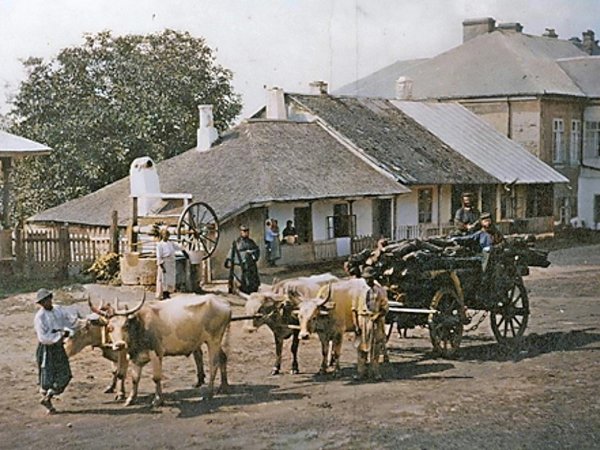
Strolling through the mahalas of old Bucharest means discovering a city in miniature, vibrant and full of contradictions—a world of tight-knit communities, central churches, and animated markets. This urban structure was not merely a cluster of houses, but a complex social organism that shaped the city's identity.
Mahala: Etymology, Spread, and Evolution
The word mahala originates from the Turkish language and, in the past, designated any kind of neighborhood, regardless of the inhabitants' standard of living. In an even older stage, in Semitic languages such as Hebrew, the term translated as "a settlement of people living in tents." Until the beginning of the 20th century, in Bucharest, the word was used strictly for administrative purposes to describe a small neighborhood. A famous example is the area around the Colțea Church, which appeared in old documents under the name Mahalaua Colței.
Gradually, however, the entire lexical family of the word—from "mahalagiu" (inhabitant of a mahala) to "mahalagism"—acquired a negative aura, referring to vulgarity and rudeness. In a modern sense, the mahala is often confused with the notion of a ghetto, describing a poor neighborhood where residents have precarious material conditions. These areas frequently lack basic services such as drinking water, electricity, or sanitation, and narrow streets can block access for fire trucks or ambulances. Historian Adrian Majuru, in his work "The Bucharest of the Mahalas," explains that these spaces are mixtures of unsanitary areas and clean central streets, where joy is experienced in different tones but is present everywhere.
Mahala – More Than Just a Neighborhood
Originally, the mahala was not a simple district delimited on a map, but a community welded around a vital nucleus. Most often, this center was the parish church. Houses rose organically around it, forming a unit that was not only territorial but also spiritual. People in a mahala all knew each other, helped one another in times of need, and shared the important events of life. It was a form of organization born from the need for belonging in a Bucharest undergoing full transformation.
A fascinating element was the professional character of these areas. There were mahalas inhabited almost entirely by members of a certain guild. Thus, we had the Coppersmiths' Mahala (Mahalaua Căldărarilor), the Tailors' Mahala (Mahalaua Croitorilor), or the Ropemakers' Mahala (Mahalaua Frânghierilor). This concentration not only eased work and trade but also strengthened the bonds between neighbors who shared the same interests and challenges. The mahala was, practically, a functional microcosm where the home, the workshop, and the socializing space merged.
The legal basis of urban organization at that time, though much simpler than today's legislation, respected these organic structures. Local custom and tradition held great power in regulating relations between neighbors. Even if the strict urban planning rules of today did not exist, this apparent chaos was perfectly adapted to the needs of the time, giving the city an irregular but lively appearance.
The Spirit of the Mahala – Solidarity, Humanity, and Urban Bustle
Beyond dictionary definitions, the spirit of the mahala was defined by a special kind of humanity and the fact that life took place, for the most part, directly in the street. Courtyards were small and open, and neighbors spent entire afternoons chatting at the gate. This constant exposure also fueled gossip, a trait that contributed to today's pejorative meaning. However, beyond curiosity, there was authentic solidarity: the mahala would immediately mobilize for a funeral, for a sick neighbor, or for a family left without resources.
The markets present in many mahalas were the beating heart of the city. Everything was sold here, from food to tools, but the place was above all one for socializing. The smell of spices and grilled meat, the shouts of merchants, and the music of the lăutari (traditional musicians) created a vibrant atmosphere. Live the moment! Even if Bucharest has changed, we can rediscover this need for community today. In a digital age, the idea of warm neighborliness remains a human necessity.
READ ALSO:
Breathe a sigh of relief! Although many historical mahalas have disappeared, giving way to modern apartment blocks or glass office buildings where startups and multinationals now operate, their imprint remains. Today's Bucharest, confirmed by data from the National Institute of Statistics as the country's main economic engine, preserves that effervescence in its genetic code. The city is a chameleon capable of reinventing itself, transforming the bustle of old markets into the productive stir of a European metropolis, without forgetting the humanity that once defined it.