The Antim Neighborhood and Antim Monastery, the history of a lost piece of the former Uranus district of Bucharest
- Articles
- 30 MAR 26
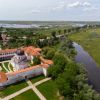
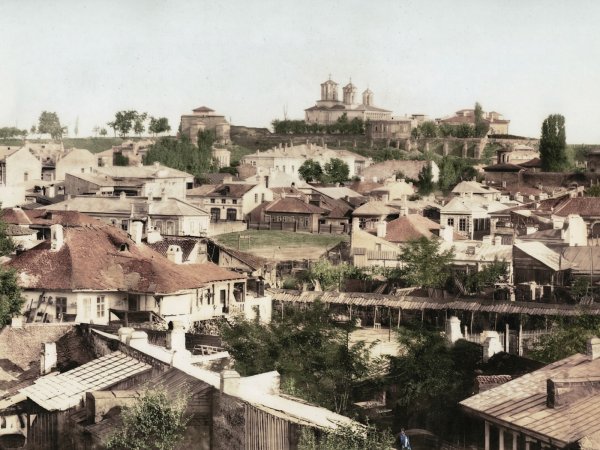
In the heart of old Bucharest, where today the rupture between past and present is strongly felt, Antim Monastery remains one of the essential landmarks of an urban geography that has almost disappeared. Located on Antim Street, at number 29, near the intersection with Justiției Street, it is not only a historical monument, but also a silent witness of a world that once was full of life and identity.
Antim Monastery – the spiritual nucleus of a vanished world
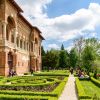
Founded between the years 1713 and 1715 by Saint Hierarch Antim Ivireanul, the monastery was built on the site of a modest wooden church. From the very beginning, the edifice was conceived not only as a place of prayer, but also as a cultural and spiritual center.
The chosen architectural style, the Brâncovenesc style, is reflected in the triconch plan of the church and in the richness of the ornamentation, which harmoniously combines Eastern and Western influences.
A truly remarkable element is the iconostasis, made of carved stone, considered unique in Romanian art. Tradition says that it was made by Antim Ivireanul himself, who is also believed to have contributed to the decoration of the church door, a piece of refined artistic execution.
Over time, the monastery also had an important educational role: starting with 1797, a school for priests functioned here, followed by the Seminary of the Ungro-Vlachian Metropolis, and for a period, between 1840 and 1864, the State Archives were also housed here.
Transformations and resistance in the face of history
The 20th century brought major changes for Antim Monastery, but also for the entire Uranus area. In the year 1912, within the monastery precinct, the Palace of the Holy Synod was built, an imposing building that still houses today the Library of the Holy Synod. It would later become a symbol of resistance in the face of the massive demolitions during the communist period.
In the 1980s, when the communist regime decided the radical reorganization of the center of Bucharest, the Uranus district was almost completely wiped off the map. Numerous churches, houses and streets disappeared, yet Antim Monastery was saved.
More than that, the Palace of the Holy Synod underwent a spectacular technical operation: it was translated over a distance of 25 meters and rotated by 13 degrees, thus becoming the heaviest building moved during that period.
Another important moment in the recent history of the monastery is the founding, in 1945, of the “Burning Bush” circle. It brought together monks and distinguished intellectuals – professors, writers, artists – who discussed spiritual themes, especially hesychasm.
Their activity was abruptly interrupted in 1950, when the communist regime dissolved the group, and many of its members were arrested and sentenced.
Today, the monastic ensemble continues to be an active spiritual center, hosting part of the patriarchal administration and the Library of the Holy Synod. It also functions as a patriarchal chapel and residence for the patriarchal auxiliary bishops.
The Antim neighborhood – the charm of a lost community
Beyond the monastery walls, the Antim neighborhood once represented one of the most picturesque and elegant areas of Bucharest. The narrow streets, the cozy houses and the generous gardens shaped an urban space full of life, in which tradition and modernity coexisted harmoniously.
The entrance into this world was made from Sfinții Apostoli Street, which led directly to Antim Street. Here, at number 36, there was a particularly beautiful house, noticed not only by passersby, but also by important personalities of the time. During the First World War, the German general von Mackensen wanted to establish his headquarters here, but gave up when he found out that German was spoken in that house.
The house continued to attract attention during the Second World War as well, and in the communist period it was nationalized. Nevertheless, the family who had built it managed to continue living there until 1984, when the building was demolished.
The story of the house at Antim 36 and of the Drogeanu family
The history of this house is closely linked to the Drogeanu family, whose story begins in a village from the Brăila area, on the shepherds’ route. These shepherds from southern Transylvania practiced transhumance, and some of them chose to settle permanently in the plains, laying the foundations of new communities.
The grandfather of Paul Drogeanu, Nicolae Drogeanu, was a railway engineer and the one who built the house at Antim 36 in 1906. Two years earlier, he had married Eleonore Grigoriu, coming from a family already established on the same street. At number 32 were the old houses of the Grigoriu family, and through marriage, the properties were united.
The house was placed on a generous plot, bordered by Antim, Logofătul Nestor and Justiției streets. Around it there were other houses belonging to families such as the Anastasești. A defining element of the property was represented by the four poplars existing from the very beginning, which were integrated into the garden design.
The garden was a true urban corner of paradise. In front of the house there was a rose garden, arranged by grandmother Eleonore, and in the back there was an orchard. Among the trees, a picturesque detail was a lilac formation in the shape of a horseshoe, between two old pear trees.
There, a resting place had been arranged, with a table and benches, where the family spent their free time. This world, apparently quiet and stable, was destroyed in just a few years, following the demolitions of the communist period.
The disappearance of the Uranus district and the memory of the place
The demolitions of the 1980s radically changed the face of Bucharest. The Uranus district, of which the Antim neighborhood was part, was almost completely destroyed to make room for the new monumental constructions of the communist regime. Dozens of streets disappeared, and thousands of people were forcibly relocated.
From this world, today only a few buildings and Antim Monastery have remained, as a symbol of continuity. The rest exists only in the memories of those who lived there and in the documents carefully preserved.
The Antim neighborhood was not only a physical space, but also a community, a way of life. The houses, the gardens, the neighborhood relations and the stories of the people formed a distinct universe, which today can only be reconstructed from fragments.
In this context, Antim Monastery gains an even deeper meaning. It is not only a historical monument or a place of worship, but also a landmark of collective memory, a bridge between past and present. Through its survival, it reminds us of an important part of Bucharest’s identity, which must not be forgotten.
We also recommend: The Delea Veche Neighborhood, Cireșului Street, and the Place Where Mihai Eminescu Read Letter V