Bucharest’s plane trees, the trees that conquered the pavement
By Eddie Țone
- Articles
- 13 MAY 26
Bucharest has a few very clear vegetal obsessions. The linden tree, for fragrance and nostalgia. The chestnut tree, for beautiful photographs and leaves that look as if they belong in an old schoolbook. The plane tree, for wide boulevards, disciplined alignments and that impression of a European city trying to keep its shirt freshly ironed, even while the tram screeches beside the curb. You see it on major arteries, in parks, on small squares, on redeveloped pavements, in new tree pits, between paving stones, benches and curbs that seem to have been replaced with an almost mythological energy.
In recent years, the plane tree has become the preferred urban tree of many local administrations in Bucharest. It has a handsome trunk, decorative bark, a broad crown, it grows quickly, tolerates the city and provides shade. From a landscape architect’s point of view, it is an elegant solution. From the point of view of a Bucharester with allergies, it can mark the beginning of a small springtime novel involving sneezing, irritated eyes and antihistamines forgotten in every pocket.
The story of Bucharest’s plane trees lies precisely in this tension. The city desperately needs mature, resilient trees capable of reducing thermal discomfort. At the same time, public health calls for diversified species, aerobiological planning and less monocultural enthusiasm. When a city plants the same species again and again, the landscape gains order, but the urban organism becomes more vulnerable.
The tree with camouflage bark and a big-city CV
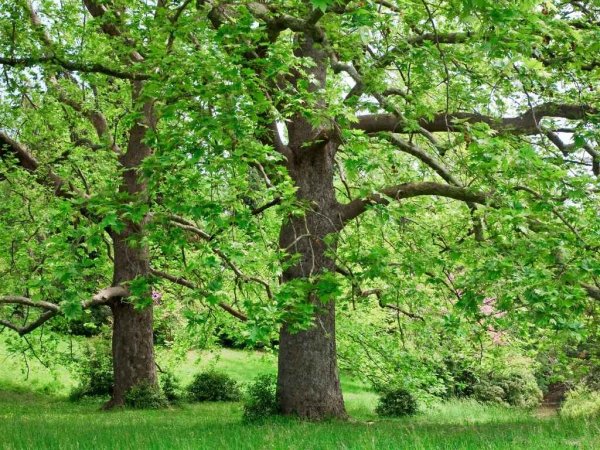
The plane tree frequently found in cities is the London plane, known botanically as Platanus × hispanica or Platanus × acerifolia. It is considered a hybrid between the Oriental plane, Platanus orientalis, and the American sycamore, Platanus occidentalis. The Royal Horticultural Society describes it as a large deciduous tree, with exfoliating bark in shades of grey and cream, maple-like leaves and spherical, clustered fruits that look like small vegetal maces.
Its success in cities comes from a rare combination of robustness and civilized appearance. The plane tree tolerates pollution, soil compaction, formative pruning and harsh urban conditions better than many other species. In London, it became an emblematic tree precisely because it endured the heavy air of the nineteenth and twentieth centuries so well, a period when the city often functioned like a thick soup of smoke, coal and imperial ambition. Trees and Shrubs Online notes that Platanus × hispanica became, in the nineteenth and early twentieth centuries, London’s most widely planted street tree, precisely because of its ability to cope with difficult urban air.
Its exfoliating bark also contributes to the plane tree’s fame. The trunk looks painted in patches of cream, green, grey and brown, like a military map produced by an artist with taste. This bark peels away periodically, and the trees always seem freshly cleaned of the city’s dust. For a Bucharest boulevard with traffic, dust, heatwaves and limited root space, such qualities sound like an offer hard to refuse.
Why so many plane trees were planted in Bucharest
In Bucharest, the plane tree has entered strongly into the administrative logic of recent years. According to a 2019 HotNews report, Bucharest’s district halls had planted tens of thousands of plane trees in previous years, while administrations cited the tree’s resistance to pollution, wind stability and pleasant appearance. The same source mentioned that the price of one tree ranged between 200 and 2,000 lei, to which costs for removing old trees and extracting roots could be added.
The choice has urban logic. Bucharest has increasingly difficult summers, with overheated asphalt, wide intersections and areas where shade becomes a form of survival infrastructure. The plane tree grows large, forms a broad crown and can turn a mineral-heavy artery into a breathable space. When you have a wide pavement, a row of trees with a regular habit and a crown that promises shade within a few years, the temptation to use it everywhere becomes very strong.
Sector 3 offers a recent example of this direction. In a 2025 press release, Sector 3 City Hall announced more than 15,000 trees planted that year, with a target of 25,000 by the end of the season, listing among the species used linden trees, plane trees, poplars, birches and bald cypresses. The administration linked the plantings to shade, biodiversity and the reduction of thermal discomfort in heavily used urban areas.
This is where the first knot in the discussion appears. On paper, the plane tree seems like the perfect urban tree. On the ground, the repeated use of the same species creates a predictable landscape and an ecological vulnerability. A disease, pest or climate stress that affects plane trees on a large scale can quickly turn a greening strategy into a problem of vegetal heritage. Cities learned this lesson painfully with elms, chestnuts and other species that were overplanted in different periods.
Pollen, fluff and springtime confusion
When Bucharesters talk about plane tree allergy, they often lump together three different things: pollen, the fine hairs on the leaves, called trichomes, and the fibres that come from the tree’s spherical fruits. All of them can circulate through the air. All of them can cause discomfort. From a medical point of view, however, their roles differ.
Plane tree pollen is the actual allergen. The plane tree is wind-pollinated, and its pollen enters the air during the spring season. In its allergen encyclopedia, Thermo Fisher Scientific states that exposure to plane tree pollen can induce asthma, rhinitis and conjunctivitis in sensitive individuals, while the allergenic components Pla a 1, Pla a 2 and Pla a 3 are important diagnostic markers for patients allergic to Platanus.
Trichomes and fruit fibres behave differently. A study carried out in Sydney and published in Annals of Allergy, Asthma & Immunology analysed plane tree pollen, trichomes and achene fibres. The researchers showed that trichomes were inhaled by participants, but tests indicated that they were not a source of IgE allergens; nevertheless, these particles can contribute to symptoms through an irritant effect.
This difference matters. One person may have a real allergy to plane tree pollen, confirmed through tests. Another may experience mechanical irritation from fine particles, especially on dry, windy days with traffic. Another may react to grass pollen, birch, ragweed or other sources, while blaming the most visible plane tree near the bus stop. The body does immunology; the city creates confusion.
What medicine says about plane tree allergy
Medical literature treats the plane tree as an important source of allergens in cities where the tree is planted extensively. In Córdoba, southern Spain, a study published in Annals of Agricultural and Environmental Medicine shows that Platanus pollen has a marked seasonality, with high values over a short interval, and that pollen concentrations correlated significantly with the airborne allergen Pla a 1. The authors concluded that the allergic response of sensitive patients coincides with the presence and magnitude of airborne pollen.
In Sydney, the previously mentioned research showed that plane tree pollen accounted for 76.2% of the total airborne pollen collected during the analysed period, while 23.4% of subjects had a positive skin-prick test to Platanus. The study was cautious in interpretation, because symptoms also overlapped with other pollen sources, but it confirmed the massive presence of plane tree particles in the urban air and the allergenic nature of the pollen for sensitized individuals.
There is also relevant Romanian data. An article in the journal Alergologia, published on Medichub, presents a case of spring seasonal allergic rhinitis with sensitization to plane tree pollen in a patient from Bucharest, associated with episodes of oral allergy syndrome after eating certain plant-based foods. The same article notes that Platanus × acerifolia is one of the notable tree species with allergenic pollen and that the plane tree is found ornamentally in Romania in parks, gardens, along alleys and streets, flowering in April.
Plane tree allergy can be medically investigated. There are tests for specific IgE to plane tree pollen and even for the molecular component Pla a 1, used in evaluating sensitization. A Romanian medical testing clinic describes the rPla a 1 test as a method for identifying sensitization to the Pla a 1 protein in plane tree pollen, associated with spring allergic rhinitis in urban areas.
Landscape design loves order, public health loves diversity
Visually, alignments of plane trees have an advantage that is hard to dispute. They give unity to the street. They create perspective. They make the boulevard look planned, even when beneath it the cables, curbs and asphalt are having a tense conversation with gravity. Urban landscape design needs such structures.
Public health looks at the picture through a different lens. A species planted excessively can raise the level of exposure to the same type of pollen across an entire neighbourhood. For a sensitized person, the fact that every second street has the same allergen source turns spring into an endurance test. In addition, low tree diversity amplifies ecological risk. When the same tree dominates a neighbourhood, any specialized pest is, practically speaking, given a full menu.
A study in Scientific Reports on the allergenic risk of urban forests shows that estimates of exposure to allergenic pollen vary greatly depending on data sets and the composition of urban trees, while the authors argue that diverse urban forests offer a safer strategy for diluting sources of allergenic pollen, until better aerobiological data are developed.
This is the key to the discussion. Bucharest’s problem is rarely found in a single plane tree. The problem appears when the plane tree becomes the reflex answer to every empty space. A healthy city uses trees like an orchestra, with different species, different ages, different flowering periods and distributed risks. Urban monoculture resembles a brass band in which everyone plays the tuba.
What Bucharest should do with its plane trees
The mature solution means balance, not vegetal panic. Mature, healthy plane trees that are well integrated into the street provide valuable shade and real ecosystem services. Cutting them down en masse would reduce thermal comfort and hit precisely the neighbourhoods that need canopy cover. The city should preserve valuable trees, maintain them properly and avoid turning every redevelopment into a parade of young plane trees.
New plantings should be planned with a smarter matrix. Diversity on each street, diversity between neighbourhoods, and the avoidance of large concentrations of the same species around schools, hospitals, crowded stations and areas with vulnerable populations. Alongside the classic criteria — drought resistance, shade, roots, compatibility with infrastructure — allergenicity should also be introduced as a criterion.
Bucharest also needs serious urban pollen monitoring. Local medical and aerobiological data are essential. A generic pollen calendar helps, but neighbourhood-level measurements would help much more. In a city with heavy traffic, heat islands, trees planted in waves and a large population with allergic rhinitis, pollen should be treated as an environmental indicator, alongside fine particles and ozone.
For sensitive residents, the simple advice remains an allergy evaluation, especially when symptoms appear year after year during the same period. The difference between allergy and irritation matters, because treatment, prevention and interpretation of symptoms depend on diagnosis. A sneeze beside a plane tree may be immunology, meteorology, dust, grass pollen or a Bucharest-style combination perfectly coherent in its chaos.
A beautiful tree, a complicated decision
The plane tree has genuine urban charm. It ages beautifully, changes its bark like a good actor changes costumes, provides generous shade and can turn a harsh street into a more bearable space. Bucharest needs such trees, especially in a climate that is pushing summers toward increasingly aggressive temperatures.
At the same time, the plane tree comes with allergenic pollen, irritating particles and planning risks when used excessively. A careful administration can preserve its advantages and reduce the problems through diversification, monitoring and long-term planting strategies. A rushed administration will see it as the universal tree, the sort of solution that looks good in a rendering and apologizes later, when spring fills the city with red eyes.
Bucharest deserves shade. It also deserves urban air planned with the same seriousness. Plane trees can remain part of the landscape, but the city needs a richer vegetal vocabulary. A beautiful boulevard is made with trees. A healthy city is made with diversity, maintenance and a little administrative modesty in the face of biology.
You may also like: When and where Bucharest blooms: trees, flowers and moments that shift the city