Giovanni's Secret and the Queue at Velocità. Bucharest and Its Love Affair with Ice Cream, Over 170 Years in the Making
- Articles
- 05 MAY 26
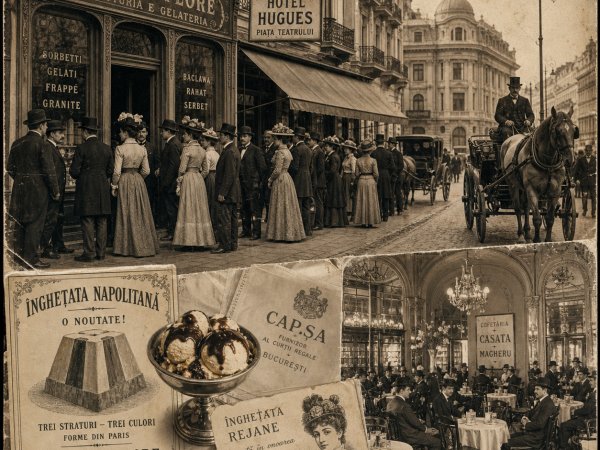
On Calea Victoriei, the queue for ice cream is 170 years old. Around 1850, the street still went by the name Podul Mogoșoaiei, and the most sought-after spot in the city was a confectionery run by an Italian — Giovanni Flore, with his shop on the ground floor of the Hugues Hotel, in Piața Teatrului, where the Novotel stands today. When the time came to prepare the ice cream, Giovanni would lock himself alone in a small room, afraid one of his assistants might steal his secret. Outside, people waited patiently.
The city was already obsessed with sweets. In 1832, there were 15 confectioneries on Podul Mogoșoaiei, all of them serving sherbets and ice creams. The Ottoman influence had left baklava, Turkish delight and şerbet on Bucharest tables, but as Italians and French opened their workshops in the centre, tastes refined quickly and cravings shifted toward northern recipes — creamier, more elaborate, more spectacular.
Moulds from Paris and Carriages on the Pavement
Giovanni Flore introduced Neapolitan ice cream to Bucharest — three layers, three colours, poured into imported moulds, a visual spectacle in a city that had never seen anything like it. Competition followed swiftly. The Capșa brothers brought their own ice cream moulds from Paris in 1863, and the effect was visible immediately on the pavement: ladies sat in carriages lined along the kerb and were served there, while young civilians and officers took the tables inside. Ice cream had already become a social ritual, a street event, a reason to leave the house.
One of the Capșa brothers left for France in 1866 with the precise aim of learning the trade in the very country that invented it, apprenticing at the Boissier firm in Paris before bringing the new ideas back to Bucharest. Capșa became a supplier to the Royal Court, the place where writers, actors and diplomats gathered as naturally as at official banquets, and the ice cream served there sometimes bore the name of the actress it was dedicated to — the Rejane, created in honour of actress Gabrielle Rejane.
By the interwar period, Bucharest had earned a reputation as the European capital with the most cafés and confectioneries. Along Calea Victoriei, on Magheru, at boulevard corners, confectioneries with gleaming shopfronts and white-clothed tables filled the role today's coffee shops occupy — spaces for conversation, discreet flirtation, afternoons spent without hurry.
Casata, Silver Foil and Stainless Steel Cups
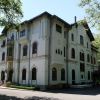
The nationalisation of 1948 erased names from shopfronts and owners from behind the counter, but the craft survived in the hands of the confectioners who remained. The great private establishments became state property, renamed, yet the laboratories kept producing and the master confectioner stayed at the centre of every venue. Cofetăria Casata settled into the ground floor of the interwar block of the same name on Magheru — a building raised in 1938 to the designs of architect Jean Văleanu — and became an urban landmark through the 1950s and 60s.
The house speciality was the ice cream that gave the place its name. Casata — an oblong, triangular ice cream divided into three: pistachio, vanilla and chocolate, with sour cherry jam between the layers, wrapped in silver foil, three lei a piece. Historian Dan Falcan describes it with the precision of someone who ate it hundreds of times: profiteroles filled with vanilla cream and chocolate sauce served in stainless steel cups, café frappé piled high with whipped cream in tall glasses, parfaits folded in white foil. The phrase "the profiterol from Casata" had lodged itself firmly in the urban vocabulary of 1970s Bucharest.
Scala, Nestor, Athénée Palace, Turn, Universității — Constantin C. Giurescu catalogues them in his Istoria Bucureștilor: spacious confectioneries, well-furnished, with attractive shopfronts, spread across every neighbourhood of the city. A Bucharest that knew how to indulge itself, even with standardised ingredients and fixed prices. The earthquake of 4 March 1977 found them unprepared: Casata, Scala and Nestor were destroyed in the tremor. Capșa held. Then came the 1980s, and the shopfronts grew steadily emptier.
Gelato, Sicilian Pistachio and In-House Laboratories
Artisan gelato arrived in Bucharest only after 2010, with Italian recipes and ingredients sourced from specialist producers. The first places opened tentatively, in the Old Town and in neighbourhoods with heavy foot traffic — gelato made daily in a dedicated laboratory, natural ingredients, flavours that changed weekly. The price struck many as steep for an ice cream. The taste convinced them at the first spoonful.
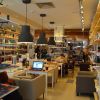
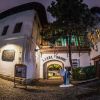
A whole wave followed: Sweetology in 2018, Saint Gelato in 2020, Friddi Gelato — with sugar-free options and an ingredient discipline closer to a workshop than a shop — and Velocità on Calea Victoriei, on the same pavement where Capșa's ladies once waited in their carriages. Saint Gelato moved into an old building in central Bucharest, its floor laid with hand-selected marble fragments arranged by hand in the tradition of Venetian mosaic — the final effect, says its founder, brings to mind shapes carved from ice. The new gelaterias treat their spaces with the same seriousness as their recipes: in-house laboratories, traceable ingredients, flavours that follow the seasons.
The pistachio comes from Sicily, the hazelnuts from Piedmont, the vanilla from Madagascar. Giovanni Flore, who used to lock himself in a small room to guard his secret, would understand the obsession. And he would probably join the queue.
Also recommended Where we eat the best ice cream in Bucharest. 10 places you must not miss